2-Digit Multiplication Fluency Probes
- 23 pages
- 3rd, 4th, 5th
$3.50
DownloadOr get it with All-Access: pick any 20 resources a month for $7.
New here? Your first month of All-Access is half off with code TEACHERTOK
Already bought this, or a member?
Instant download. One teacher's license: colleagues need their own copy. Each file carries a license number.
Also on Teachers Pay Teachers: see the Bright Path Sped store
About this resource
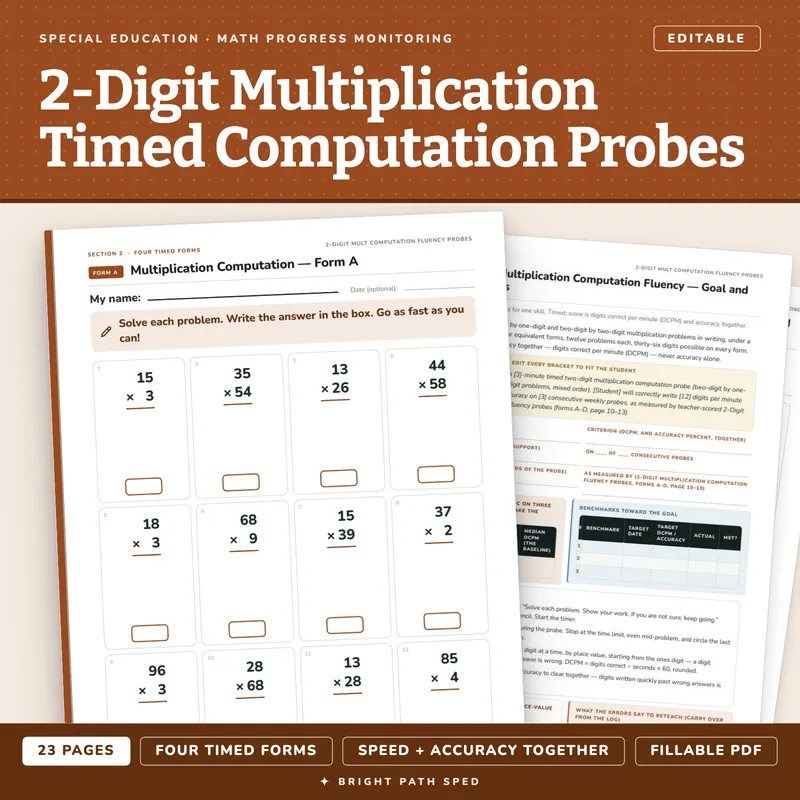
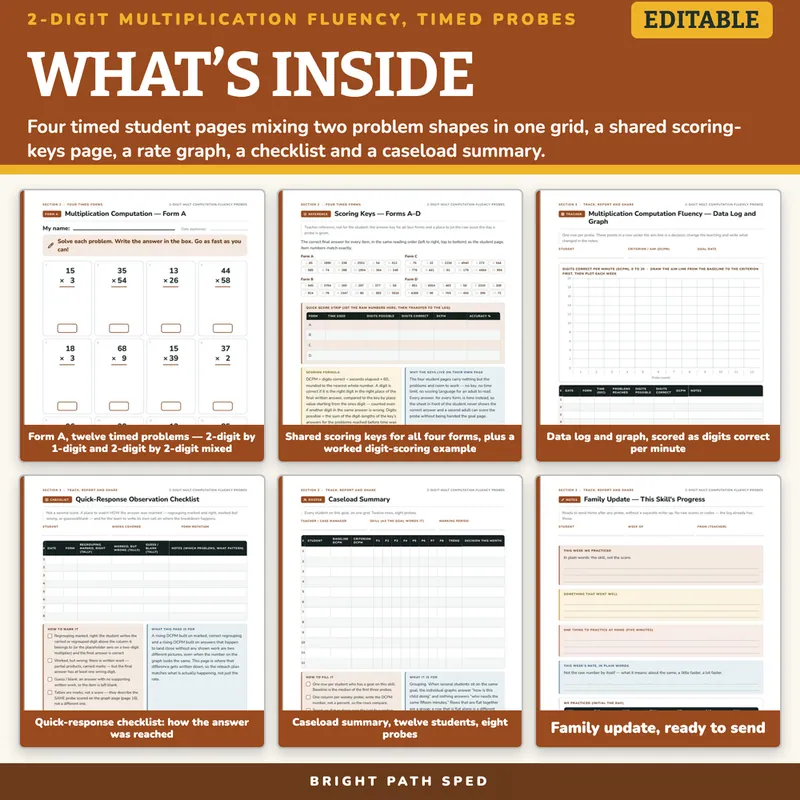
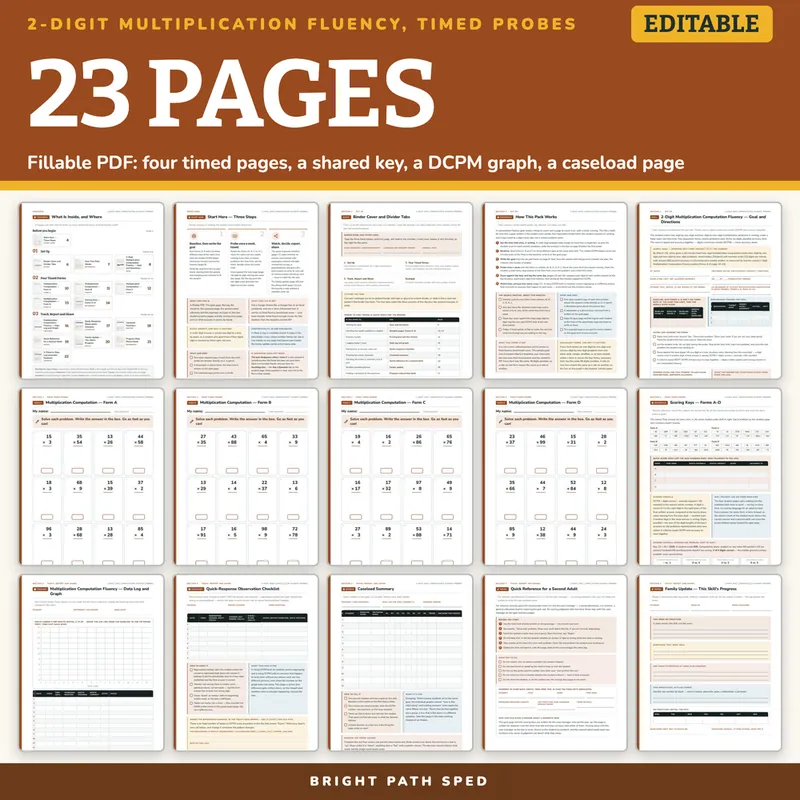
Everything inside: 23 pages · 392 type-in fields · four timed student practice pages (12 multiplication problems each) · a shared scoring-keys page for all four forms, with a worked digit-by-digit scoring example · a data log and graph scored as digits correct per minute · a quick-response observation checklist · a caseload summary · a quick reference card for a second adult · a family update · a 19-starter phrase bank · a binder cover and 4 cut-out divider tabs · a worked, invented example.
This store already has two UNTIMED multi-digit multiplication probes (ten problems, right or wrong, no clock) and one TIMED multiplication probe that measures single-digit FACT recall (6 x 7), not the multi-digit computation algorithm. Nothing in the store times the multi-digit multiplication algorithm itself — the same split CBM-Math progress monitoring draws everywhere else: can the student do the algorithm, and separately, how fast and accurately can the student do it under a clock. This file is that second measure. Four equivalent timed forms, twelve problems each — six two-digit by one-digit and six two-digit by two-digit, shuffled into one grid so the two problem shapes never fall in their own block — answered in writing under a time limit your team sets, scored digit by digit: every digit of the written final answer is compared to the key by place value, so a student who gets three of four digits right is counted as three right, not zero. The score is digits correct per minute (DCPM) and accuracy together, with a second page that watches HOW the answer was reached (regrouping marked and right, worked but wrong, or guessed/blank) and gives the team a place to write its own call on where practice should go next, never a cutoff this file imposes.
WHAT IS INCLUDED — 23 pages, 392 type-in fields
Set Up
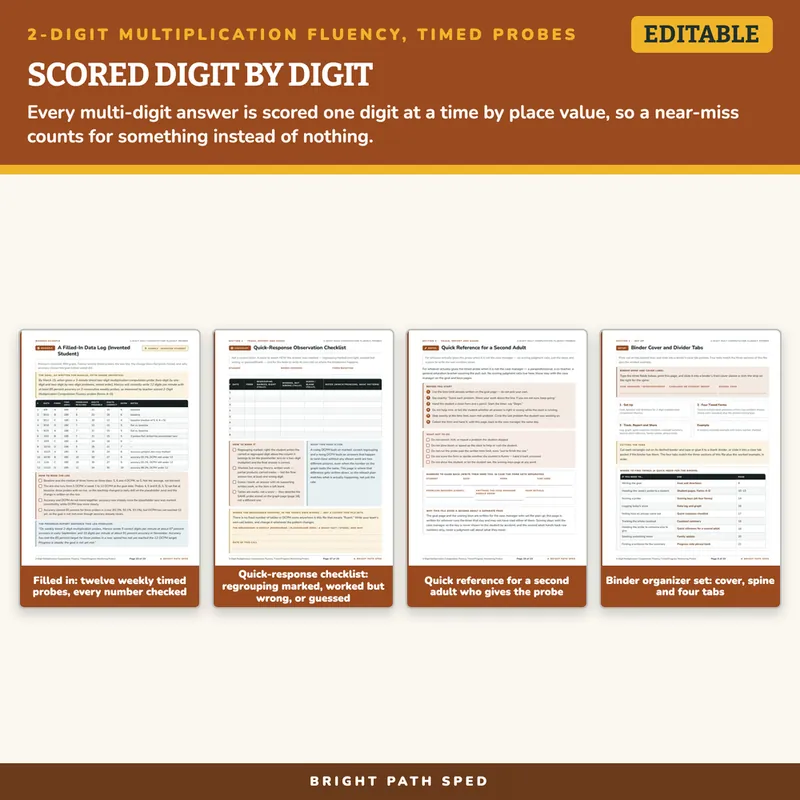
- Binder Cover and Divider Tabs — a spine/cover card, 4 cut-out tabs, and a 9-row "where to find things" index
- How This Pack Works — six numbered steps from baseline to weekly routine to reteach decision
- 2-Digit Multiplication Computation Fluency — Goal and Directions — a sample goal with a six-part fill-in frame, a 3-probe baseline table, a 3-row benchmark table, and scoring directions including the digit-by-digit comparison method and the DCPM formula
Four Timed Student Pages, Plus A Shared Key
- Forms A-D — 12 multiplication problems each (six two-digit by one-digit, six two-digit by two-digit, drawn from a single store-wide sample so no problem repeats within a form OR across the four forms), mixed order, every problem regroups at least once, each page clean for the student: a "My name" line, one short instruction with a drawn pencil icon, and a vertical problem box with room above the answer line to show the written work
- Scoring Keys — the correct final answer for every item on all four forms, laid out in the same reading order as the student page, a quick score strip, the DCPM scoring formula, and a worked example showing exactly how a partially-correct answer (935 against a key of 1035) is scored 2 of 4 digits correct — kept off the student page entirely
Track, Report And Share
- 2-Digit Multiplication Computation Fluency — Data Log and Graph — a 12-row log (date, form, time, problems reached, digits possible, digits correct, DCPM, notes) and a graph scaled 0-20 DCPM
- Quick-Response Observation Checklist — an 8-row tally log (regrouping marked and right / worked but wrong / guess-blank) plus a write-in note on where the breakdown happens — the team's own call, never a fixed cutoff
- Caseload Summary — 12 students by 8 probes, one decision column
- Quick Reference for a Second Adult — six numbered steps, a "what not to do" list, and a mini scoring strip to hand back, for whoever gives the probe when it is not the case manager
- Family Update — a ready-to-send communication page: what was practiced, one win, a home-practice idea, this week's rate in plain words, and a 7-day practiced table
- Progress Note Phrase Bank — 19 observable-language starters across 5 groups (speed/accuracy, pattern across probes, next steps, quarterly report sentence, caseload-wide)
- A Filled-In Data Log — a worked, invented example (Marcus, fifth grade) with 12 weekly timed probes, every digits-possible, digits-correct and DCPM number checked against its own row
Plus a Start Here quick-start, a 3-section contents page with real page thumbnails, 3 section dividers, and a "what's next" back page.
What This Is, And What It Is Not
It is a fillable PDF. Open it in a PDF reader, click a field, type, Save As once per student. It works offline with no account or subscription. It is NOT a Google Sheets file, a Google Doc, or an Excel workbook, and it is not a norm-referenced test — it carries no fixed fluency benchmark score anywhere in the file. The four student practice pages and the scoring-keys page print; the goal page, log, checklist, caseload page, second-adult reference and organizer are type-in.
It is not the store's existing Multi-Digit Multiplication Progress Monitoring Probes (2-digit by 1-digit) or Two-Digit by Two-Digit Multiplication Progress Monitoring Probes, both of which are untimed — ten problems, no clock, right or wrong. Use those files to check whether a student can do the algorithm at all; use this one once the algorithm is solid, to see whether it has become fast and automatic. It is also not the store's Multiplication Facts Fluency, Timed Progress Monitoring Probes, which times single-digit FACT recall (6 x 7), not the multi-digit computation algorithm (34 x 6, 23 x 45). All three pair naturally with this one and none replaces another.
It is not a curriculum, and it is not a rule about how many digits per minute counts as "fluent." What fluent enough means for a given student is the team's own judgment, written in from the baseline and the IEP; this file never sets that number on its own — the quick-response checklist page is a blank the team fills in, by design. No age, eligibility or IDEA-timeline claim anywhere; no health data is pre-filled, and the example student (Marcus) is invented and named as such on page 22. Two-digit by one-digit and two-digit by two-digit multiplication only, both factors' ones digit never zero, every problem regrouping at least once — this first build does not cover 3-digit multiplicands or division.
Who This Is For
Math interventionists, special education teachers and case managers who need a timed, repeatable way to track multi-digit multiplication computation fluency — not just whether the algorithm is right, but how fast and accurately it runs — plus a second, condensed page for whoever else gives the probe.
If You Want More
Multiplication Facts Fluency, Timed Progress Monitoring Probes Editable is the same timed, rate-scored shape for the single-digit facts this computation builds on. Multi-Digit Multiplication Progress Monitoring Probes (2-digit by 1-digit) and Two-Digit by Two-Digit Multiplication Progress Monitoring Probes are the untimed, accuracy-only companions for the same two algorithms. IEP Goal Tracking Editable is the weekly summary and progress-report writer these graphs feed.
You might also need
3-Digit Addition and Subtraction Mixed Regrouping Probes
$3.50 or with All-Access
3-Digit by 1-Digit Multiplication Progress Monitoring Probes
$3.50 or with All-Access
3-Digit by 2-Digit Multiplication Progress Monitoring Probes
$3.50 or with All-Access

3D Shape Attributes (Faces/Edges/Vertices) Probes
$3.50 or with All-Access