Articulation Progress Monitoring Probes Bundle
- Not Grade Specific
$28.00$18.20
DownloadOr get it with All-Access: pick any 20 resources a month for $7.
New here? Your first month of All-Access is half off with code TEACHERTOK
Already bought this, or a member?
Instant download. One teacher's license: colleagues need their own copy. Each file carries a license number.
Also on Teachers Pay Teachers: see the Bright Path Sped store
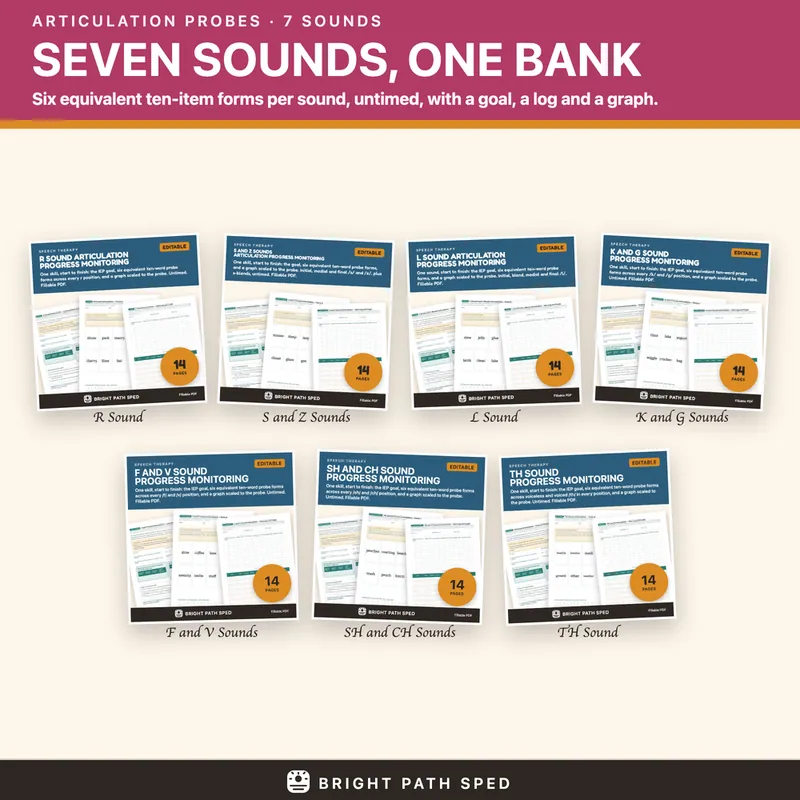
What's in the bundle (7)
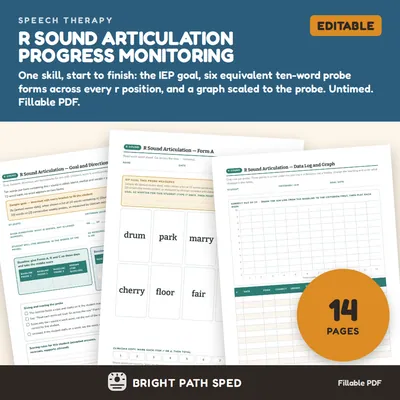 R Sound Articulation Progress Monitoring Probes$4.00
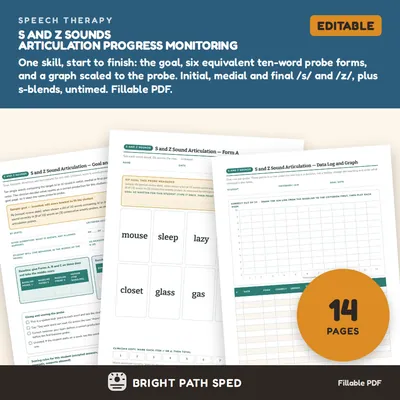 S and Z Articulation Progress Monitoring Probes$4.00
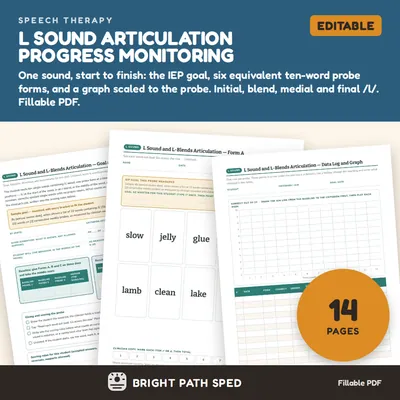 L Sound Articulation Progress Monitoring Probes$4.00
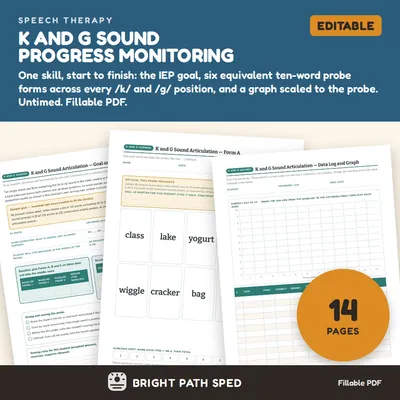 K and G Sound Articulation Progress Monitoring Probes$4.00
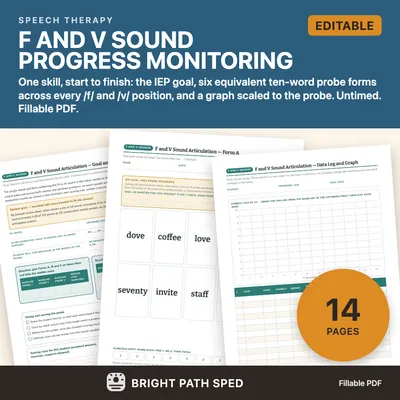 F and V Sound Articulation Progress Monitoring Probes$4.00
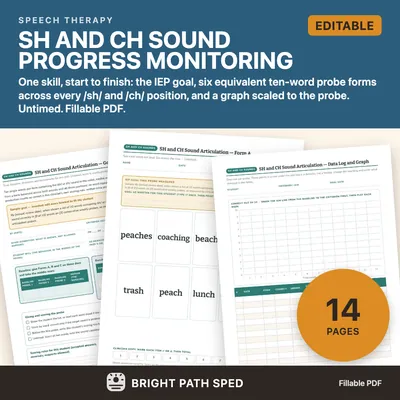 SH and CH Sound Articulation Progress Monitoring Probes$4.00
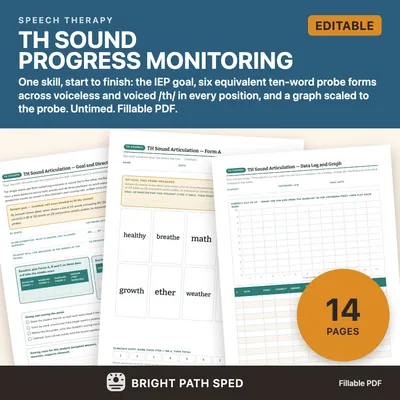 TH Sound Articulation Progress Monitoring Probes$4.00
About this resource
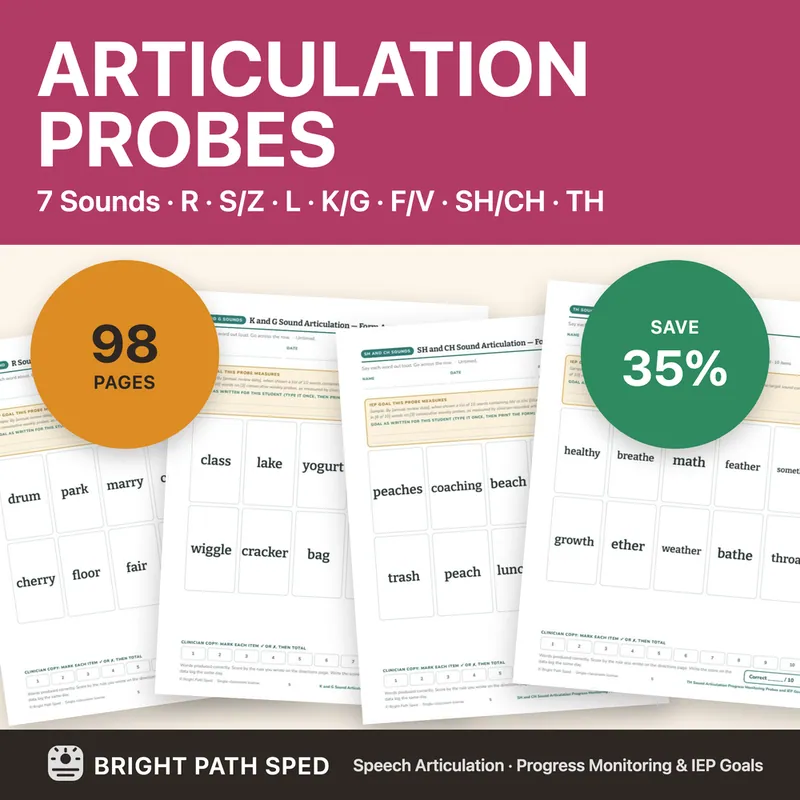
Seven sounds, one shelf, at 35% off buying them one at a time. Six packs — R, S and Z, L, K/G, F/V and SH/CH — now include a large picture card for every probe word, in color and in an ink-saver black-and-white set, for a student who cannot yet read the word list; the last one (TH) is still the original printed word-list probes. Every pack carries a data log, graph and caseload summary; the TH word-list pack also carries a separate IEP goal page.
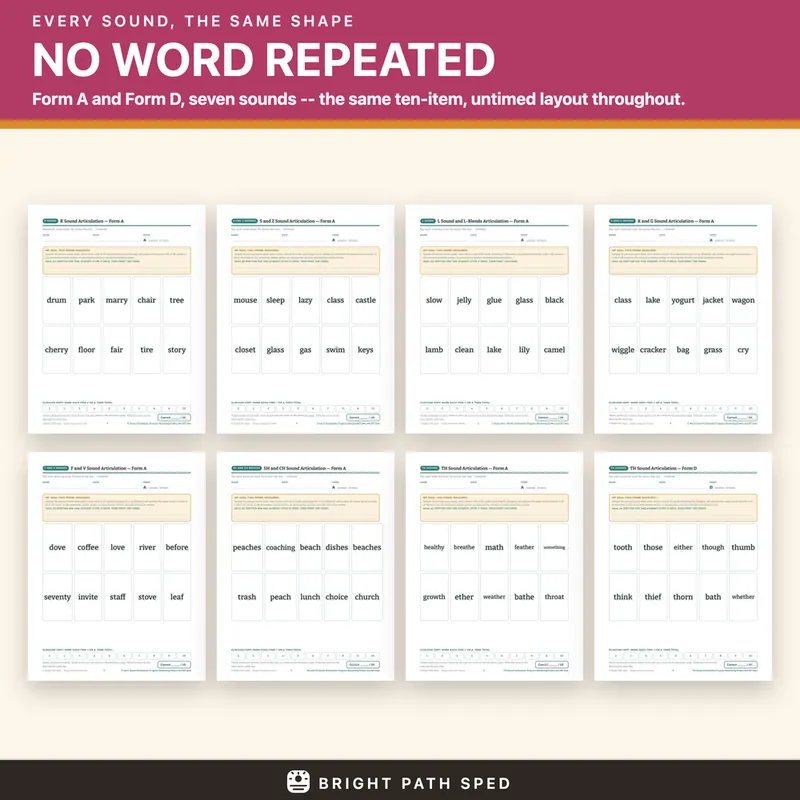
On the TH word-list pack, every form is ten words and untimed, so a score of 8 means the same thing on every form, and a student is never scored on speed. On the R, S/Z, L, K/G, F/V and SH/CH picture packs, every probe form is untimed, marked correct / error / approximation, and carries six pictures except a few smaller buckets where English simply does not have enough real, correctly-pictured words: S and Z's initial /z/ position (4 pictures); F and V's /v/-initial (4), /v/-medial (6) and /v/-final (3) positions; and SH and CH's /sh/-medial (3), /sh/-final (4), /ch/-medial (2, the thinnest bucket this shelf carries) and /ch/-final (5) positions — each disclosed on its own pack's contents and probe-form pages, not padded to look even.
WHAT IS IN THE BUNDLE - 7 PDFs, 194 pages, 96 probe forms (6 ten-word forms on the one remaining word-list pack, 90 picture-probe forms on R, S/Z, L, K/G, F/V and SH/CH)
- R Sound Articulation Picture Cards and Progress Monitoring - 24 pages, 9 picture-probe forms. 36 picture cards (initial, medial, final position, 12 each) in full color and ink-saver black-and-white, plus the probe forms, log, graph, caseload summary, family page and phrase bank.
- S and Z Sound Articulation Picture Cards and Progress Monitoring - 33 pages, 18 picture-probe forms. A two-sound merge, not the single-sound shape R and L use: 60 picture cards (36 /s/, 24 /z/ — /z/ initial is only 4 pictures, English has very few real ones) in full color and ink-saver black-and-white, plus the probe forms, ONE shared data log, graph and caseload page covering both sounds, a family page and a phrase bank.
- L Sound Articulation Picture Cards and Progress Monitoring - 24 pages, 9 picture-probe forms. 36 picture cards (initial, medial, final position, 12 each) in full color and ink-saver black-and-white, plus the probe forms, log, graph, caseload summary, family page and phrase bank.
- K and G Sound Articulation Picture Cards and Progress Monitoring - 33 pages, 18 picture-probe forms. A two-sound merge, not the single-sound shape R and L use: 72 picture cards (36 per sound, initial/medial/final, 12 each) in full color and ink-saver black-and-white, plus the probe forms, ONE shared data log, graph and caseload page covering both sounds, a family page and a phrase bank.
- F and V Sound Articulation Picture Cards and Progress Monitoring - 33 pages, 18 picture-probe forms. A two-sound merge, the most asymmetric bank on this shelf: 43 picture cards, not a symmetric 72 (/f/ initial 12, medial 12, final 6; /v/ initial 4, medial 6, final 3 — English simply has few concrete, kid-nameable /v/ words), in full color and ink-saver black-and-white, plus the probe forms, ONE shared data log, graph and caseload page covering both sounds, a family page and a phrase bank.
- SH and CH Sound Articulation Picture Cards and Progress Monitoring - 33 pages, 18 picture-probe forms. A two-sound merge, the thinnest bank on this shelf: 34 picture cards, not a symmetric 72 (/sh/ initial 11, medial 3, final 4; /ch/ initial 9, medial 2, final 5 — English simply has few concrete, kid-nameable words in most of these positions), in full color and ink-saver black-and-white, plus the probe forms, ONE shared data log, graph and caseload page covering both sounds, a family page and a phrase bank.
- TH Sound Articulation Progress Monitoring Probes and IEP Goal - 14 pages, 6 forms. Voiceless and voiced /th/ in the initial, medial and final position of the word, from a bank balanced across both voicings and all three positions.
On The One Remaining Word-List Pack (Th) — What Is On The Goal Page
- What the probe measures, in one paragraph.
- A sample goal, invented, with every bracket meant to be edited by the team, and a type-in six-part goal frame: by (date), given, student will, criterion, on ___ of ___ consecutive probes, as measured by.
- A baseline table (three probes and the median) and three benchmark rows with target date, target score, actual score and met.
- The administration and scoring directions, with lines for this student's own scoring rules.
Every Probe Form On That Pack
- Ten words, untimed, in a five-across, two-row grid.
- The goal prints on the sheet: the sample goal plus the type-in goal as written for this student.
- A clinician scoring strip, 1 to 10, and a Correct ___ / 10 box.
TH carries its own twelve-probe data log and a graph scaled 0 to 10 with instructions to draw the aim line from baseline to criterion first.
On R And L — No Separate Goal Page
R and L do not carry the goal-page format above. Instead, each opens with 36 picture cards (color and ink-saver black-and-white), then 9 picture-probe forms (3 positions x 3 forms of 6 pictures, marked correct / error / approximation), an 18-row data log, a percent graph scaled 0-100 over 14 probes, a family practice page and a phrase bank of observable-language starters — see each single listing for the full page-by-page breakdown.
On K And G — One Picture Pack, Two Sounds, Shared Tracking Pages
K and G also has no separate goal page, but it is not shaped like R or L: it covers /k/ AND /g/ in one file, so it opens with 72 picture cards (36 per sound), then 18 picture-probe forms (2 sounds x 3 positions x 3 forms of 6 pictures), then ONE shared data log (18 rows, a Sound column), ONE shared percent graph (two mini graphs, one per sound, each its own 10-probe axis and its own criterion field), and ONE shared caseload summary (16 rows, a Sound column) — not two of each. A family page and phrase bank cover both sounds together. See the single listing for the full page-by-page breakdown.
On F And V — The Same Shared-Section Shape As K And G, With Six Smaller Buckets
F and V is built the same way as K and G (one shared log, graph, caseload, family page and phrase bank covering both sounds), but its word banks are the most uneven on this shelf: /f/ initial and medial each reach the full 12-picture floor, but /f/ final carries only 6, and every /v/ position falls short of 12 (initial 4, medial 6, final 3) — English simply does not have many concrete, kid-nameable /v/ words, and this store's Noto/Fluent art narrows that further. 43 picture cards total, not a symmetric 72. Every smaller bucket's probe form uses every picture in that bucket, disclosed honestly on its own contents and probe-form pages rather than padded to look even. See the single listing for the full page-by-page breakdown and the exact word lists.
On Sh And Ch — The Thinnest Bank On This Shelf
SH and CH uses the same shared-section shape as K/G and F/V, but not one of its six positions reaches the 12-picture floor: /sh/ initial 11, medial 3, final 4; /ch/ initial 9, medial 2, final 5 — 34 picture cards total. /ch/-medial carries only two words ("picture," "wheelchair"), the thinnest bucket this shelf carries; every probe form on that page necessarily shows the same two pictures, reshuffled. A naming risk on "picture" (the icon could also be read "photo" or "painting," neither of which carries /ch/) is flagged directly on that card's own page, telling the clinician not to score a mis-named trial as an error. See the single listing for the full page-by-page breakdown and the exact word lists.
Every Pack'S Caseload Summary
All seven packs carry a caseload summary — every student on one grid, with a trend and a decision column, so a data meeting reads the whole caseload at once instead of one file at a time.
What This Is, And What It Is Not
Every pack is a fillable PDF: on TH, the goal page, the goal box on every form, the data log and the caseload page are type-in fields; on R, S/Z, L, K/G, F/V and SH/CH, the data log, graph, caseload page and family page are type-in fields. The probe forms in all seven are meant to be printed; the student reads or looks at a picture from paper and writes nothing. It works offline with no account or subscription and does not calculate percents or draw the graph.
None of the seven is a norm-referenced assessment, and none carries a benchmark score, "typical" rate, or age of acquisition. On TH, the criteria in every sample goal are in brackets because your team sets them from the baseline and the student's IEP; on R, S/Z, L, K/G, F/V and SH/CH, there is no separate goal page, and the team writes its own criterion (one per sound, on the two-sound merges) into the field on the graph page instead. These are data sheets, not a therapy method: they do not tell the clinician how to elicit or teach a sound, and none labels an error as a distortion, substitution or any other category — the clinician's own scoring rule decides what counts as correct for this student, written once (on the goal page for TH, or wherever the file asks for it on R, S/Z, L, K/G, F/V and SH/CH) and reused every session.
READ THIS BEFORE YOU BUY: R, S and Z, L, K and G, F and V and SH and CH now include large picture cards, so a student who cannot yet read can work from the picture instead of the printed word. The last pack (TH) is still a printed list of words the student reads aloud, with no picture cards, and assumes a student who can read the words. If your student does not read yet and needs TH, the pack still gives you the goal page, the log, the graph and the caseload summary, but you will need to decide how you present the words and write that on the directions line so every probe is given the same way.
Who This Is For
Speech-language pathologists carrying an articulation caseload across more than one sound, and the classroom teachers or paraprofessionals who help give a weekly probe under the SLP's direction.