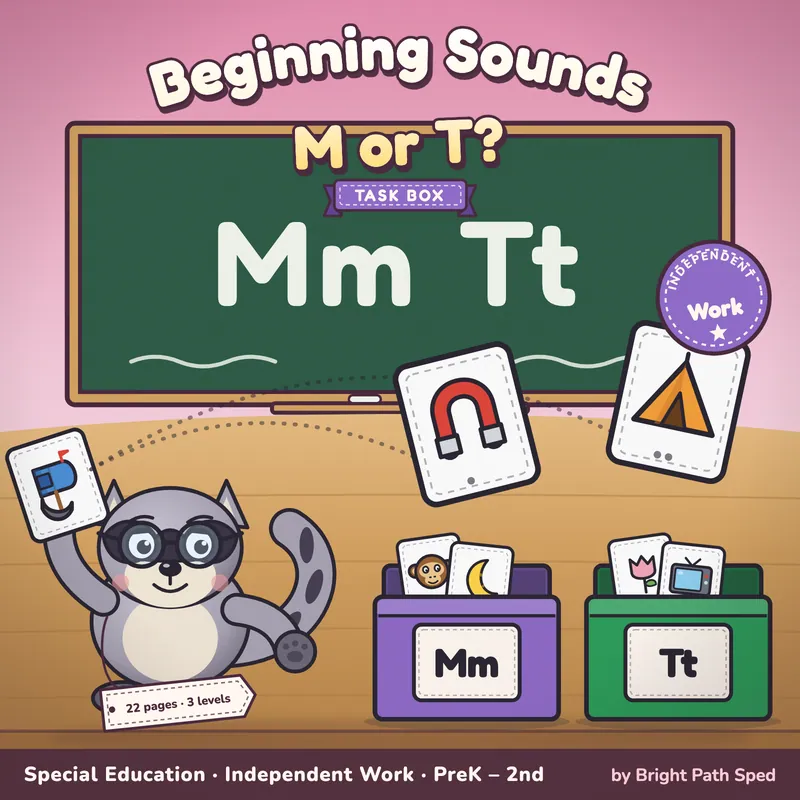
Beginning Sound M or T Sort Task Box
- 22 pages
- Not Grade Specific
$3.00
DownloadOr get it with All-Access: pick any 20 resources a month for $7.
New here? Your first month of All-Access is half off with code TEACHERTOK
Already bought this, or a member?
Instant download. One teacher's license: colleagues need their own copy. Each file carries a license number.
Also on Teachers Pay Teachers: see the Bright Path Sped store
About this resource
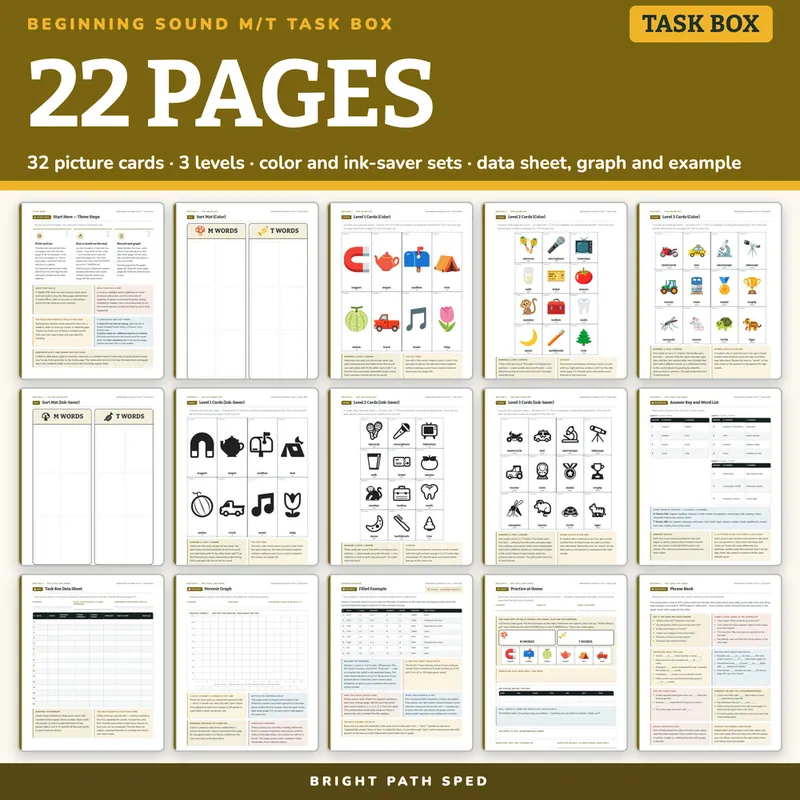
EVERYTHING INSIDE — 22 pages, 151 type-in fields
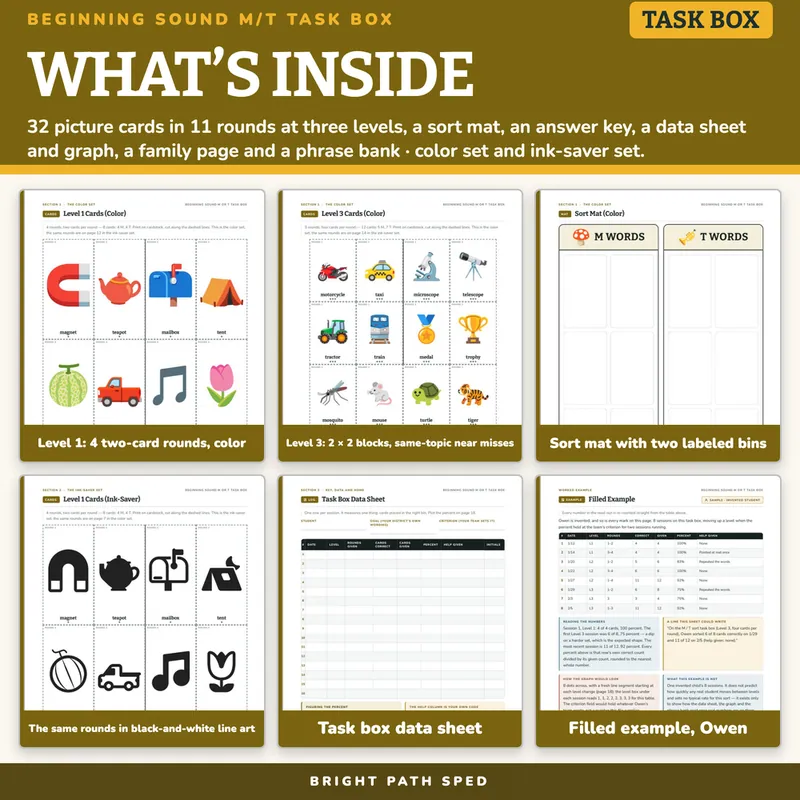
- 32 picture cards in 11 rounds across 3 levels (14 M words, 18 T words), each round boxed to cut apart as a strip
- Every card twice: a full-color set for a laminated classroom box and a black-and-white ink-saver set for the photocopier
- 2 sort mats (color and ink-saver) with two labeled bins, M WORDS and T WORDS, six card slots each
- An answer key listing every round by level, plus the full word list
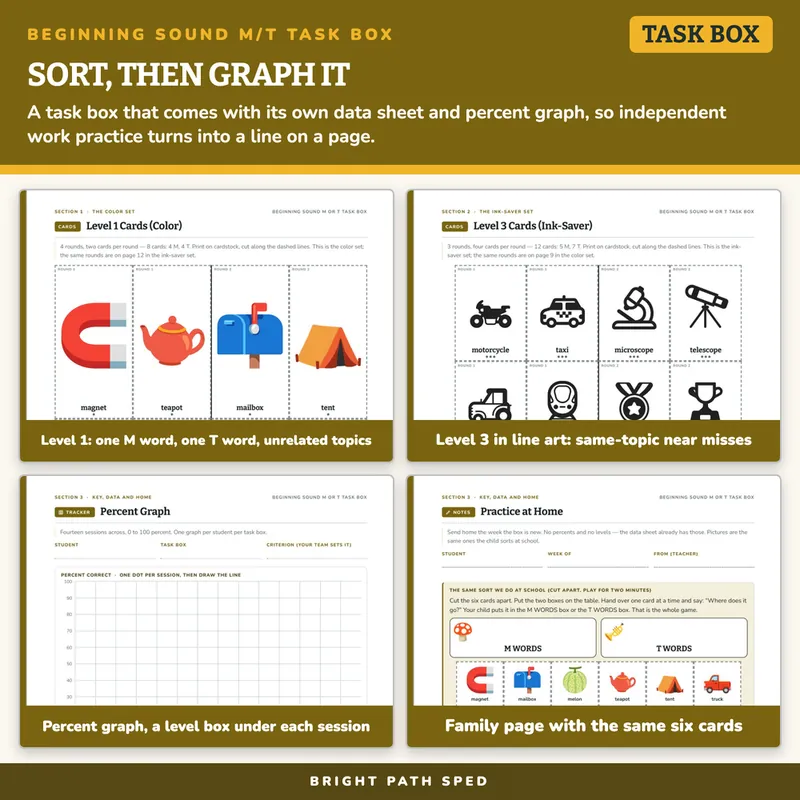
- A task box data sheet (16 rows: date, level, rounds given, cards correct, cards given, percent, help given, initials)
- A percent graph, 14 sessions across, with a level box under each session
- A filled example — an invented student, 8 sessions, every percent re-counted from its own row
- A family practice page with the same six cards and a mini mat
- A phrase bank: 25 lines in 6 groups (spoken lines for running the box, written starters for the note afterward)
- Start Here, a contents page with page thumbnails, and a "what's next" back page
A beginning-sound sort with the same data-and-graph system as the rest of the Task Box Collection: a child sorts pictures by their first sound, not by what the picture is a picture of, and every session lands on the data sheet behind it.
The Three Levels
- Level 1 — 4 rounds of two cards: one M word beside one T word, picked from unrelated topics so the first sound is the only thing to notice (magnet and teapot, mailbox and tent). The first sorts are nearly impossible to get wrong.
- Level 2 — 4 rounds of three cards. The split varies (two M words and one T, or one and two), so a child looks at each card instead of counting.
- Level 3 — 3 rounds of four cards, cut as 2 × 2 blocks. The harder pairs live here: pictures from the same everyday topic that start with a different sound — a motorcycle hiding among a taxi, a tractor and a train; a microscope and a telescope; a medal and a trophy; a mosquito and a mouse next to a turtle and a tiger — so a child has to listen to the word instead of guessing by what the pictures have in common. Splits run from one M word to three.
Nothing on a card says its level except a dot code in the corner (one, two or three dots), so a mixed-up box sorts itself back together and nobody at a shared table can see who has the two-card rounds.
The Words
- M words (14): magnet, mailbox, maracas, medal, melon, microphone, microscope, milk, monkey, moon, mosquito, motorcycle, mouse, music
- T words (18): taxi, teapot, telescope, television, tent, ticket, tiger, tomato, toolbox, tooth, toothbrush, tractor, train, tree, trophy, truck, tulip, turtle
- Mat icons (never cards): mushroom, trumpet
This is a short honest bank, smaller than the collection's usual 72-card shape, because M is a genuinely tight letter for clean beginning-sound pictures: every one of the 14 M candidates passed, and the box is sized around that. On the T side, several plausible pictures were checked and left out rather than stretched in: a clock-faced timer icon (a child says "clock," not "timer"), an old telephone handset (a child says "phone," which starts with the wrong sound), a shirt-and-tie image (a child says "shirt"), a teddy bear (a child says "bear," which starts with B, not T), and a taco whose black-and-white ink-saver picture alone is a plain rounded shape with no color to read it by. Every picture that stayed was chosen to be named in one word, starting with the right letter, in color AND in the black-and-white set.
What This Is, And What It Is Not
It is a fillable PDF: type into the data sheet, the graph header, the family page and the example-style notes, or print and use a pen. The card pages and mats print on cardstock or plain paper and cut along dashed lines. It works offline with no account or subscription. It is NOT an editable online slideshow or word-processor document, and it is not a test of anything.
It carries no prompt hierarchy, fading schedule or mastery rule, and it does not decide what a percent means for a student or when to move up a level. It does not teach letter names, letter formation or phoneme blending — it only sorts pictures by first sound. The goal line and the criterion field are blanks for your district's own wording and your team's own number. It measures one thing: cards placed in the right bin.
Who This Is For
Special education teachers and paraprofessionals running independent work stations, task box rotations or beginning-sound phonics practice with early or pre-reading students, case managers who need that practice to show up as data, and the families who get the practice page sent home.
More In The Collection
This is one set in the Task Box Collection; more sort and matching boxes are being added to the collection regularly, all on the same cards-plus-data shape.
Pictures (color pages): Noto Emoji by Google, Apache License 2.0. Pictures (ink-saver pages): Fluent Emoji, Copyright (c) Microsoft Corporation, MIT License.