Counting 1-10 Picture Task Box
- 22 pages
- Not Grade Specific
$3.00
DownloadOr get it with All-Access: pick any 20 resources a month for $7.
New here? Your first month of All-Access is half off with code TEACHERTOK
Already bought this, or a member?
Instant download. One teacher's license: colleagues need their own copy. Each file carries a license number.
Also on Teachers Pay Teachers: see the Bright Path Sped store
About this resource
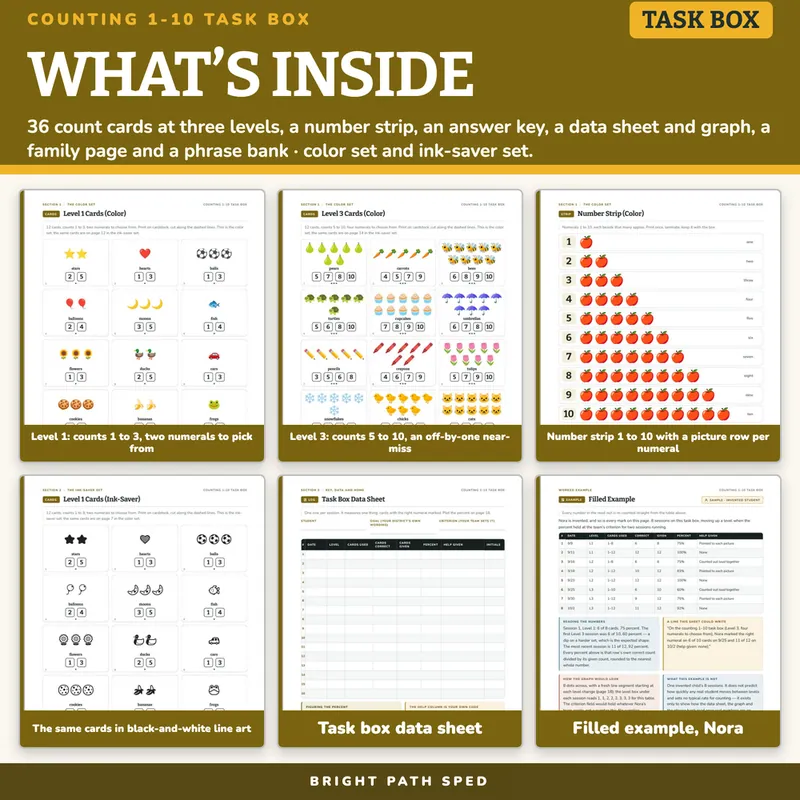
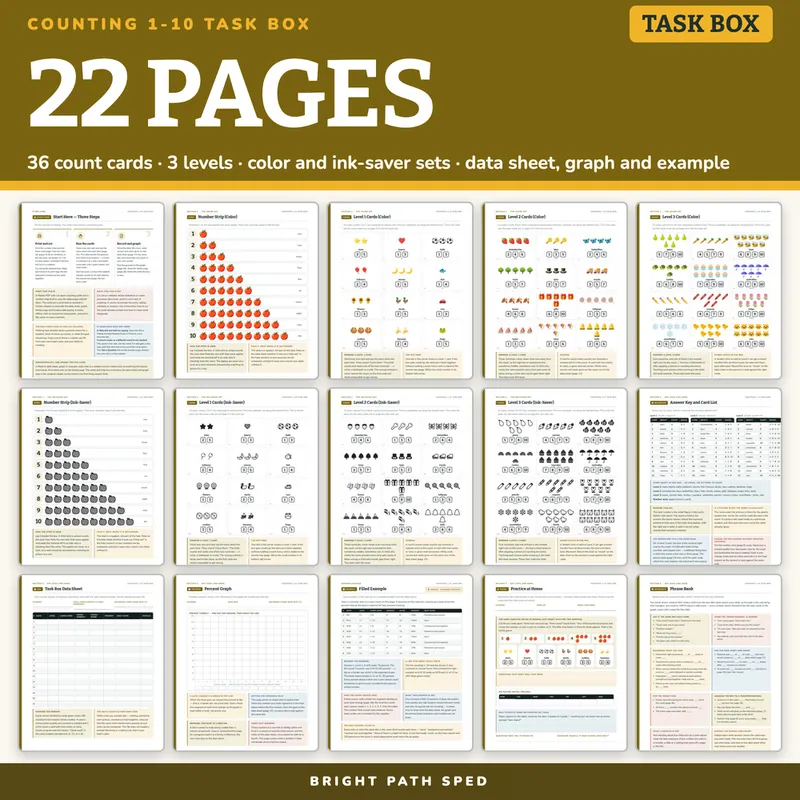
EVERYTHING INSIDE — 22 pages, 150 type-in fields
- 36 count cards across 3 levels (168 pictures to count): each card is a cluster of one object, its word, and a row of printed numeral boxes to circle, clip a clothespin on, or cover with a chip
- Every card twice: a full-color set for a laminated classroom box and a black-and-white ink-saver set for the photocopier
- 2 number strips (color and ink-saver): numerals 1 to 10, each beside that many apples, a visual anchor that never appears on a card
- An answer key listing every card by level with its count and the numerals printed on it, plus the full object list
- A task box data sheet (16 rows: date, level, cards used, cards correct, cards given, percent, help given, initials)
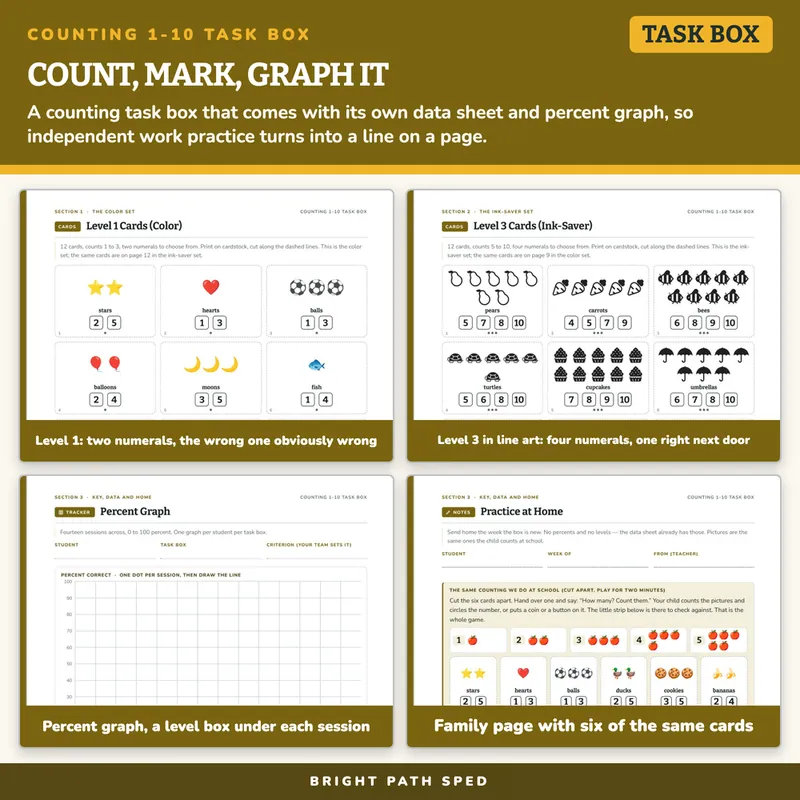
- A percent graph, 14 sessions across, with a level box under each session
- A filled example — an invented student, 8 sessions, every percent re-counted from its own row
- A family practice page with a short 1-to-5 strip and six of the same cards
- A phrase bank: 25 lines in 6 groups (spoken lines for running the box, written starters for the note afterward)
- Start Here, a contents page with page thumbnails, and a "what's next" back page
A counting task box that comes with its own data. Most counting card sets stop at the cards; this one adds the data sheet, the graph and the phrase bank behind them, so independent work practice turns into a line on a page a case manager can bring to a meeting.
The Three Levels
- Level 1 — 12 cards, counts 1 to 3, two numeral boxes. The wrong numeral is never next to the count (2 or 5, 1 or 4), so the first cards are nearly impossible to get wrong.
- Level 2 — 12 cards, counts 3 to 6, three numeral boxes. The wrong ones are never closer than two away from the count, and the right box is first on four cards, middle on four and last on four, so a child who marks the same position every time gets some wrong and a child who counts gets them right.
- Level 3 — 12 cards, counts 5 to 10, four numeral boxes, and one of them is the numeral right next to the count — the box a child lands on after skipping a picture or counting one twice. Touching each picture while counting is the habit this level rewards.
Pictures sit in rows of five, so six reads as "five and one." Nothing on a card says its level except a dot code in the corner (one, two or three dots), so a mixed-up box sorts itself back together and nobody at a shared table can see who has the two-box cards.
The Objects
- Level 1 (counts 1–3): stars, hearts, balls, balloons, moons, fish, flowers, ducks, cars, cookies, bananas, frogs
- Level 2 (counts 3–6): strawberries, keys, kites, lollipops, hats, bells, butterflies, boats, trucks, gifts, leaves, trees
- Level 3 (counts 5–10): pears, carrots, bees, turtles, cupcakes, umbrellas, pencils, crayons, tulips, snowflakes, chicks, cats
- Number strip (never a card): apples
Every object is one discrete thing a young child names in one word, in color AND in the black-and-white set, at the size it prints; an object that failed in either set was left out of both. The strip object is never a card, so no card can be answered by matching its picture to a strip row.
What This Is, And What It Is Not
It is a fillable PDF: type into the data sheet, the graph header, the family page and the example-style notes, or print and use a pen. The cards themselves are a print task — the numeral boxes are printed squares a child circles, clips or covers, not type-in fields — and laminated cards take a dry-erase marker. The card pages and strips print on cardstock or plain paper and cut along dashed lines. It works offline with no account or subscription. It is NOT an editable online slideshow or word-processor document, and it is not a test of anything.
It carries no prompt hierarchy, fading schedule or mastery rule, and it does not decide what a percent means for a student or when to move up a level. The goal line and the criterion field are blanks for your district's own wording and your team's own number. It measures one thing: cards with the right numeral marked.
Who This Is For
Special education teachers and paraprofessionals running independent work stations or task box rotations with early or pre-reading students, case managers who need that counting practice to show up as data, and the families who get the practice page sent home.
More In The Collection
The Task Box Collection also has ten sort boxes on the same cards-plus-data shape (food vs not food, big vs small, living vs not living, and more); a Counting 11–20 box is next. New sets are added to the collection regularly.
Pictures (color pages): Noto Emoji by Google, Apache License 2.0. Pictures (ink-saver pages): Fluent Emoji, Copyright (c) Microsoft Corporation, MIT License.