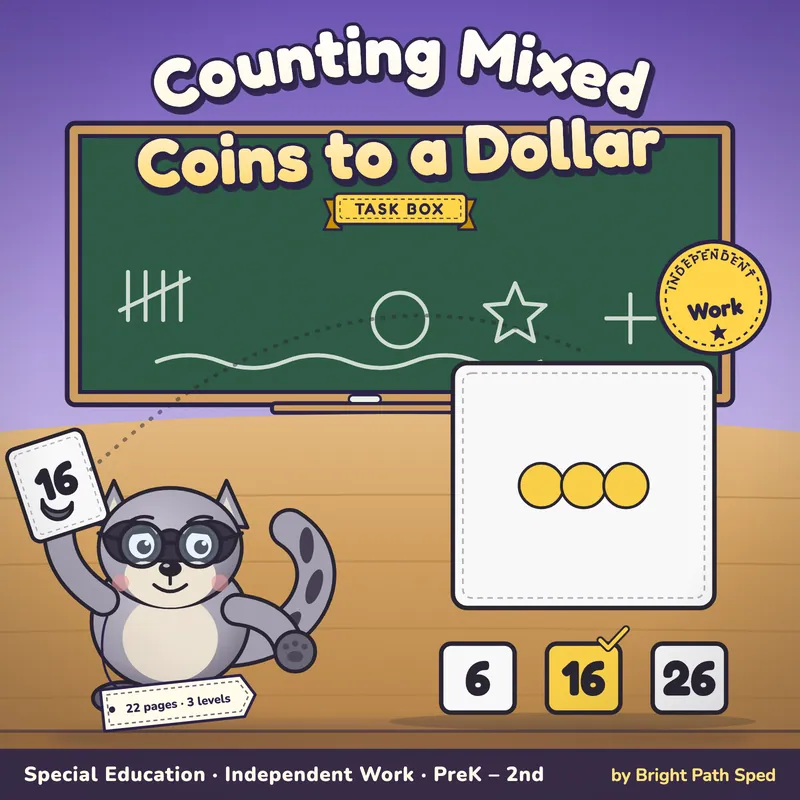
Counting Mixed Coins to a Dollar Task Box
- 22 pages
- Not Grade Specific
$3.00
DownloadOr get it with All-Access: pick any 20 resources a month for $7.
New here? Your first month of All-Access is half off with code TEACHERTOK
Already bought this, or a member?
Instant download. One teacher's license: colleagues need their own copy. Each file carries a license number.
Also on Teachers Pay Teachers: see the Bright Path Sped store
About this resource
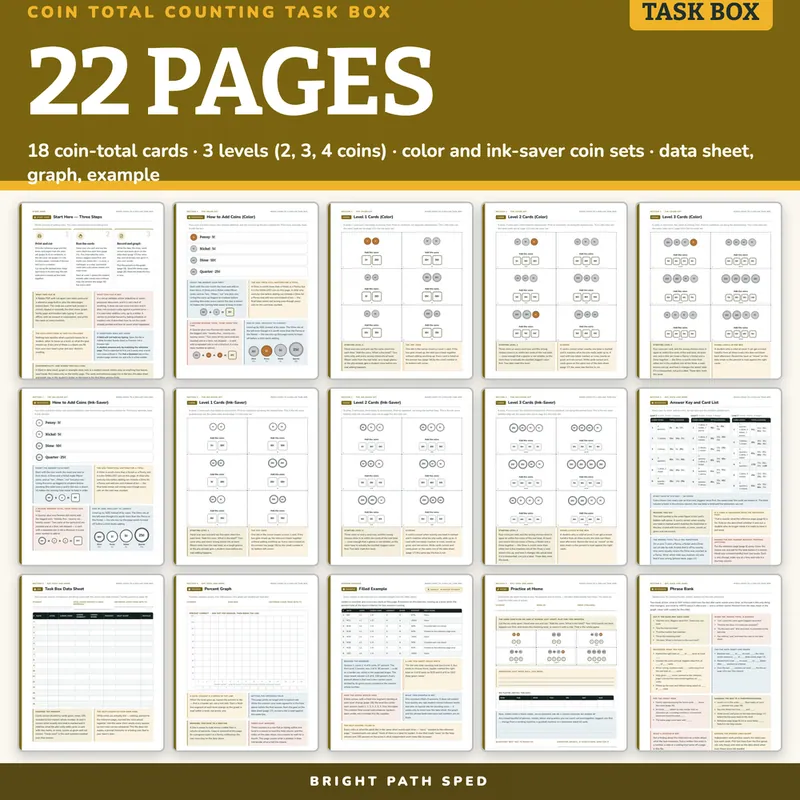
EVERYTHING INSIDE — 22 pages, 152 fillable fields
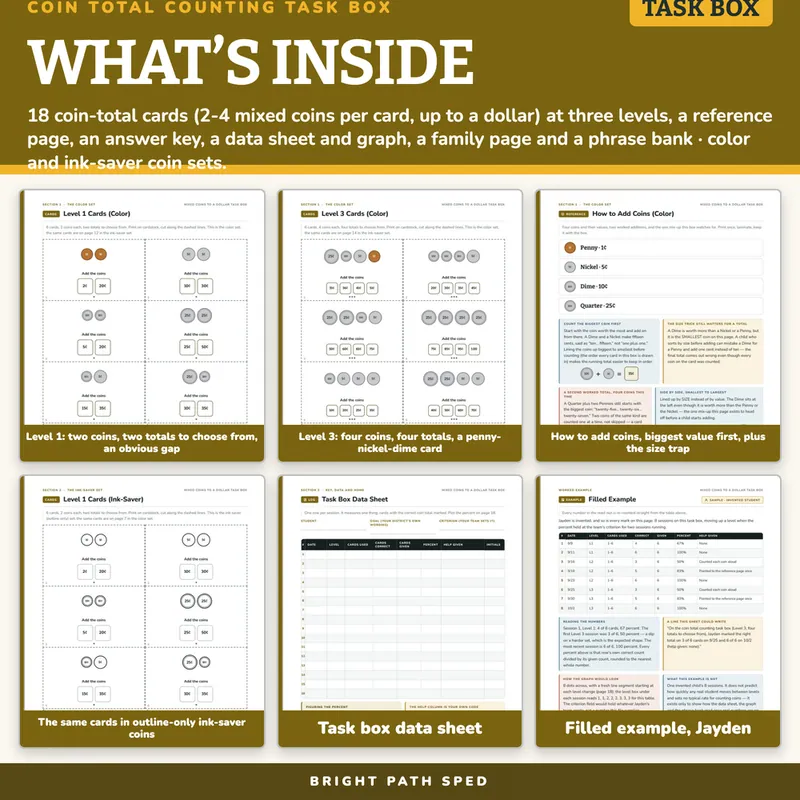
- 18 coin-total cards across 3 levels (6 cards per level). Every card shows 2-4 mixed coins (any combination of penny, nickel, dime and quarter); the child adds them up, biggest value first, and marks the matching total from a row of numeral choice tiles. The total is never printed on the card
- Every card twice: filled copper and silver coins for a laminated classroom box, and outline-only coins for the photocopier
- A "How to Add Coins" reference page (color and ink-saver) showing all four coins and their values, a worked addition example, and a plain-language note on the one trap the box watches for
- An answer key listing every card by level: the coins shown (biggest value first), the real total, and every numeral choice with the correct one in bold
- A task box data sheet (16 rows: date, level, cards used, cards correct, cards given, percent, help given, initials)
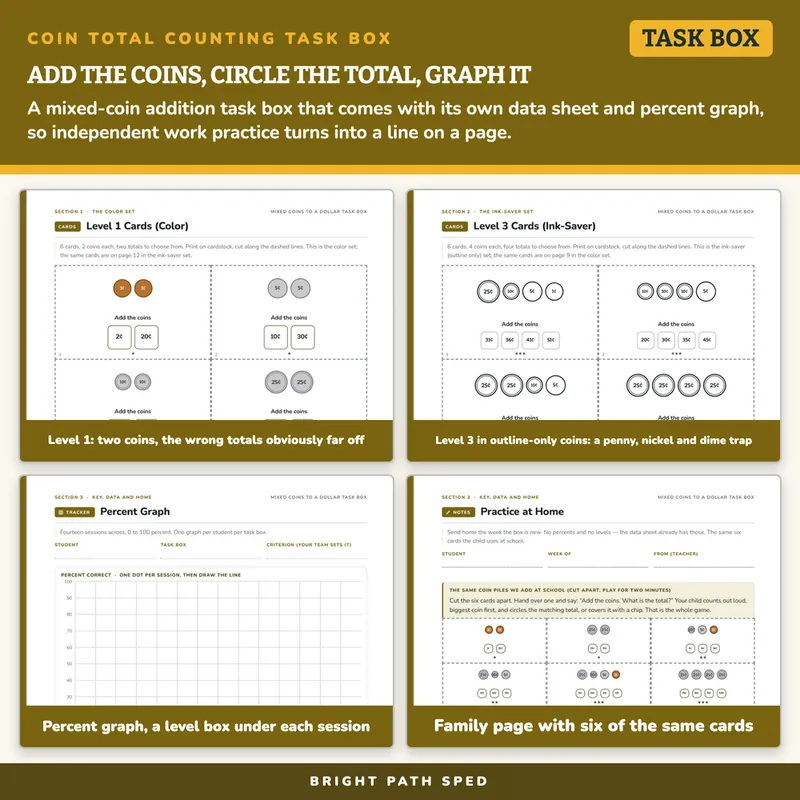
- A percent graph, 14 sessions across, with a level box under each session
- A filled example — an invented student, 8 sessions, every percent re-counted from its own row
- A family practice page with six of the same cards, cut apart as one 3-across strip
- A phrase bank: spoken lines for running the box and written starters for the note afterward, 24 lines in 6 groups
- Start Here, a contents page with page thumbnails, and a "what's next" back page
Coin-total addition in one card: a handful of mixed coins, and a row of numbers to choose the right total from. This is the shape most "count your coins" worksheets are actually asking for — not naming one coin, and not comparing a pile to a printed price.
Three Levels, And The Difficulty Is How Many Coins Are On The Card
- Level 1 — 6 cards, 2 coins each, 2 totals to choose from. Every wrong choice sits at least 15¢ from the real total, so the two coins involved and the gap between the choices both keep this level forgiving.
- Level 2 — 6 cards, 3 coins each, 3 totals to choose from. The gap narrows to at least 10¢ — close enough that the coins have to actually be added, biggest value first.
- Level 3 — 6 cards, 4 coins each, 4 totals to choose from. The gap narrows again to at least 5¢, and the box reaches as high as a full dollar (four quarters, one card). At least one Level 3 card mixes a penny, a nickel AND a dime on the same pile — the dime is worth more than either but is the smallest coin of the three, and on this card getting its value wrong changes the actual total, not just a label.
Nothing on a card says its level except a dot code in the corner (one, two or three dots), so a mixed-up box sorts itself back together.
AMOUNTS WITHOUT A CURRENCY SYMBOL, ON PURPOSE — a dollar sign is never used anywhere in this file. Under a dollar, an amount is written in cents (35¢); a dollar exactly, it is written the way a register shows it (1.00). No coin on any card and no choice on any card goes past a dollar.
What This Is, And What It Is Not
It is a fillable PDF: type into the data sheet, the graph header, the family page and the example-style notes, or print and use a pen. The card pages and reference page print on cardstock or plain paper and cut along dashed lines. It works offline with no account or subscription. It is NOT an editable online slideshow or word-processor document, and it is not a test of anything. It does not sort coins into bins and it does not compare a pile against a printed price — those are the store's other two coin task boxes (cross-links below); this one is coin-total addition only.
It carries no prompt hierarchy, fading schedule or mastery rule, and it does not decide what a percent means for a student or when to move up a level. The goal line and the criterion field are blanks for your district's own wording and your team's own number. It measures one thing: cards with the correct total marked.
Who This Is For
Special education teachers and paraprofessionals running independent work stations or task box rotations with students working on money and coin-counting skills, case managers who need that practice to show up as data, and the families who get the practice page sent home.
More In The Collection
This is one set in the Task Box Collection; more sort, counting and life-skills boxes are being added to the collection regularly, all on the same cards-plus-data shape.