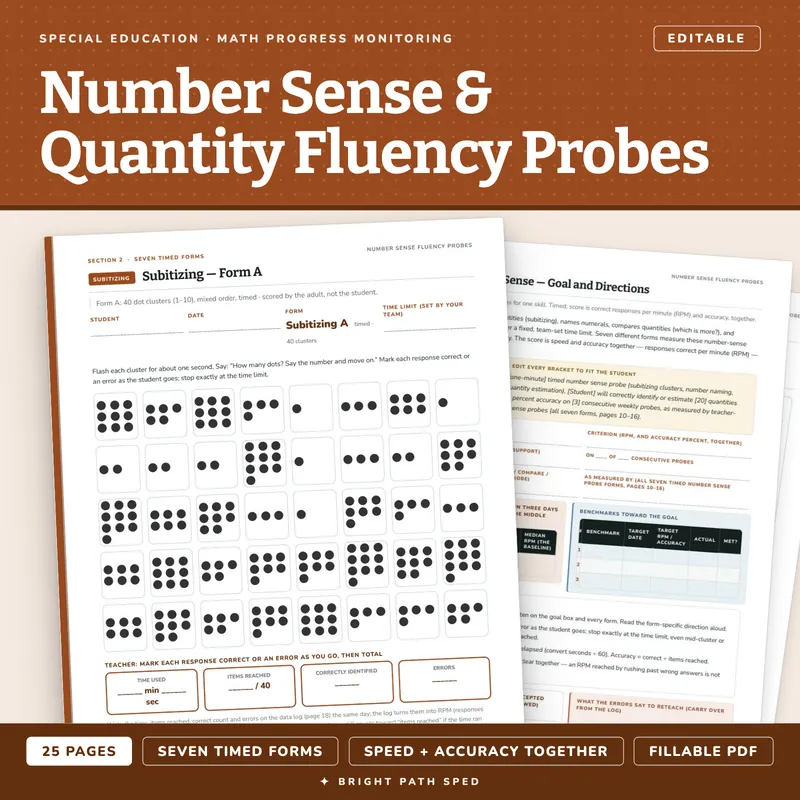
Number Sense & Quantity Fluency Probes
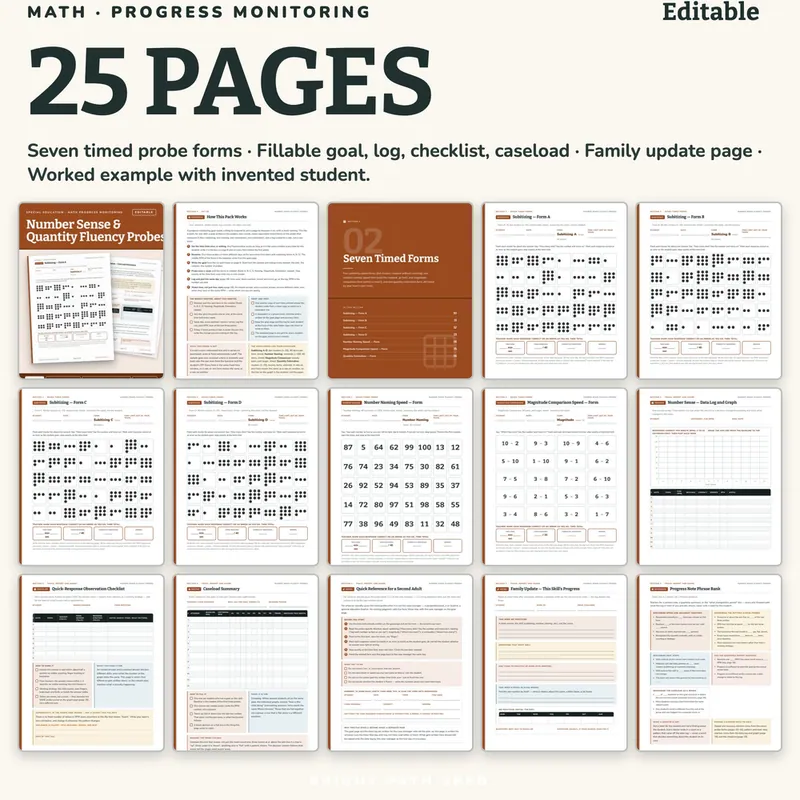
- 25 pages
- PreK, Kindergarten, 1st, 2nd
$3.50
DownloadOr get it with All-Access: pick any 20 resources a month for $7.
New here? Your first month of All-Access is half off with code TEACHERTOK
Already bought this, or a member?
Instant download. One teacher's license: colleagues need their own copy. Each file carries a license number.
Also on Teachers Pay Teachers: see the Bright Path Sped store
About this resource
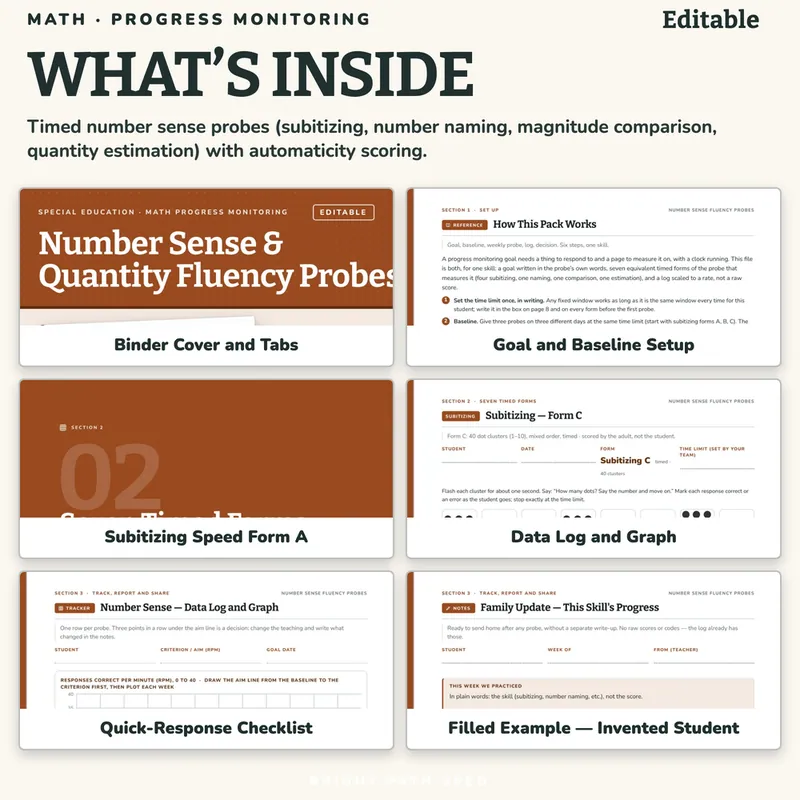
Seven timed probes for the number-sense skills that require automaticity — subitizing (instant recognition without counting), number-naming speed, magnitude comparison, and quantity estimation — in one fillable PDF. Type the goal once, print the forms once per student, run a weekly probe, log the score as responses-per-minute (RPM) and accuracy together, and watch for automaticity growth. Goal page, seven timed forms, data log with graph, quick-response observation checklist, caseload summary, second-adult reference card, family update, phrase bank, filled example, and binder tabs.
WHAT IS INCLUDED - 25 pages, 394 type-in fields
Setup
- Binder Cover and Divider Tabs — Print, cut and slide into a binder; tabs for all seven forms plus the worked example
- How This Pack Works — One page: goal, baseline, weekly probe, log, decision, six steps
- Goal and Directions — Six-part goal frame with a filled-in sample; baseline table for three starting probes; directions for each form type
Seven Timed Forms
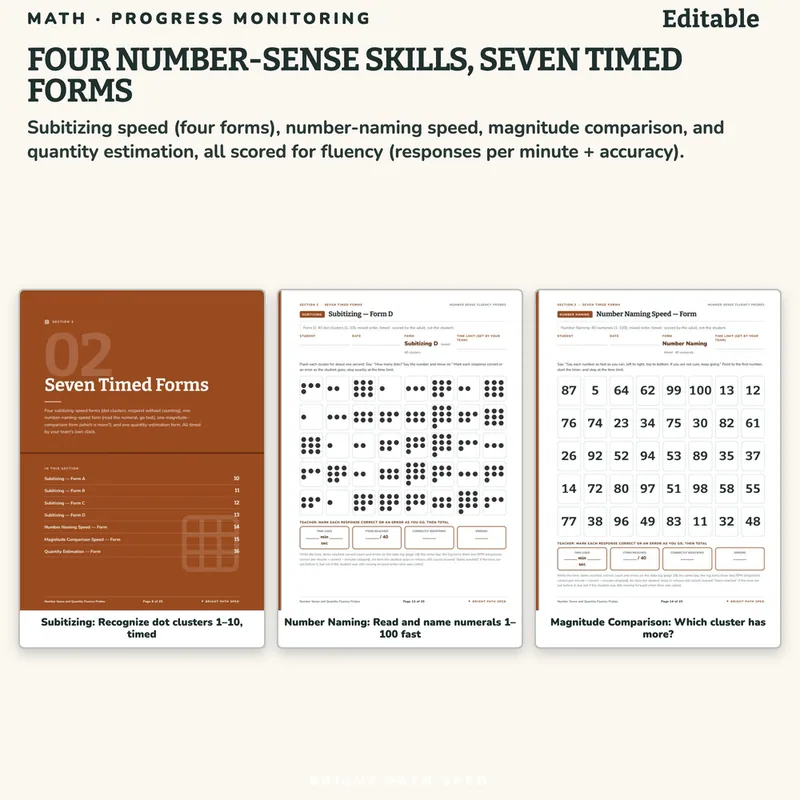
- Subitizing Speed — Four forms (A, B, C, D): dot clusters 1–10, 40 clusters per form, respond instantly without counting, timed
- Number Naming Speed — One form: numerals 1–100, 40 numerals per form, read and say the number fast, timed
- Magnitude Comparison Speed — One form: twenty pairs of clusters, say which has more, timed
- Quantity Estimation — One form: clusters 1–15, twenty items, estimate the quantity, timed
Tracking And Reporting
- Data Log and Graph — Twelve rows (weeks 1–12): date, form type, time used, items reached, correct, errors, RPM, notes; grid graph 0–40 RPM with aim line
- Quick-Response Observation Checklist — Eight rows: mark whether responses came instantly, from memory, or from a working strategy; team notes on automaticity
- Caseload Summary — Twelve students by eight probes, baseline, criterion, trend, decision column; groups students with the same trend for team grouping
- Quick Reference for a Second Adult — For the paraprofessional or co-teacher who gives the probe; no scoring judgment, just the steps and raw numbers
- Family Update — Student, week, what we practiced, something that went well, one thing to practice at home, rate in words, check-in boxes, reply line
- Progress Note Phrase Bank — Five groups of starters (speed and accuracy, pattern across probes, next steps, quarterly report, caseload-wide); never a label for the student
- Filled-in Example — Invented first grader, Mira: twelve weekly timed probes, the aim line drawn, the criterion close to being met, every number checked against its own table
What This Is, And What It Is Not
It is a fillable PDF. Open it in a PDF reader, click a line, a box or a cell, type, press Tab to move on, and Save As once per student. It works offline with no account or subscription. It is NOT a Google Sheets file, a Google Doc or an Excel workbook. It does not calculate rates or draw the graph.
It is not a norm-referenced test and it carries no benchmark score or fixed automaticity cutoff. The sample goal uses invented criteria in brackets; your team sets the real ones from the baseline and the student's IEP. Every form is timed by your team's own fixed time window, so a rate on one form means the same as a rate on another. The quick-response checklist measures HOW the answer came (instantly, from memory, from a strategy), not whether it was right or wrong — that goes on the graph.
Who This Is For
Early-math interventionists and special education teachers with number-sense IEP goals, the paraprofessionals who take weekly timed probes, and general education teachers who need to track automaticity on a numeracy goal. This is the speed companion to the number-IDENTIFICATION accuracy probes; the two go together. A teacher who has a goal written and nothing to measure it with on Friday, or who tracked accuracy for eight weeks and realized the real question is whether it's automatic.
You might also need
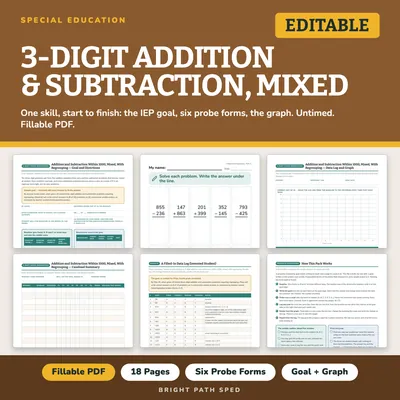
3-Digit Addition and Subtraction Mixed Regrouping Probes
$3.50 or with All-Access
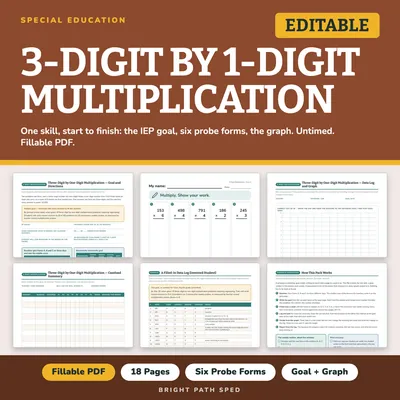
3-Digit by 1-Digit Multiplication Progress Monitoring Probes
$3.50 or with All-Access
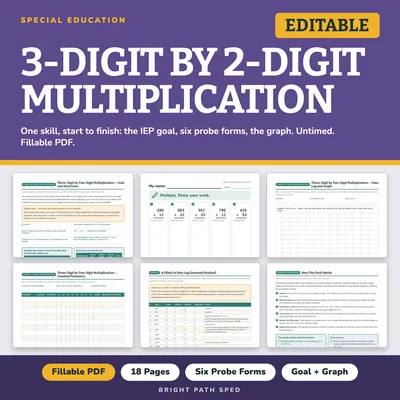
3-Digit by 2-Digit Multiplication Progress Monitoring Probes
$3.50 or with All-Access
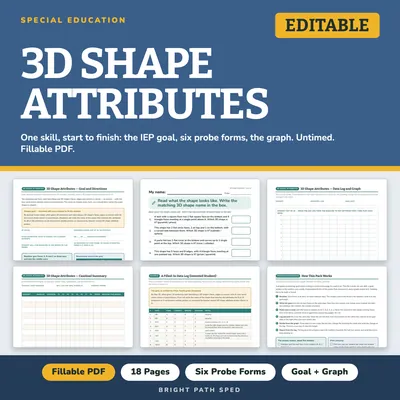
3D Shape Attributes (Faces/Edges/Vertices) Probes
$3.50 or with All-Access