Point of View Probes Editable
- 25 pages
- Not Grade Specific
- PDF, fillable
$4.00
DownloadOr get it with All-Access: pick any 20 resources a month for $7.
New here? Your first month of All-Access is half off with code TEACHERTOK
Already bought this, or a member?
Instant download. One teacher's license: colleagues need their own copy. Each file carries a license number.
Also on Teachers Pay Teachers: see the Bright Path Sped store
About this resource
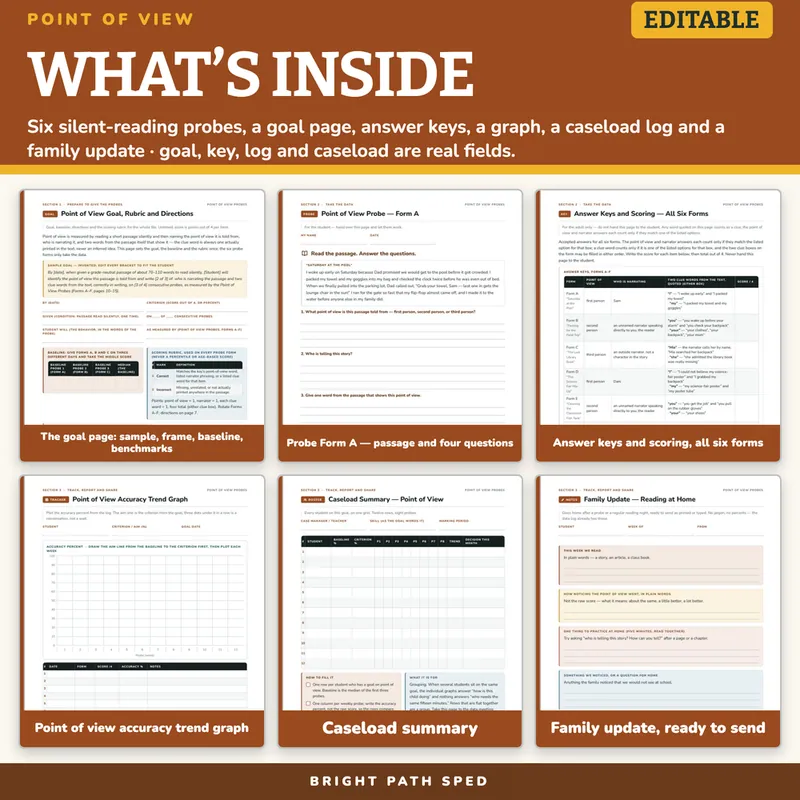
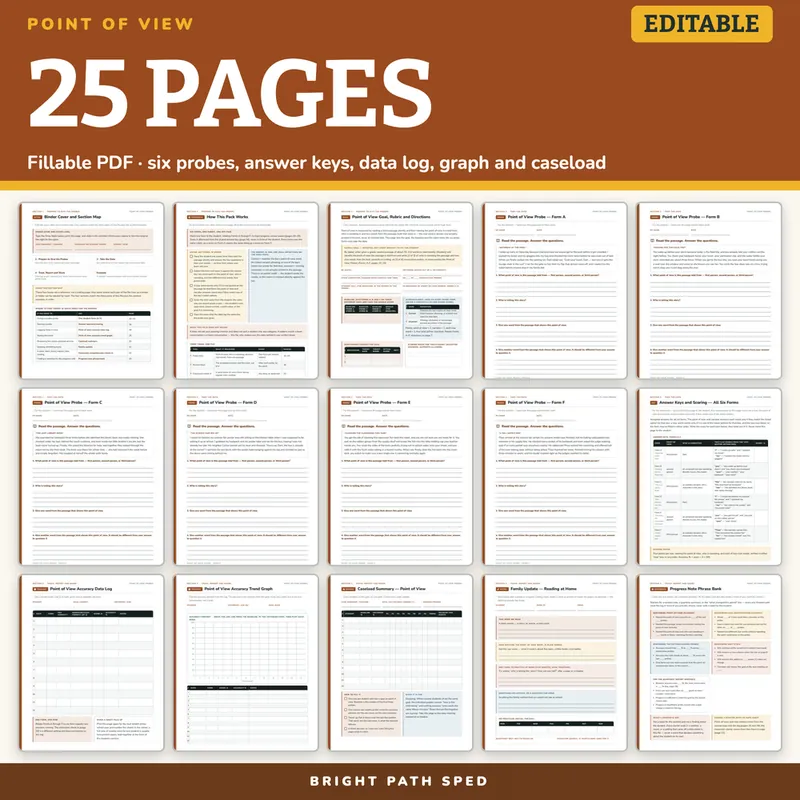
Everything inside: 25 pages · 6 original silent-reading passages with 24 questions · 6 equivalent probe forms · a shared answer-key and scoring page for all six forms · a data log and scaled trend graph · a caseload summary · a ready-to-send family update · a classroom teacher check-in (a second setting) · a 17-starter phrase bank · a binder cover and 4-section binder map · a worked, invented example.
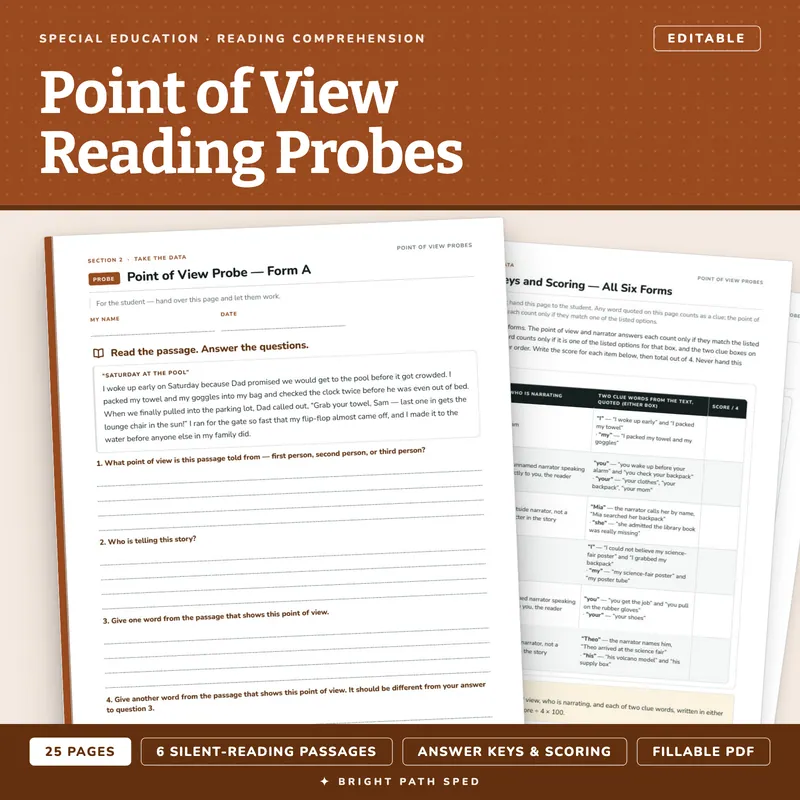
The store had probes for comparing two things, a stated cause and effect, a main idea and a character's inferred traits, but nothing that measures whether a student can name the point of view a passage is told from, who is narrating it, and the actual words in the text that prove it. This file hands the student six original, invented passages, each about 70–110 words, about an everyday school-life moment (a Saturday pool trip, packing for a field trip, a lost library book, a science-fair poster mix-up, cleaning a classroom fish tank, a borrowed baking-soda packet) with nothing but the passage and four write-in questions on the page the student sees. Two forms are told in first person, two in second person and two in third person, so a student practices telling all three apart rather than seeing the same pattern six times. Scoring, the rubric and the answer key live on separate adult-only pages, never in the student's hands. Because the word that proves the point of view is always printed in the passage itself (a pronoun or a name), every accepted clue on the key page is a literal quote from that form's own passage, so a scorer can check any accepted answer against the text itself without taking the file's word for it.
WHAT IS INCLUDED — 25 pages, 491 type-in fields
Prepare To Give The Probes
- Binder Cover and Section Map — a spine/cover card, a 4-box section reference (not a cutting page), and an 8-row "where to find things" index
- How This Pack Works — how the six forms share one rubric and one key page, plus a 3-row table comparing what each of the file's three tools measures
- Point of View Goal, Rubric and Directions — a sample IEP-style goal (invented, every bracket editable), a baseline table (median of the first three probes), a rubric defining correct/incorrect (a clue word counts only if it is quoted on the key page for that form), and a 2-row benchmark table
Take The Data
- Six Probe Forms (A–F) — each a clean, student-facing page: a "My name" line, one kid-worded instruction with a book icon, the passage, and four numbered questions with a real four-line answer box each (1 question naming the point of view, 1 on who is telling the story, 2 asking for a different clue word each) — nothing scored, no goal text, no marks on this page. Two forms are first person, two second person, two third person.
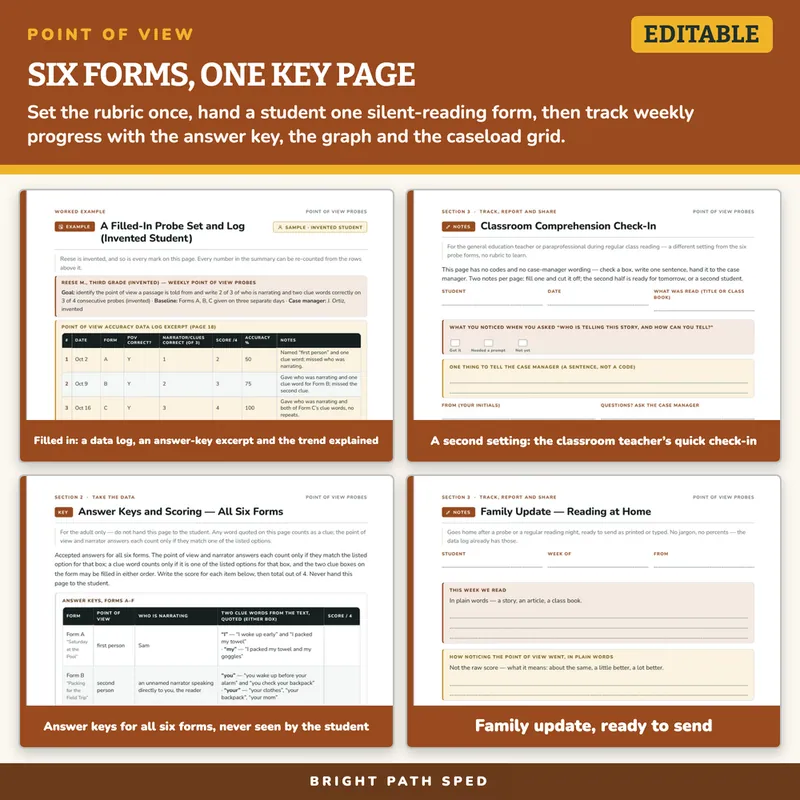
- Answer Keys and Scoring — one shared adult-only page with all six forms' accepted point-of-view word, narrator phrasing and two quoted clue words (the point of view and narrator answers are each one of a short closed list; the two clue answers accepted in either box) and a Score /4 field per form
Track, Report And Share
- Point of View Accuracy Data Log — 12 dated rows, one form per row
- Point of View Accuracy Trend Graph — a scaled 0–100% grid plus a 12-row log table
- Caseload Summary — 12 students by 8 probes, baseline and criterion percent, trend and decision columns
- Family Update — Reading at Home — a ready-to-send communication page: what was read, how it went in plain words, a practice idea, and a 7-day practiced table
- Classroom Comprehension Check-In — two half-page notes per sheet, cut apart: a checkbox, one sentence, no codes, for the general education teacher or paraprofessional during regular class reading (a different setting from the six probe forms)
- Progress Note Phrase Bank — 17 observable-language starters across 5 groups (point-of-view accuracy, clue-identification accuracy, pattern across probes, next steps, the quarterly-report sentence), every one ending in a blank pulled from a data sheet in the file
- A Filled-In Probe Set and Log — a worked, invented example (Reese M., third grade) with a 4-row weekly log and a 2-row answer-key excerpt, every number cross-checked against the arithmetic behind it
Plus a Start Here quick-start, a 3-section contents page with real page thumbnails, 3 section dividers, and a "what's next" back page.
What This Is, And What It Is Not
It is a fillable PDF. Open it in a PDF reader, click a field, type, save. It works offline with no account or subscription. It is NOT a Google Sheets file, a Google Doc, or an Excel workbook, and it does not calculate a percent for you. The six probe forms print cleanly for the student to write directly on.
It is not a norm-referenced or standardized reading test, and it is not a Lexile or grade-level placement tool. It does not set a passing criterion or sort a student into any category — that is a blank line for your team. It is not Character Traits and Motivation, Compare and Contrast, Cause and Effect, or Main Idea and Supporting Details Reading Comprehension Probes, each of which measures a different comprehension skill from the same six-form shape; this file's point-of-view questions are the one place in the family where the evidence word is always a pronoun or a name actually printed in the text, never an inferred idea.
No age, eligibility or IDEA-timeline claim anywhere; no health data is pre-filled, and the example student (Reese) is invented and named as such on page 24.
Who This Is For
Special education teachers, reading interventionists and case managers who need point of view measured with the student's own written answers as the evidence, scored from an answer key in under a minute a form.
If You Want More
Character Traits and Motivation Reading Comprehension Probes, Compare and Contrast Reading Comprehension Probes, Cause and Effect Reading Comprehension Probes and Main Idea and Supporting Details Reading Comprehension Probes are the sibling comprehension-passage probes, the same six-form shape, each scoring a different reading skill.
You might also need
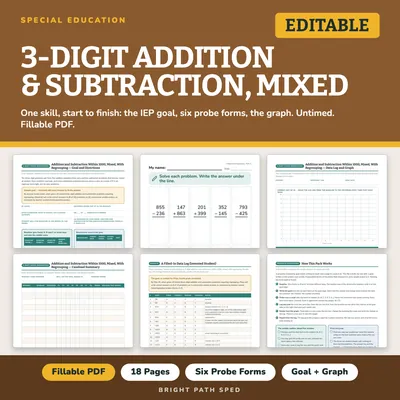
3-Digit Addition and Subtraction Mixed Regrouping Probes
$3.50 or with All-Access
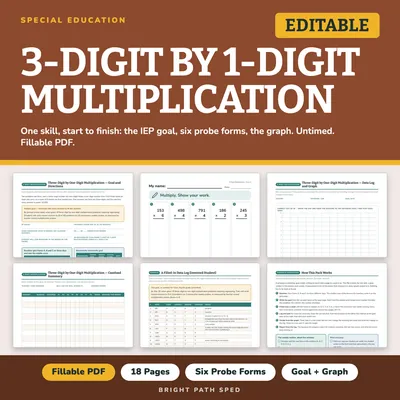
3-Digit by 1-Digit Multiplication Progress Monitoring Probes
$3.50 or with All-Access
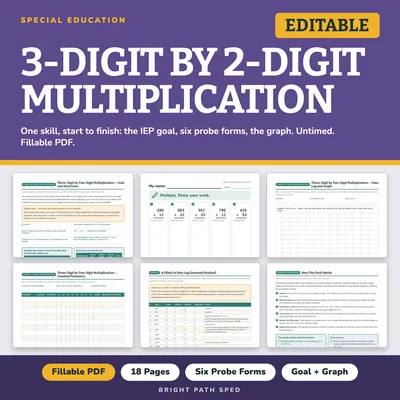
3-Digit by 2-Digit Multiplication Progress Monitoring Probes
$3.50 or with All-Access
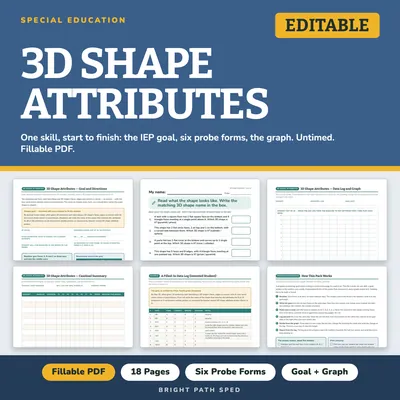
3D Shape Attributes (Faces/Edges/Vertices) Probes
$3.50 or with All-Access