Pre-Primer Reading Fluency Probes
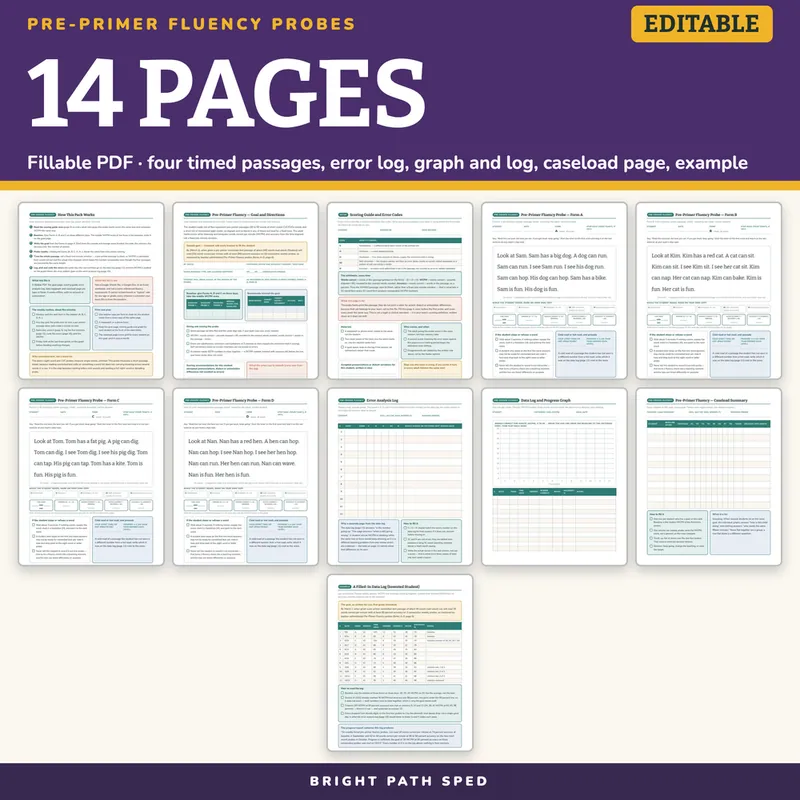
- 14 pages
- PreK, Kindergarten, 1st, 2nd
$3.50
DownloadOr get it with All-Access: pick any 20 resources a month for $7.
New here? Your first month of All-Access is half off with code TEACHERTOK
Already bought this, or a member?
Instant download. One teacher's license: colleagues need their own copy. Each file carries a license number.
Also on Teachers Pay Teachers: see the Bright Path Sped store
About this resource
The store's sight-word probe and CVC decoding probe both measure single words, untimed. Neither measures a beginning reader working through a few lines of connected text for rate as well as accuracy — the step in between letter-sound knowledge and a full sight-word or decoding probe. This is that step: a pre-primer connected-text fluency probe, timed, scored for words correct per minute (WCPM) and accuracy together.
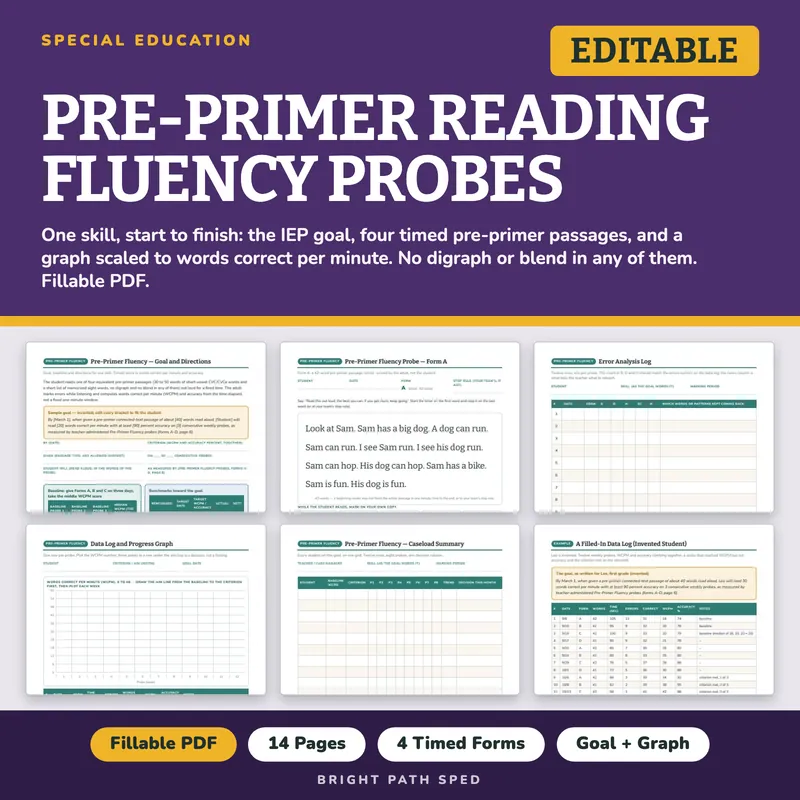
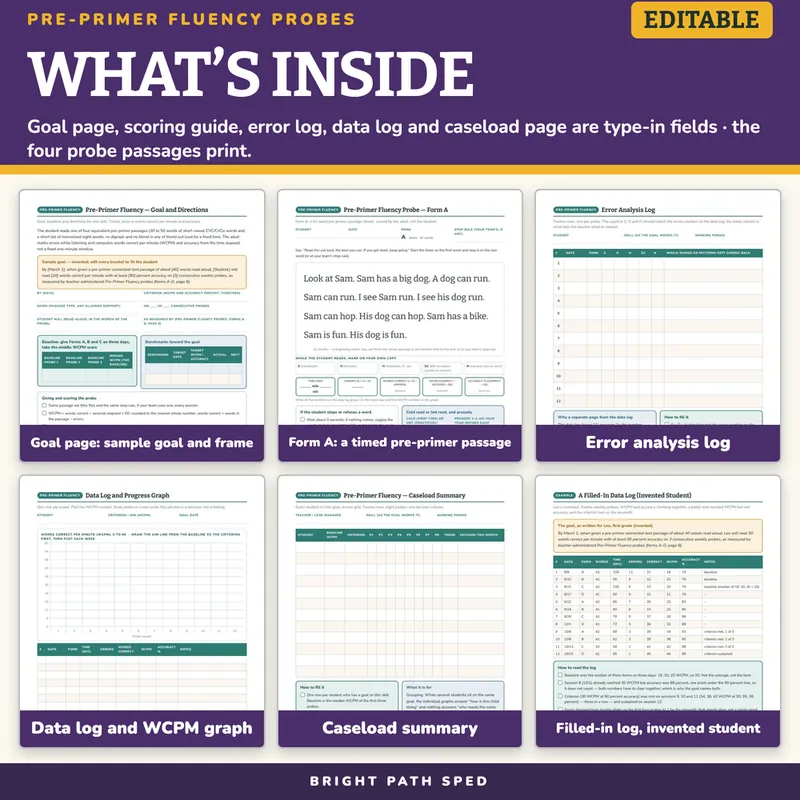
WHAT IS INCLUDED - 14 pages, 4 timed probe forms, FIELDS_TBD type-in fields
The Goal Page
- What the probe measures, in one paragraph
- A sample goal, invented, with every bracket meant to be edited by the team
- The six-part goal frame as type-in fields: by (date), given, student will, criterion (WCPM and accuracy together), on ___ of ___ consecutive probes, as measured by
- A baseline table: three probes and the median WCPM
- Two benchmark rows with target date, target WCPM/accuracy, actual and met
- The administration and scoring directions, including the WCPM and accuracy formulas and the rule that both numbers have to clear together
- Lines for this student's own scoring accommodations, and a box for what the errors say to reteach
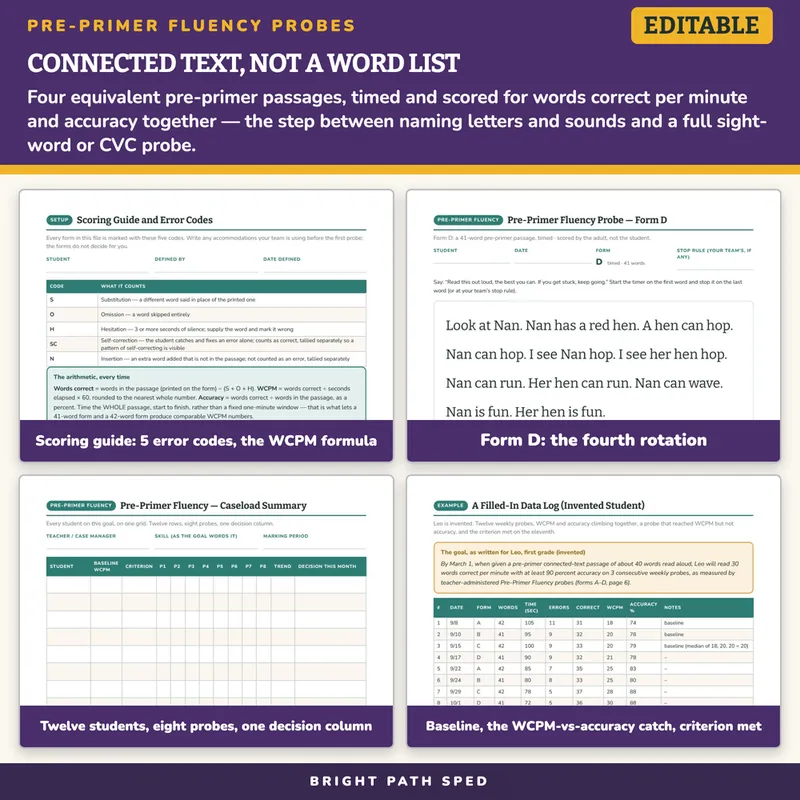
The Scoring Guide
- Five error codes (S substitution, O omission, H hesitation, SC self-correction, N insertion) and exactly what each one counts
- The WCPM and accuracy formulas spelled out, including why the passage is timed start-to-finish rather than a fixed one-minute window
- Blank lines for this student's accepted pronunciations or dialect variations, and any stop rule the team is using
Four Timed Pre-Primer Passages, A Through D
- 41 to 42 words each, short-vowel CVC and CVCe words plus a short list of memorized high-frequency sight words — no consonant digraph and no consonant blend anywhere in the pool, checked in code against the whole word list, not just a sample
- A large-print passage card built for a beginning reader, a quick-reference error-code legend, and a five-box scoring strip (time, errors, words correct, WCPM, accuracy)
- A card for what to do if the student stops or refuses a word, and a cold-read/hot-read plus prosody field
- Name, date, form letter and word count at the top of every form
An Error Analysis Log
- Twelve rows, one per probe: tallies for S, O, H, SC and N, and a notes column for which words or patterns kept coming back wrong
- Answers a different question from the data log: not "is the number going up" but "what is still going wrong"
The Data Log And Graph
- A y-axis scaled 0 to 60 WCPM, twelve probe columns, and the instruction to draw the aim line from the baseline to the criterion first
- A twelve-row log: date, form, time, errors, words correct, WCPM, accuracy percent, and notes
The Caseload Summary
- Twelve student rows, baseline WCPM and criterion, eight probe columns, a trend column and a decision column
A Worked Example
- An invented first grader, twelve weekly probes: the baseline taken as a median, a session that reached the WCPM target but not the accuracy line (and so did not count), the criterion met on three consecutive probes, and the progress-report sentence the log produces. Every number in that sentence is on the log.
What This Is, And What It Is Not
It is a fillable PDF. The goal page, scoring guide, error analysis log, data log and caseload page are type-in fields: open the file in a PDF reader, click a line or a cell, type, and Save As once per student. The four probe forms are meant to be printed; the student reads from paper. It works offline with no account or subscription. It does not calculate WCPM or accuracy for you, and it does not draw the graph.
It is not a norm-referenced fluency assessment and it carries no benchmark WCPM or "typical" rate for any age or grade. The criteria in the sample goal are in brackets because your team sets them from the baseline. It is not a Google Sheets file, a Google Doc, or an Excel workbook.
Who This Is For
Special education teachers and case managers writing early reading-fluency goals, kindergarten and first grade intervention and Title teachers, and the paraprofessionals who give the weekly probe.
If You Want The Step Before Or After This One
Letter Naming Progress Monitoring Probes measures the step before this one (naming upper- and lowercase letters, untimed). CVC Word Reading Progress Monitoring Probes measures real CVC words for decoding accuracy, untimed, once a student is past connected-text pre-primer text.
You might also need
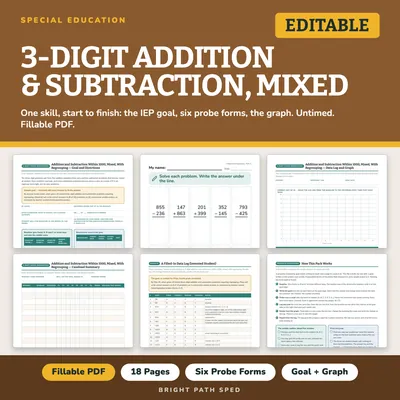
3-Digit Addition and Subtraction Mixed Regrouping Probes
$3.50 or with All-Access
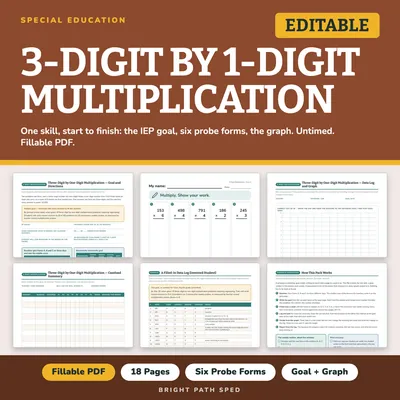
3-Digit by 1-Digit Multiplication Progress Monitoring Probes
$3.50 or with All-Access
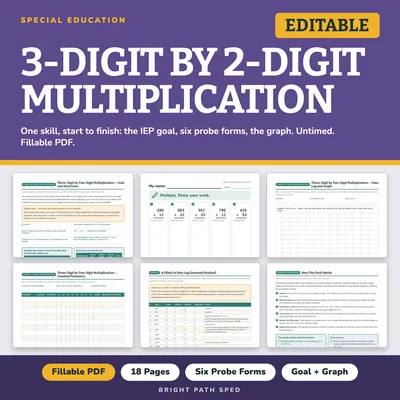
3-Digit by 2-Digit Multiplication Progress Monitoring Probes
$3.50 or with All-Access
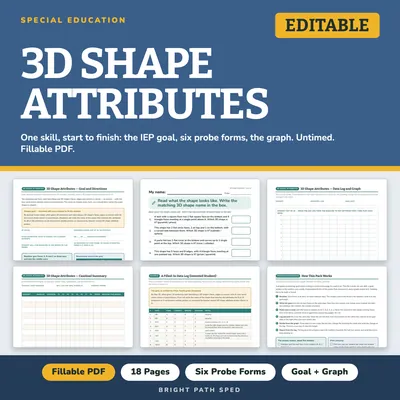
3D Shape Attributes (Faces/Edges/Vertices) Probes
$3.50 or with All-Access