Subtraction Facts Fluency Probes
- 23 pages
- 1st, 2nd, 3rd
$3.50
DownloadOr get it with All-Access: pick any 20 resources a month for $7.
New here? Your first month of All-Access is half off with code TEACHERTOK
Already bought this, or a member?
Instant download. One teacher's license: colleagues need their own copy. Each file carries a license number.
Also on Teachers Pay Teachers: see the Bright Path Sped store
About this resource
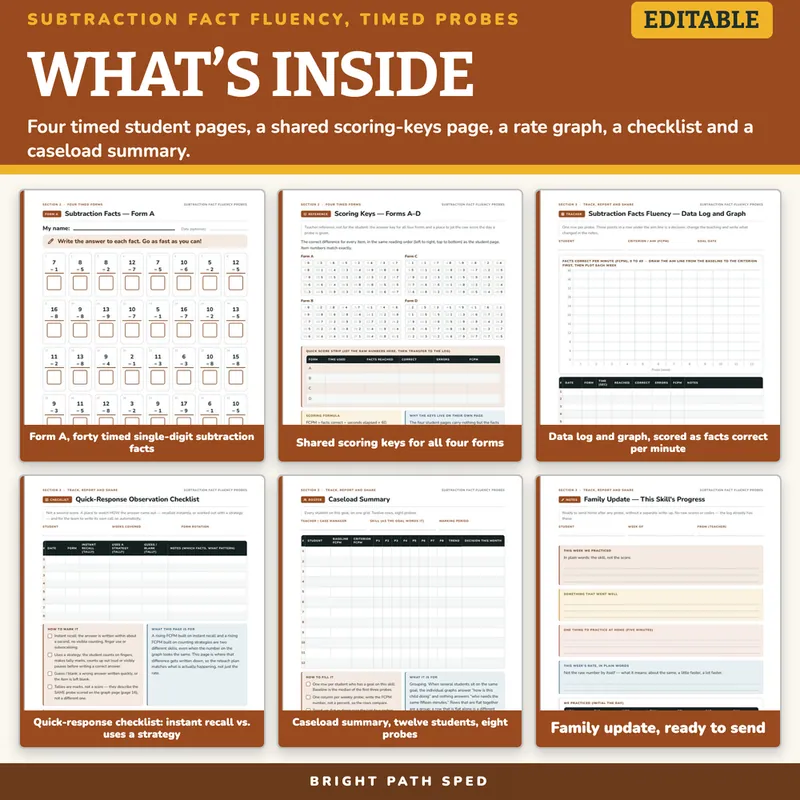
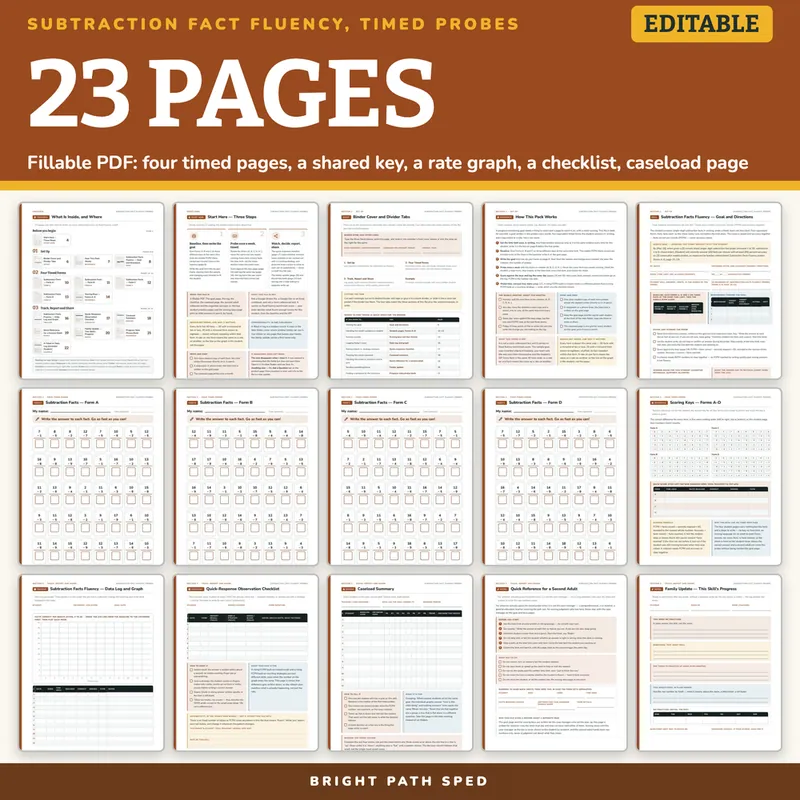
Everything inside: 23 pages · four timed student practice pages (40 subtraction facts each) · a shared scoring-keys page for all four forms · a data log and graph scored as facts correct per minute · a quick-response observation checklist · a caseload summary · a quick reference card for a second adult · a family update · a 19-starter phrase bank · a binder cover and 4 cut-out divider tabs · a worked, invented example.
WHAT IS INCLUDED — 23 pages, 392 type-in fields
Set Up
- Binder Cover and Divider Tabs — a spine/cover card, 4 cut-out tabs, and a 9-row "where to find things" index
- How This Pack Works — six numbered steps from baseline to weekly routine to reteach decision
- Subtraction Facts Fluency — Goal and Directions — a sample goal with a six-part fill-in frame, a 3-probe baseline table, a 3-row benchmark table, and scoring directions including the FCPM (facts correct per minute) formula
Four Timed Student Pages, Plus A Shared Key
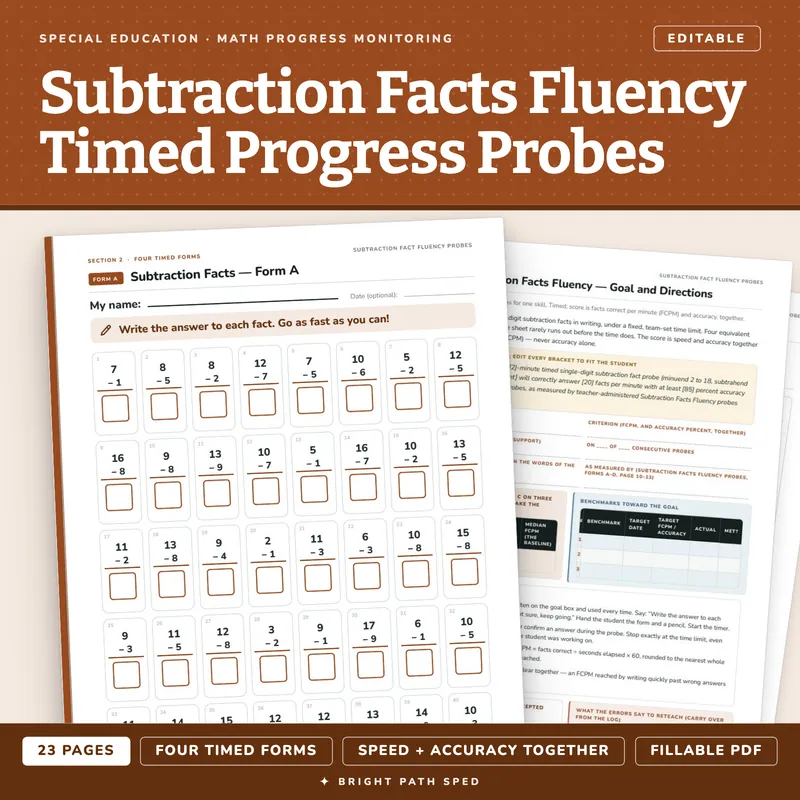
- Forms A-D — 40 single-digit subtraction facts each (20 with a minuend of 10 or less, 20 with a minuend of 11-18, minuend 2-18, answer always 1-9, no borrow-across-tens), mixed order, no exact fact repeated within a form, each page clean for the student: a "My name" line, one short instruction with a drawn pencil icon, and a handwriting-sized answer box next to every fact
- Scoring Keys — the correct difference for every item on all four forms, laid out in the same reading order as the student page, plus a quick score strip and the scoring formula — kept off the student page entirely
Track, Report And Share
- Subtraction Facts Fluency — Data Log and Graph — a 12-row log (date, form, time, reached, correct, errors, FCPM, notes) and a graph scaled 0-40 FCPM
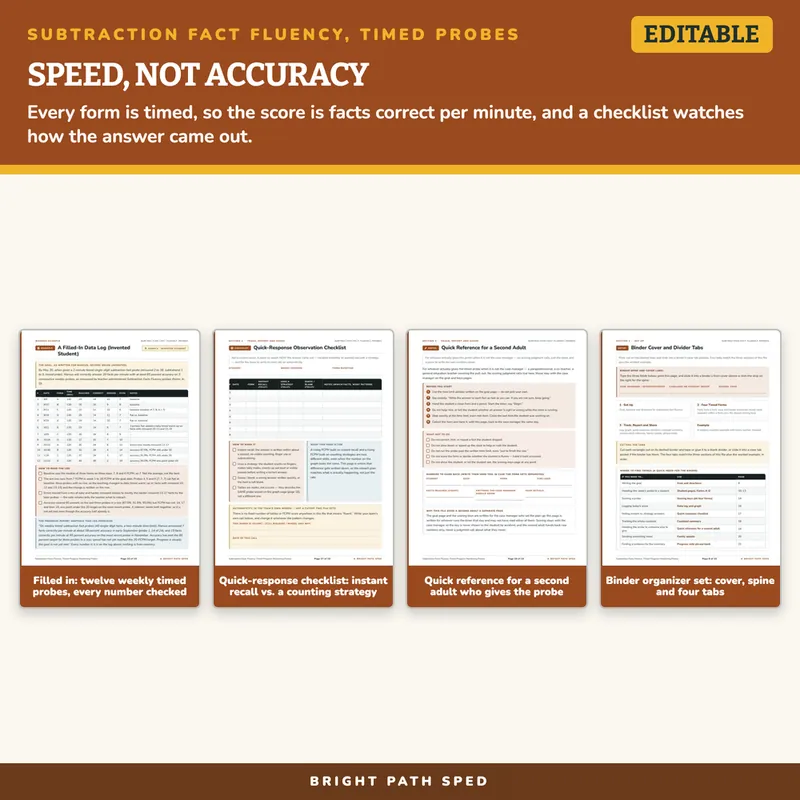
- Quick-Response Observation Checklist — an 8-row tally log (instant recall / uses a strategy / guess-blank) plus a write-in automaticity note — the team's own call, never a fixed cutoff
- Caseload Summary — 12 students by 8 probes, one decision column
- Quick Reference for a Second Adult — six numbered steps, a "what not to do" list, and a mini scoring strip to hand back, for whoever gives the probe when it is not the case manager
- Family Update — a ready-to-send communication page: what was practiced, one win, a home-practice idea, this week's rate in plain words, and a 7-day practiced table
- Progress Note Phrase Bank — 19 observable-language starters across 5 groups (speed/accuracy, pattern across probes, next steps, quarterly report sentence, caseload-wide)
- A Filled-In Data Log — a worked, invented example (Marcus, second grade) with 12 weekly timed probes, every FCPM and accuracy number checked against its own row
Plus a Start Here quick-start, a 3-section contents page with real page thumbnails, 3 section dividers, and a "what's next" back page.
What This Is, And What It Is Not
It is a fillable PDF. Open it in a PDF reader, click a field, type, Save As once per student. It works offline with no account or subscription. It is NOT a Google Sheets file, a Google Doc, or an Excel workbook, and it is not a norm-referenced test — it carries no fixed fluency benchmark score anywhere in the file. The four student practice pages and the scoring-keys page print; the goal page, log, checklist, caseload page, second-adult reference and organizer are type-in.
It is not the store's existing Addition Facts Fluency probes, which measure addition facts (sums 2-18) — this file measures subtraction facts instead (minuend 2-18, single-digit subtrahend, no borrow-across-tens, answer always 1-9). The two are built on the same timed, rate-scored shape and can be used together to build both facts across a year.
It is not a curriculum, and it is not a rule about how many facts per minute counts as "fluent." What fluent enough means for a given student is the team's own judgment, written in from the baseline and the IEP; this file never sets that number on its own — the quick-response checklist page is a blank the team fills in, by design. No age, eligibility or IDEA-timeline claim anywhere; no health data is pre-filled, and the example student (Marcus) is invented and named as such on page 22. Subtraction facts only (minuend 2-18, subtrahend 1-9, no borrow-across-tens), single operation — this first build does not cover addition, mixed operations or regrouping.
Who This Is For
Math interventionists, special education teachers and case managers who need a timed, repeatable way to track subtraction fact automaticity — not just whether the fact is right, but how fast and how it got there — plus a second, condensed page for whoever else gives the probe.
If You Want More
Addition Facts Fluency, Timed Progress Monitoring Probes Editable is the timed twin for addition facts — the same goal-log-graph shape, four forms, forty facts a form, scored as FCPM. Math Counting Fluency and Number Identification Speed Probes Editable is the same timed, rate-scored shape for counting and number identification, not fact fluency.
You might also need
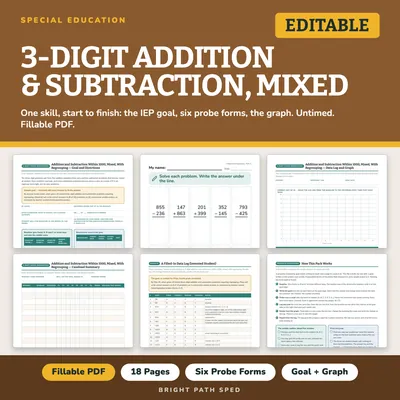
3-Digit Addition and Subtraction Mixed Regrouping Probes
$3.50 or with All-Access
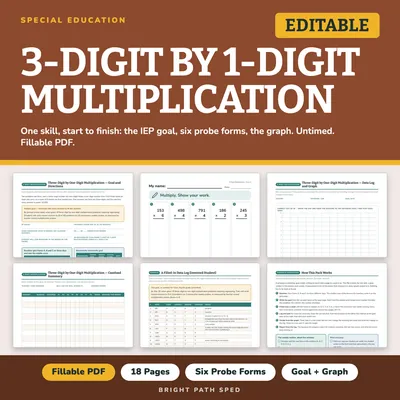
3-Digit by 1-Digit Multiplication Progress Monitoring Probes
$3.50 or with All-Access
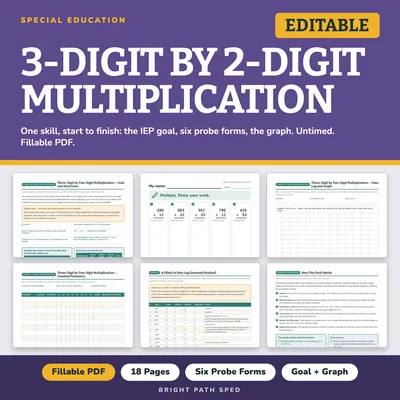
3-Digit by 2-Digit Multiplication Progress Monitoring Probes
$3.50 or with All-Access
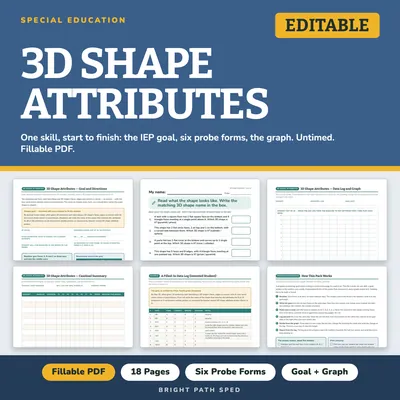
3D Shape Attributes (Faces/Edges/Vertices) Probes
$3.50 or with All-Access