Telling Time to the Nearest Minute Task Box
- 22 pages
- Not Grade Specific
$1.50 $3.00 on Teachers Pay Teachers
Half the Teachers Pay Teachers price. The same PDF, sold direct.
DownloadOr get it with All-Access: pick any 20 resources a month for $7.
New here? Your first month of All-Access is half off with code TEACHERTOK
Already bought this, or a member?
Instant download. One teacher's license: colleagues need their own copy. Each file carries a license number.
Also on Teachers Pay Teachers: see the Bright Path Sped store
About this resource
EVERYTHING INSIDE — 22 pages
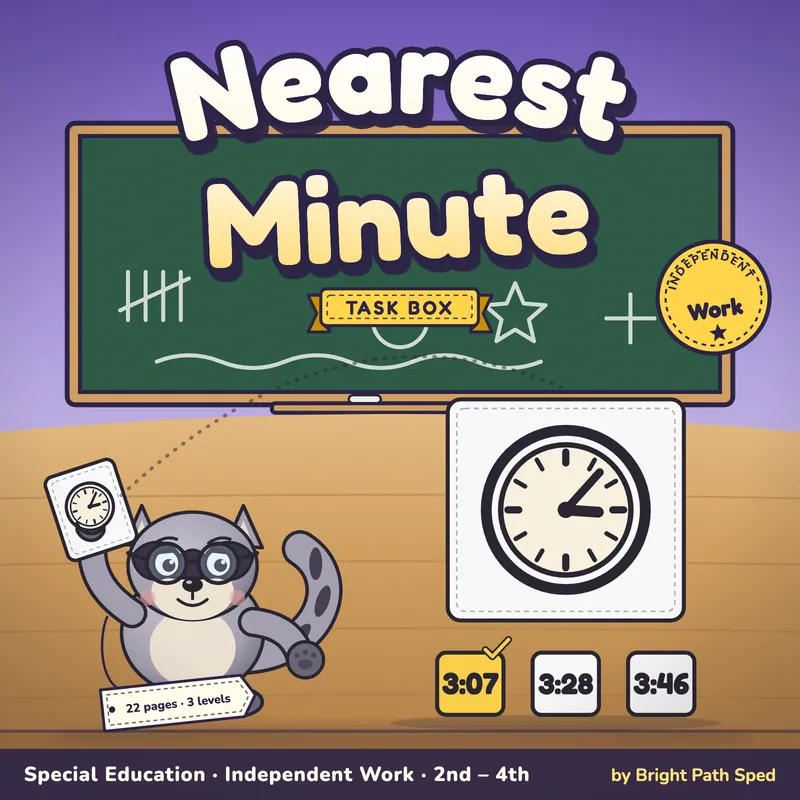
- 18 clock cards across 3 levels (6 cards each). Every card is a drawn analog clock with the numerals 1 to 12, a mark for every minute, a short thick hour hand and a long thin minute hand, over digital times such as 3:07, 8:23 and 11:38. The child reads the clock and marks the matching digital time. Every hour 1 through 12 is the hour of at least one card, every one of the 18 clock times falls between the fives, and all 18 are different
- Every card twice: tinted clock faces for a laminated classroom box, and black-and-white faces for the photocopier. Every clock is drawn in the file, so both hands sit exactly at the minute in both sets, and the two hands read apart by length and thickness, never by color alone
- A count-by-fives-then-ones strip (color and ink-saver): 12 clocks at minutes between the fives, each over its digital time with a caption such as "5 x 7 = 35, then 4 more"
- An answer key listing every card by level: the time the clock shows and every time printed on the card, the right one in bold
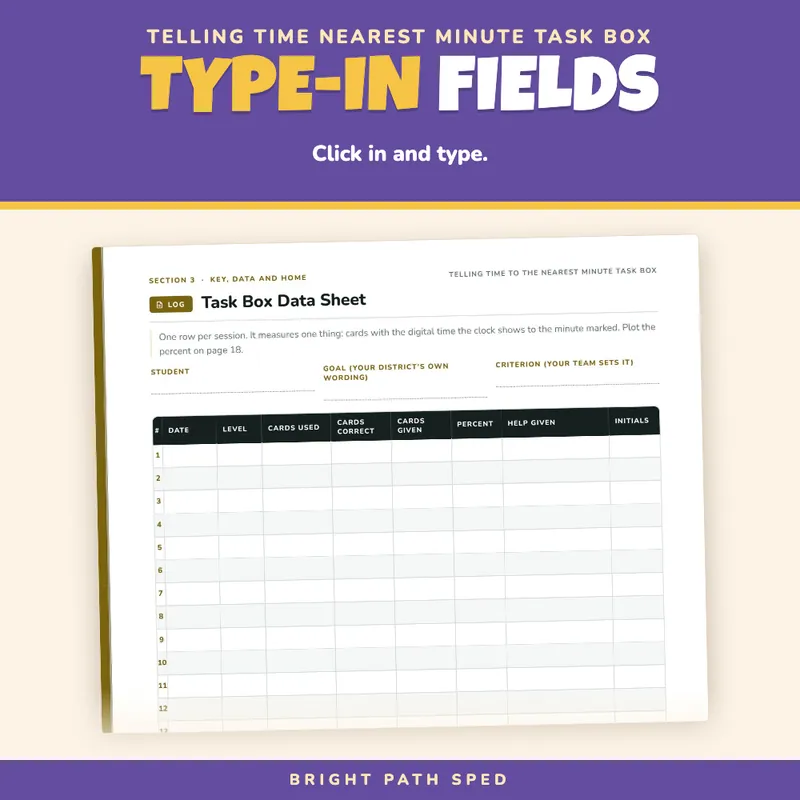
- A task box data sheet (16 rows: date, level, cards used, cards correct, cards given, percent, help given, initials)
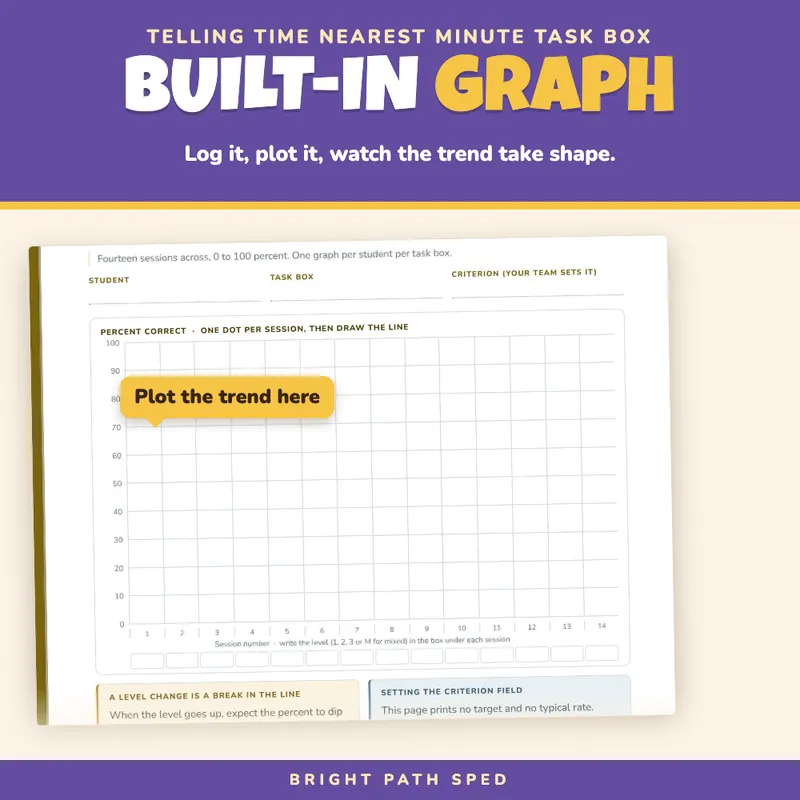
- A percent graph, 14 sessions across, with a level box under each session
- A filled example: an invented student, 8 sessions, every percent re-counted from its own row
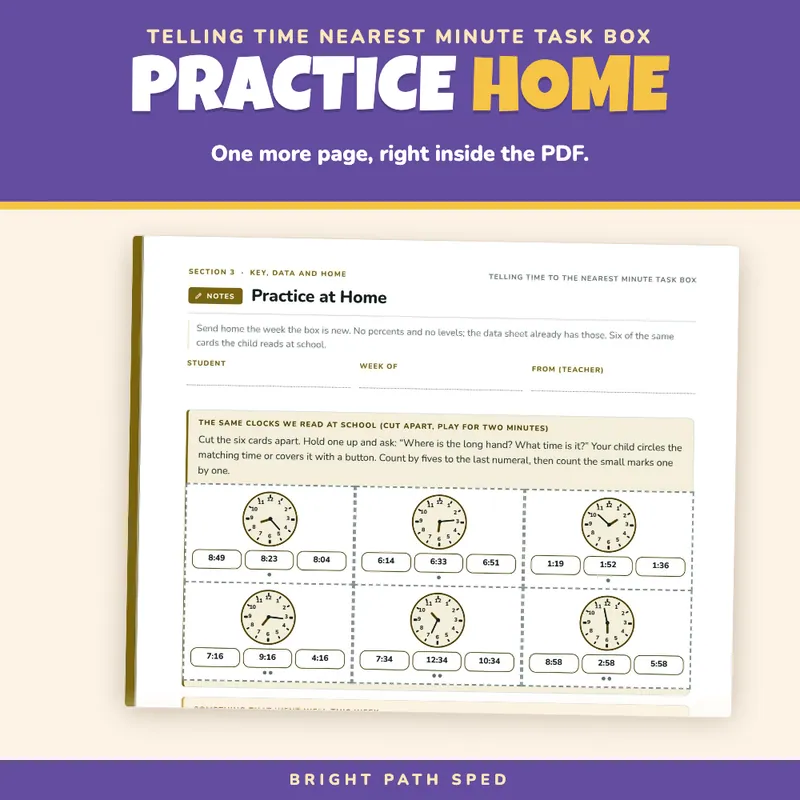
- A family practice page with six of the same cards, cut apart as one 3 x 2 grid
- A phrase bank: spoken lines for running the box and written starters for the note afterward, 25 lines in 6 groups
- Start Here, a contents page with page thumbnails, and a "what's next" back page
How To Use It, In Three Steps
1. Print and cut. Color set on cardstock or ink-saver set on plain paper; cut along the dashed lines, six cards a page. Keep each level in its own bag; the dots in the corner put a jumbled box back in order.
2. Run the cards. Hand over one card and use the same short words each time. The child counts by fives round the dial to the last numeral the long hand passed, counts the small marks one by one, reads the short hand for the hour, and marks the one digital time that matches.
3. Record and graph. Write cards correct and cards given on the data sheet, plot the percent on the graph, and send the family page home the week the box is new.
Three Levels, And The Difficulty Is Which Hand The Tiles Disagree About
- Level 1: 6 cards, 3 times each. Every time on a card has the same hour; only the minutes change, and every pair is at least 15 minutes apart on the dial. The child reads the long hand.
- Level 2: 6 cards, 3 times each. Every time on a card has the same minutes; only the hour changes, and every pair is at least two hours apart. The child reads the short hand.
- Level 3: 6 cards, 5 times each. Besides the right time, each card has one tile with the two hands read the wrong way round (4:17 read as 3:20), one tile with the next hour over and the same minutes, one tile with the right hour and minutes at least ten away, and one tile with the right hour and the minute just one or two off. Four misreadings children really make, one tile each.
The answer is never printed on the card.
DRAWN CLOCKS, ON PURPOSE. No emoji or clip-art clock can be set to an exact minute. Every clock in this file is drawn from code, so the short hand sits where it belongs past the hour, in both sets, and the ink-saver version is pure black line.
What This Is, And What It Is Not
It is a fillable PDF: type into the data sheet, the graph header, the family page and the example-style notes, or print and use a pen. The card pages and strip print on cardstock or plain paper and cut along dashed lines. It works offline with no account or subscription. It is NOT an editable online slideshow or word-processor document, and it is not a test of anything.
It reads times to the minute and nothing past it: no seconds, no elapsed time. It is not a telling-time curriculum: it carries no lesson sequence, no prompt order, no fading schedule and no mastery rule, and it does not decide what a percent means for a student or when to move up a level. The goal line and the criterion field are blanks for your district's own wording and your team's own number. It measures one thing: cards with the matching time marked.
Who This Is For
Special education teachers and paraprofessionals running independent work stations or task box rotations with students who already read five-minute times and are moving on to the exact minute, case managers who need that practice to show up as data, and the families who get the practice page sent home.
STARTING EARLIER? The Telling Time to the Nearest 5 Minutes Task Box is the step before this one, with the same cards-plus-data shape. The Half Hour and To the Hour task boxes come before that.
More In The Collection
This is one set in the Task Box Collection; more sort, counting and life-skills boxes are being added regularly, all on the same cards-plus-data shape.