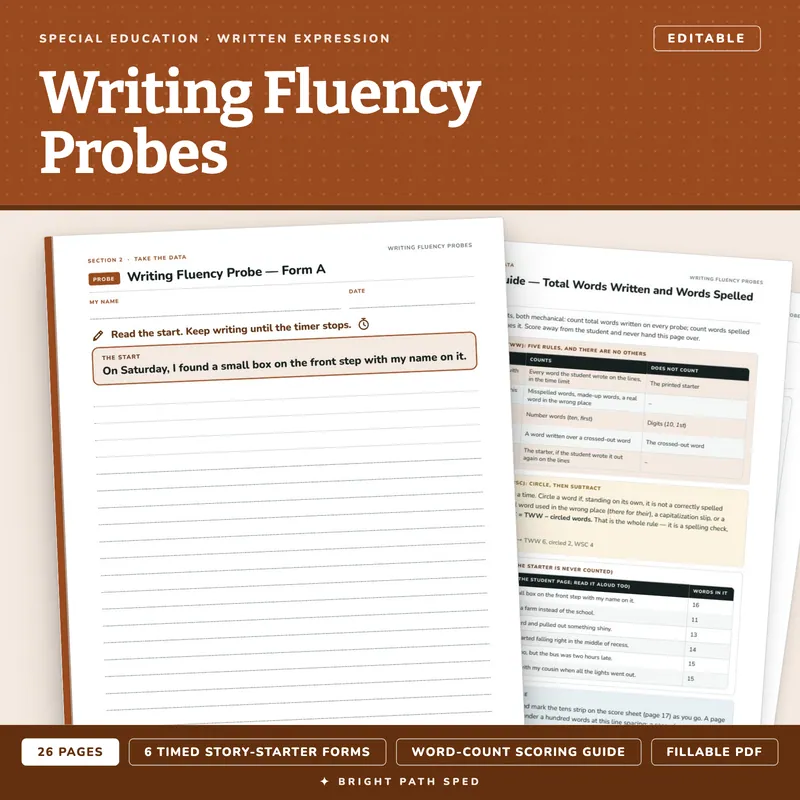
Writing Fluency Probes Editable
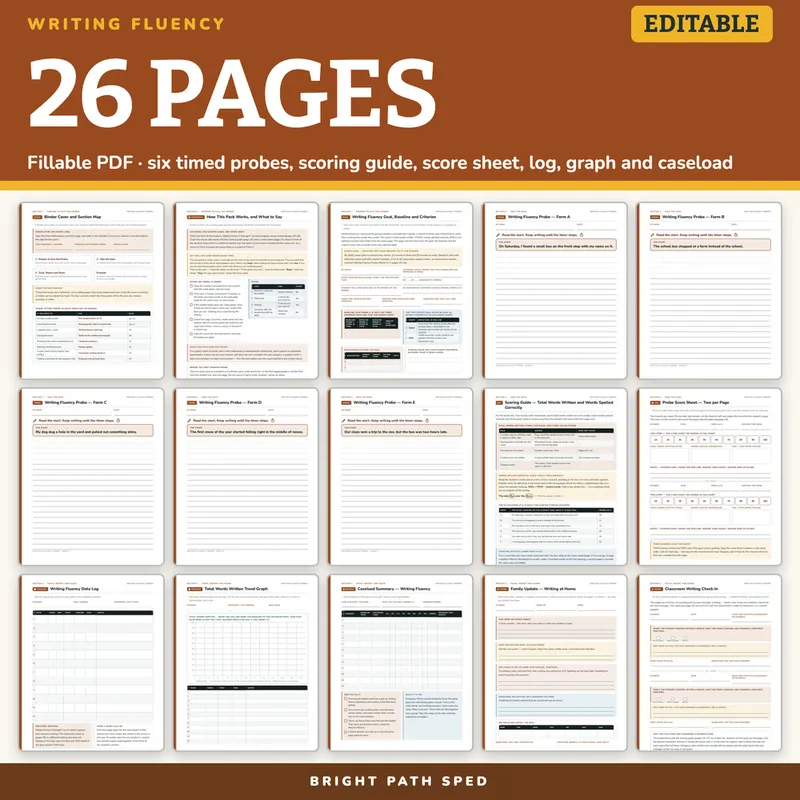
- 26 pages
- 2nd, 3rd, 4th, 5th, 6th
- PDF, fillable
$4.00
DownloadOr get it with All-Access: pick any 20 resources a month for $7.
New here? Your first month of All-Access is half off with code TEACHERTOK
Already bought this, or a member?
Instant download. One teacher's license: colleagues need their own copy. Each file carries a license number.
Also on Teachers Pay Teachers: see the Bright Path Sped store
About this resource
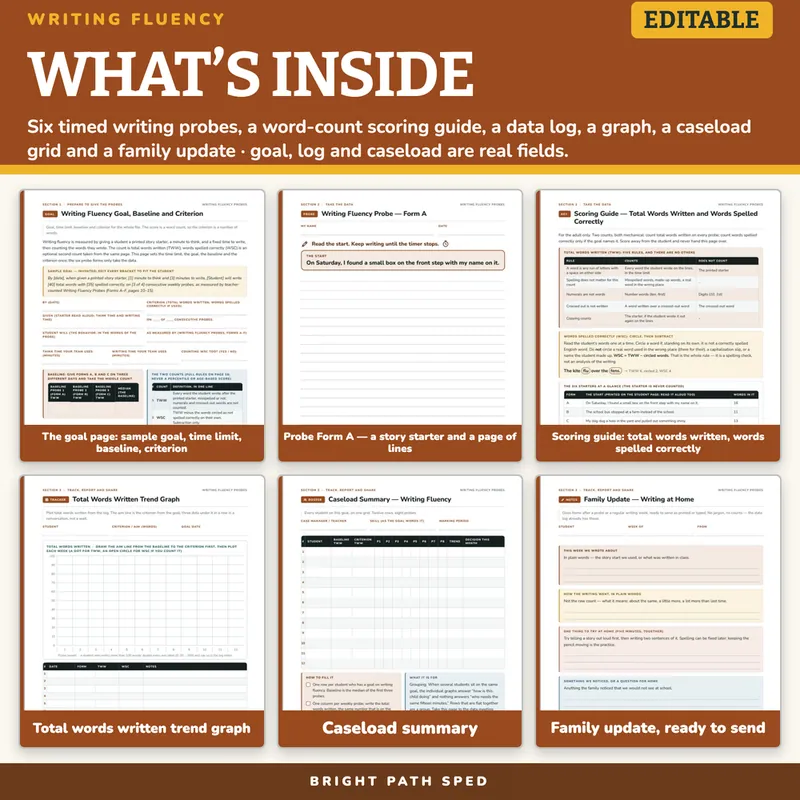
Everything inside: 26 pages · 6 timed writing probe forms, each a different invented story starter over 21 wide-ruled lines · a scoring guide that defines Total Words Written in five rules and Words Spelled Correctly in one · a probe score sheet (two per page, with a tens strip) · a 12-row data log · a trend graph scaled in words · a caseload summary (12 students by 8 probes) · a ready-to-send family update · a classroom writing check-in (a second setting) · a 17-starter phrase bank · a binder cover and 4-section binder map · a worked, invented example whose writing sample is counted word by word on the page.
A written-expression IEP goal needs a number that two adults would count the same way. This file gives the student a printed story starter, a minute to think and a fixed writing time (three minutes as written; a blank on the goal page for your team's own times), then the adult counts the words on a separate teacher page. Total Words Written (TWW) is a plain count: every word the student wrote after the starter, misspelled or not; numerals and crossed-out words do not count; the printed starter does not count. Words Spelled Correctly (WSC) is optional and is subtraction only: circle each word that is not a correctly spelled word standing on its own, then WSC = TWW minus the circled words. Nothing on the student's page is scored in front of them.
WHAT IS INCLUDED — 26 pages, 536 type-in fields
Prepare To Give The Probes
- Binder Cover and Section Map — a spine/cover card, a 4-box section reference (not a cutting page), and an 8-row "where to find things" index
- How This Pack Works, and What to Say — the exact script to read every time, a 5-step order for giving a probe, a 4-row timing table (think time, writing time, counting), what the pack does not decide, and a note on giving one practice run before the first logged probe
- Writing Fluency Goal, Baseline and Criterion — a sample IEP-style goal (invented, every bracket editable), blanks for your team's think time and writing time, a baseline table (median of the first three probes), the two counts defined in one line each, and a 2-row benchmark table
Take The Data
- Six Probe Forms (A–F) — each a clean, student-facing page: a big "My name" line, one kid-worded instruction with a pencil and a timer glyph ("Read the start. Keep writing until the timer stops."), the story starter in a rounded box, and 21 wide-ruled lines — no goal text, no scoring, no adult directions on this page
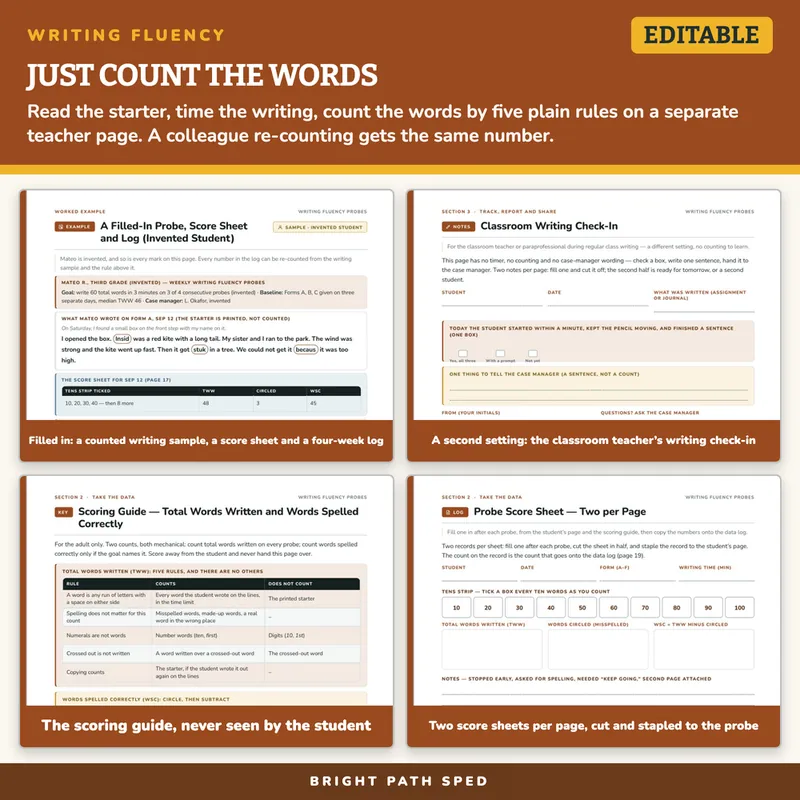
- Scoring Guide — one adult-only page: the five TWW rules in a counts / does-not-count table, the WSC circle-and-subtract rule with a worked six-word mini-count, all six starters at a glance with their word counts, and a tip for counting without losing your place
- Probe Score Sheet — two records per page, cut and stapled to the probe: student/date/form/time, a tens strip (tick a box every ten words), three tall count boxes (TWW, circled, WSC) and two note lines
Track, Report And Share
- Writing Fluency Data Log — 12 dated rows: form, minutes, TWW, circled, WSC, notes
- Total Words Written Trend Graph — a 0–100 words grid (with the rule for a student who writes more) plus a 12-row log table
- Caseload Summary — 12 students by 8 probes, baseline and criterion TWW, trend and decision columns
- Family Update — Writing at Home — a ready-to-send communication page: what was written about, how it went in plain words, a five-minute practice idea, and a 7-day practiced table
- Classroom Writing Check-In — two half-page notes per sheet, cut apart: one box (started within a minute, kept the pencil moving, finished a sentence), one sentence, no timer and no counting, for the general education teacher or paraprofessional during regular class writing (a different setting from the six timed probes)
- Progress Note Phrase Bank — 17 observable-language starters across 5 groups (total words written, spelling in the sample, the pattern across probes, next steps, the quarterly-report sentence), every one ending in a blank pulled from a data sheet in the file
- A Filled-In Probe, Score Sheet and Log — a worked, invented example (Mateo R., third grade): his Form A writing sample printed with the three circled words, counted to 48 words and 45 spelled correctly on the page, the score sheet for that probe, and a 4-row log where every WSC is the subtraction shown
Plus a Start Here quick-start, a 3-section contents page with real page thumbnails, 3 section dividers, and a "what's next" back page.
What This Is, And What It Is Not
It is a fillable PDF. Open it in a PDF reader, click a field, type, save. It works offline with no account or subscription. It is NOT a Google Sheets file, a Google Doc, or an Excel workbook, and it does not count the words for you. The six probe forms print cleanly for the student to write directly on.
It is a plain count of words. It is not a norm-referenced or standardized writing test, it carries no published benchmarks or growth rates, and it is not a grade-level placement tool. It does not set a criterion, a time limit, or sort a student into any category — every one of those is a blank line for your team. It does not score ideas, organization, grammar, or handwriting; Words Spelled Correctly is a spelling check by subtraction, not an analysis of the writing.
Every story starter is invented, mundane and narrative (a box on the step, a bus that stops at a farm, a dog and something shiny, the first snow at recess, a late zoo bus, a board game when the lights go out). No age, eligibility or IDEA-timeline claim anywhere; no health data is pre-filled, and the example student (Mateo) is invented and named as such on page 25.
Who This Is For
Special education teachers, case managers, writing interventionists and the paraprofessionals who give the weekly probe: anyone with a written-expression goal that needs a number a colleague could re-count and get the same answer.
If You Want More
Capitalization and Punctuation Editing Progress Monitoring Probes and Subject-Verb Agreement Editing Progress Monitoring Probes measure sentence mechanics, one rule at a time, for a goal that names conventions. Handwriting Fluency and Motor Skill Progress Monitoring Probes measures timed letter and word copying, the motor side of getting words onto a page. Spelling: Fry Third Hundred Progress Monitoring Probes scores dictated spelling word by word.
You might also need
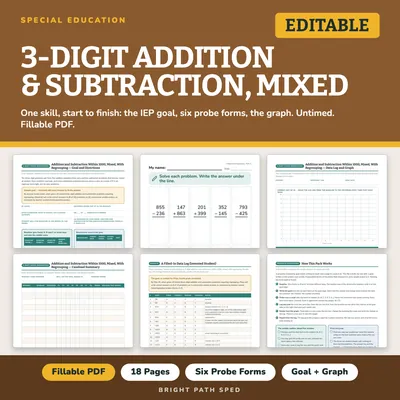
3-Digit Addition and Subtraction Mixed Regrouping Probes
$3.50 or with All-Access
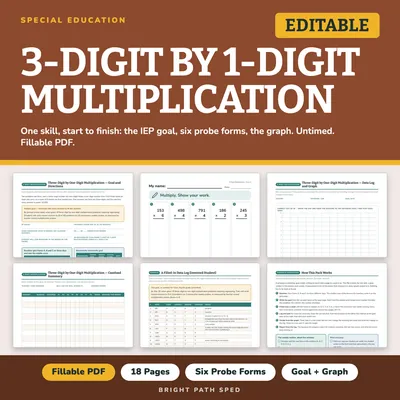
3-Digit by 1-Digit Multiplication Progress Monitoring Probes
$3.50 or with All-Access
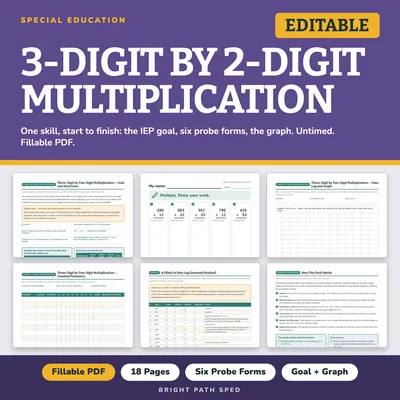
3-Digit by 2-Digit Multiplication Progress Monitoring Probes
$3.50 or with All-Access
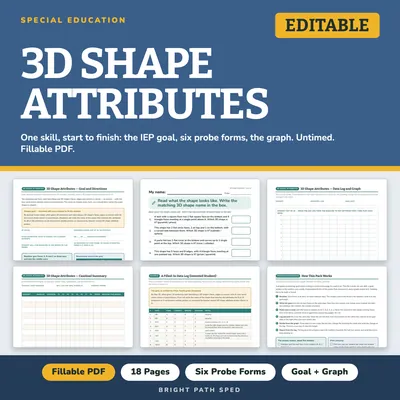
3D Shape Attributes (Faces/Edges/Vertices) Probes
$3.50 or with All-Access