AAC Data Collection Sheets Editable
- 20 pages
- Not Grade Specific
- PDF, fillable
$5.00
DownloadOr get it with All-Access: pick any 20 resources a month for $7.
New here? Your first month of All-Access is half off with code TEACHERTOK
Already bought this, or a member?
Instant download. One teacher's license: colleagues need their own copy. Each file carries a license number.
Also on Teachers Pay Teachers: see the Bright Path Sped store
About this resource
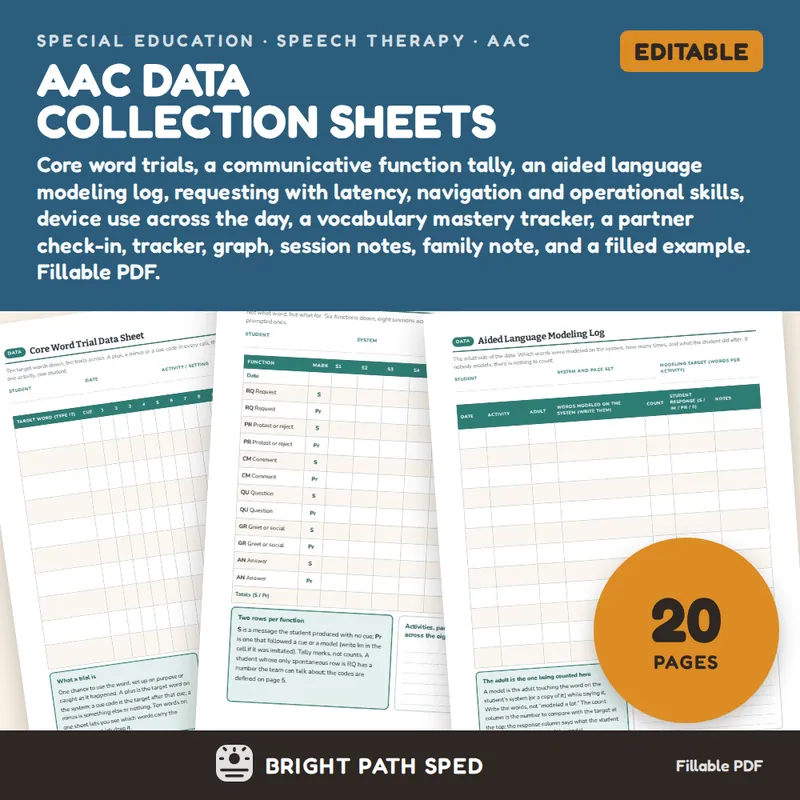
Every data sheet a student who uses AAC needs, in one fillable PDF: core word trials, a communicative function tally, an aided language modeling log for the adults, requesting with latency, navigation and operational skills, device use across the day, a vocabulary mastery tracker, a communication partner check-in for the classroom, a tracker and graph, session notes, a family note with eight words to practice, and a filled-in example. Type the roster, the target words and the headers once, Save As per student, pen the marks beside the device.
Systems are named generically throughout: a core board, a speech-generating device, a communication book. No product or app is named, so the sheets fit whatever your students use.
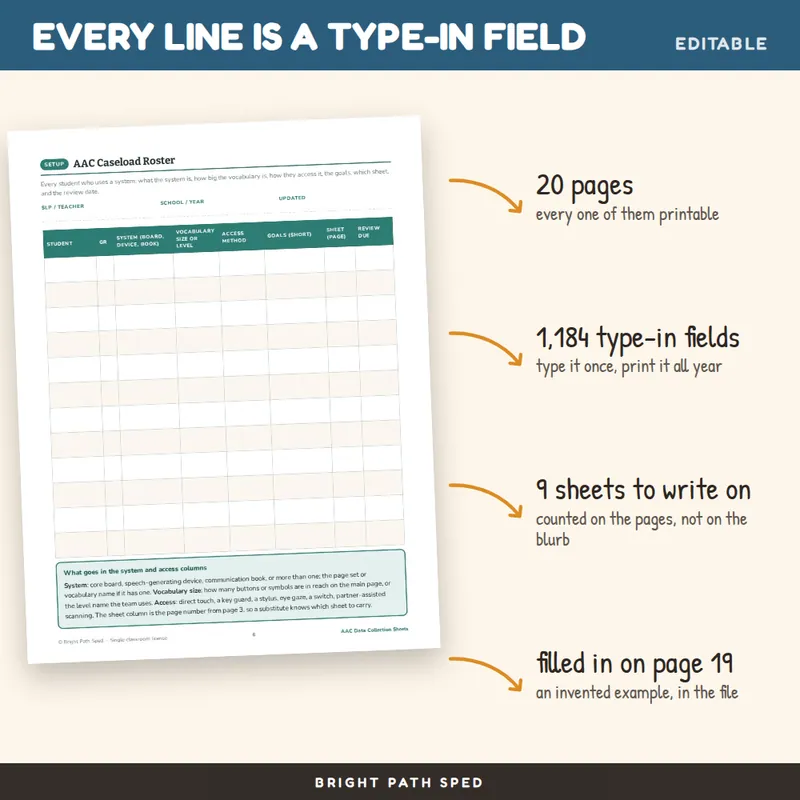
WHAT IS INCLUDED - 20 pages, 1184 type-in fields
Setup
- Which Sheet for Which AAC Goal - a chooser that matches the goal's wording (requesting, core words, functions, navigation, modeling counts, device access) to the sheet that counts it, and a table of how the paper moves each session, day and week
- How the Type-In Fields Work - one page, so nobody emails you
- Code Key - six cue levels, seven response marks (spontaneous, prompted, imitated, modeled by an adult, error, no response, not given), and six communicative function codes (request, protest, comment, question, greet, answer) with a type-in column for what each looks like for your students
- AAC Caseload Roster - 12 rows: system, vocabulary size or level, access method, goals, which sheet, review date
Eight Data Sheets
- Core Word Trial Data Sheet - 10 target words you type by 10 trials, a cue column, the count and the percent
- Communicative Function Tally - six functions down, each with a spontaneous row and a prompted row, by 8 sessions, with totals
- Aided Language Modeling Log - 12 rows for the adult: activity, words modeled on the system, the count, and what the student did after
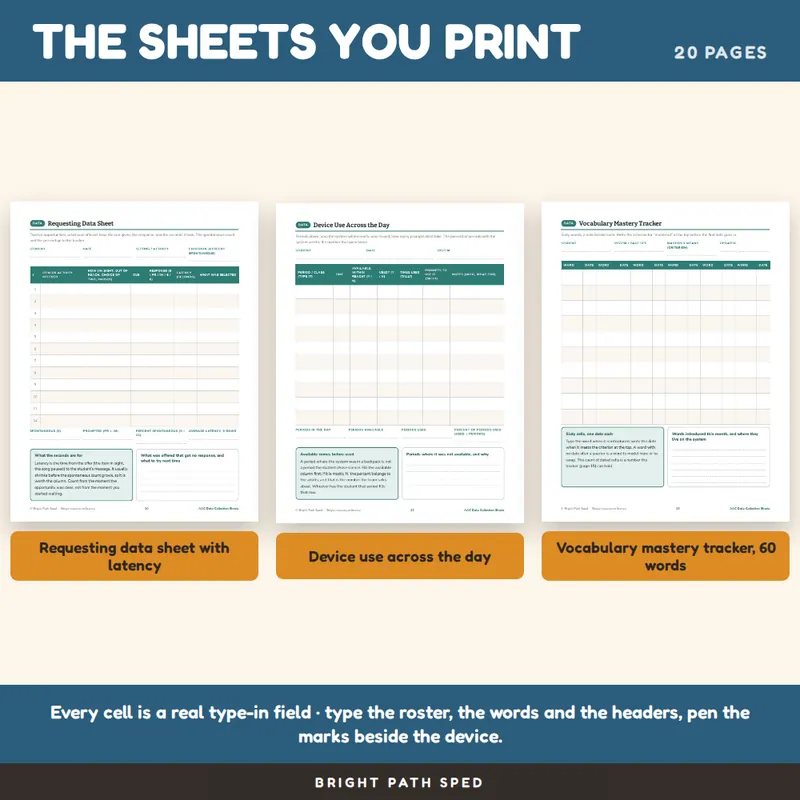
- Requesting Data Sheet - 12 opportunities: what was offered, how, the cue, the response, latency in seconds, what was selected; spontaneous count, prompted count and percent at the foot
- Navigation and Operational Skills Sheet - 12 skills you type (turn on, find a page, clear, volume) by 6 sessions with a cue code in every cell
- Device Use Across the Day - 10 periods: available, used, times used, prompts, notes, and the percent of periods used
- Vocabulary Mastery Tracker - 60 word cells in a six-by-ten grid, a date cell beside each, the criterion for mastered at the top
- Communication Partner Check-In - five days for the teacher or para: I modeled, I waited, the student responded, notes, and a reply line
Tracking, Notes And Home
- Cumulative Tracker - 36 sessions in three blocks: date, measure, score
- Progress Graph - twelve sessions, 0 to 100 labeled as percent of opportunities or words per session, a date and score row
- Session Notes - two per page: targeted, words modeled, the data, the response, the plan
- Family Note and Home Practice - what we are working on in plain words, how it went, eight words to say and touch together, one thing to try, a week of initials, a reply line
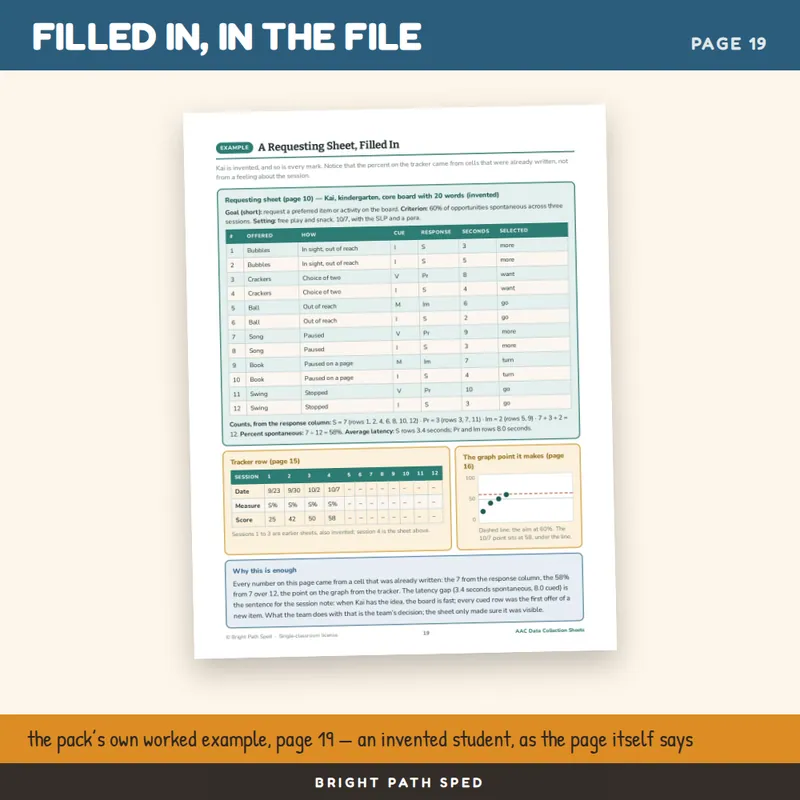
- A filled-in example for an invented kindergartener: a requesting sheet with 12 opportunities, the counts and the percent worked from the response column, the tracker row and the graph point it produces
What This Is, And What It Is Not
It is a fillable PDF. Open it in a PDF reader, click a line, a box or a cell, type, press Tab to move on, and Save As once per student. It works offline with no account or subscription. It is NOT a Google Sheets file, a Google Doc or an Excel workbook, and it does not calculate percents or draw the graph.
It is not a vocabulary set, a device manual or a therapy program. Nothing in it says which words to teach first, which cue to use, or what counts as mastery; you write those in from the IEP and your own judgment. The sheets make sure the count gets written down the same way by every adult who works with the student.
Who This Is For
School SLPs with students who use AAC, special education teachers and case managers with an AAC goal on the caseload, the paraprofessionals who model all day and take the data, and general education teachers handed a communication partner check-in for one week.