Animal Names and Sounds Picture Cards
- 25 pages
- Not Grade Specific
$3.50
DownloadOr get it with All-Access: pick any 20 resources a month for $7.
New here? Your first month of All-Access is half off with code TEACHERTOK
Already bought this, or a member?
Instant download. One teacher's license: colleagues need their own copy. Each file carries a license number.
Also on Teachers Pay Teachers: see the Bright Path Sped store
About this resource
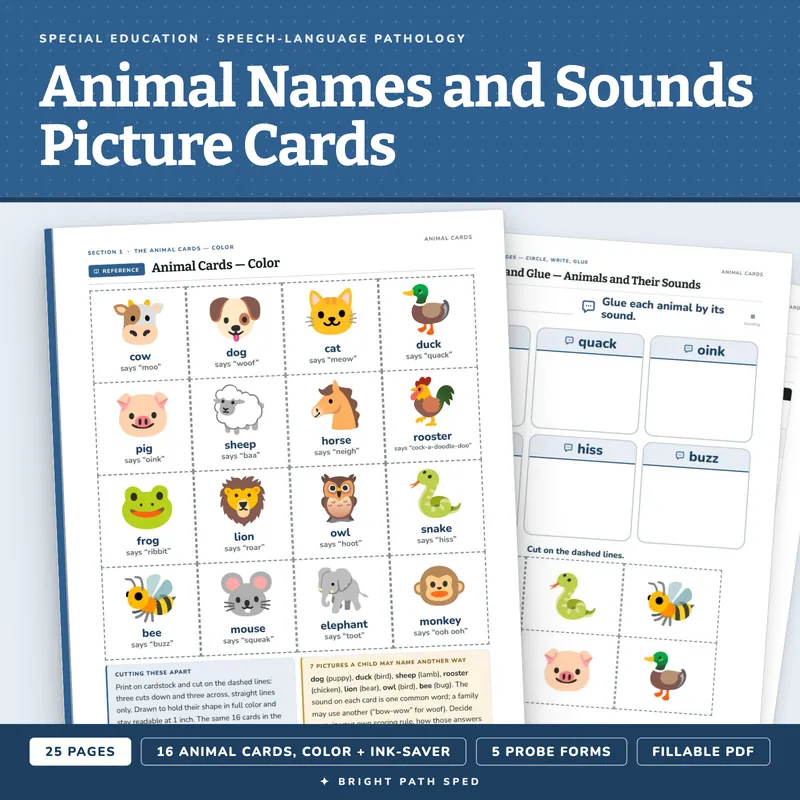
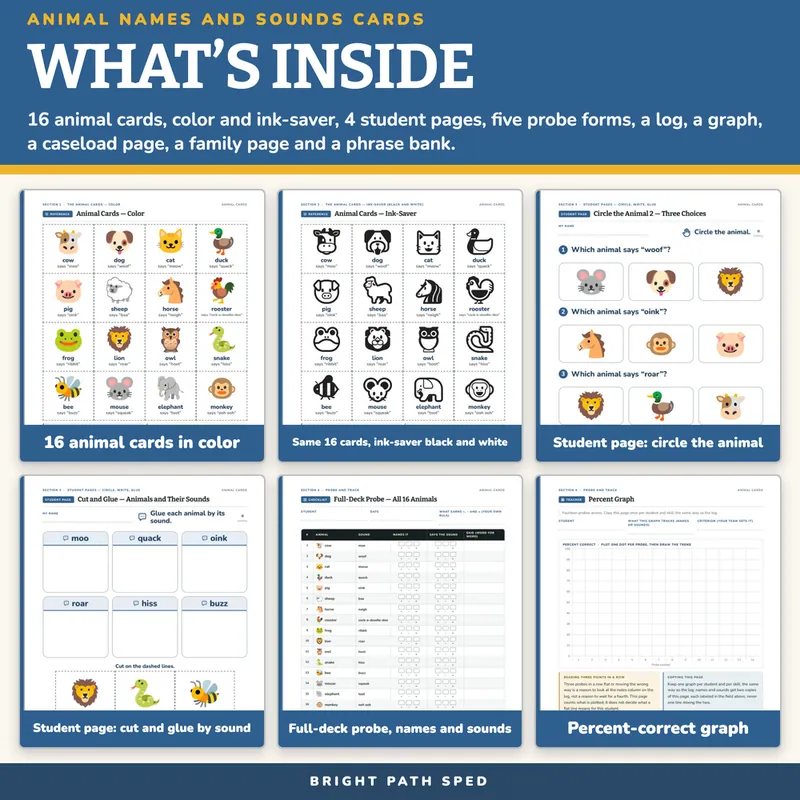
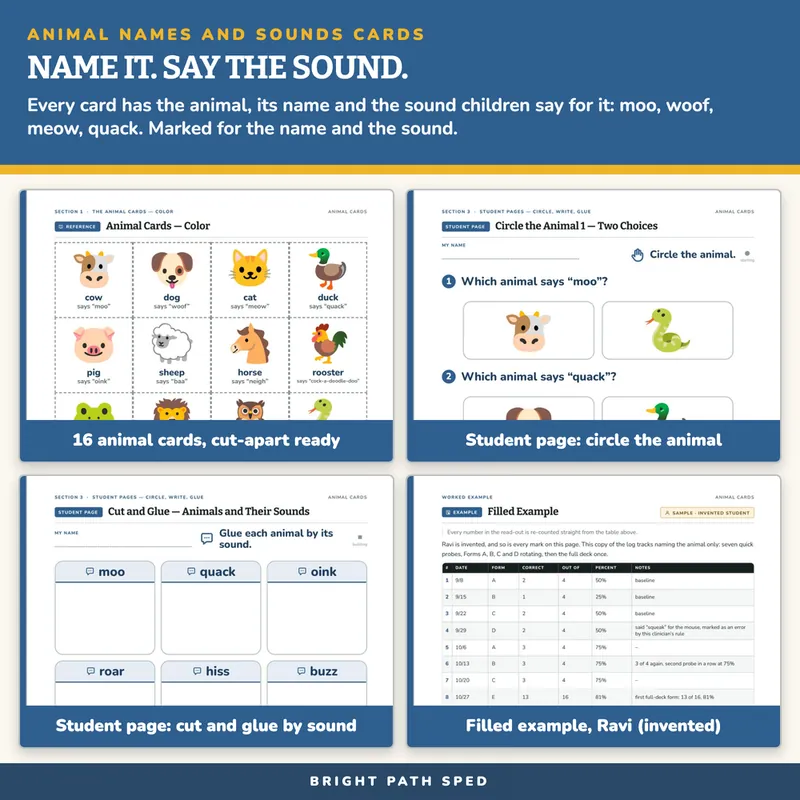
One big card for every animal: the picture, its name, and the sound children say for it. Sixteen cut-apart cards (cow says "moo," dog says "woof," cat says "meow," duck says "quack," and twelve more), each in full color and again in ink-saver black and white. The file also has four student pages a child can work on with a pencil and glue, five probe forms that mark the animal's name and its sound separately, and a log, graph and caseload page. The file never decides what counts as a correct name or sound; that stays your own scoring rule.
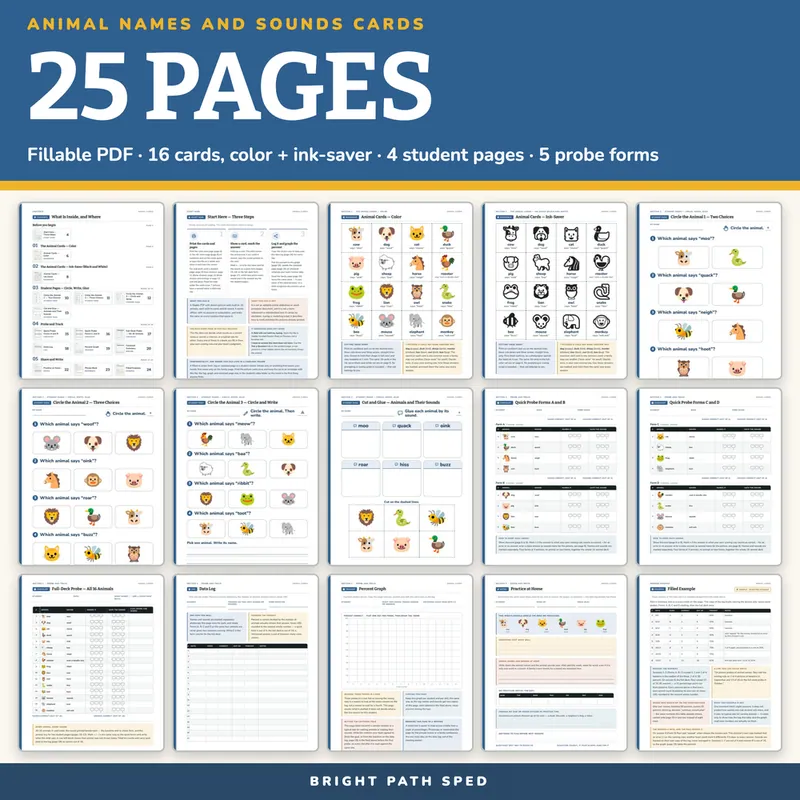
WHAT IS INCLUDED -- 25 pages, 459 type-in fields
The Animal Cards
- 16 animal cards in full color: cow, dog, cat, duck, pig, sheep, horse, rooster, frog, lion, owl, snake, bee, mouse, elephant, monkey. Each card is a big cut-apart piece laid edge to edge in a 4-across, 4-down grid, so cutting is a few straight lines
- The same 16 cards again as an ink-saver set in pure black outlines, for the photocopier
- The sound on each card is one common word (moo, woof, meow, quack, oink, baa, neigh, cock-a-doodle-doo, ribbit, roar, hoot, hiss, buzz, squeak, toot, ooh ooh). A note under the cards names the 7 pictures a child may name another way (dog, duck, sheep, rooster, lion, owl, bee) so you can decide once how to mark them
Student Pages
- 3 "Circle the Animal" pages with a My name line, one short instruction and big pictures to circle: two choices (4 questions), three choices (4 questions), and three choices plus two primary writing lines for writing an animal's name (4 questions)
- 1 cut-and-glue page: a sound in each of six boxes, six animals cut from a strip of touching pieces, and the child glues each animal by its sound
- The answers are on the full-deck probe page
Probe And Track
- 4 quick probe forms (A, B, C, D), 4 animals each, no animal on two forms -- together the whole 16-animal deck. Each animal is marked for the name and for the sound
- Full-Deck Probe -- all 16 animals in card order with the sound beside each, a mark for the name, a mark for the sound, and a column for what the child said, word for word
- Data Log -- 17 rows: date, form, correct, out of, percent, notes
- Percent Graph -- 14 probes across, 0-100 percent grid, a field for the team's own criterion
- Caseload Summary -- 16 rows: student, names or sounds, baseline, current, trend, decision
Share And Write
- Practice at Home -- a family update built from six of the same pictures used in session, a weekly practice table, and lines to write down the animal names and sounds a child said at home, in the family's own words
- Phrase Bank -- 20 observable-language starters across 5 groups (accuracy, what was said, carryover, the log and graph, the caseload page)
- Filled Example -- an invented student, eight sessions, every percent re-counted from its own row
What This Is, And What It Is Not
It is a fillable PDF: type into the log, graph, caseload page, family page, and probe-form headers, or print and use a pen. It works offline with no account or subscription. It is NOT an editable online slideshow or word-processor document, and it is not a norm-referenced or standardized test. It is a picture-card and data set for animal names and sounds; it is not a farm or zoo matching binder, and it has no story and no hook-and-loop pieces.
It carries no elicitation, cueing or modeling script. It does not decide what counts as a correct name or sound, a criterion, or a typical rate for either -- every one of those is your own call, written once and reused every session. Pictures replace the printed word list a child cannot yet read; they do not replace your scoring rule.
Who This Is For
Speech-language pathologists, special education teachers and paraprofessionals with young or pre-reading students who are working on first words, and the families who get the practice page sent home.
Pictures: Noto Emoji by Google, Apache License 2.0 (color); Fluent Emoji by Microsoft, MIT License (ink-saver black and white).