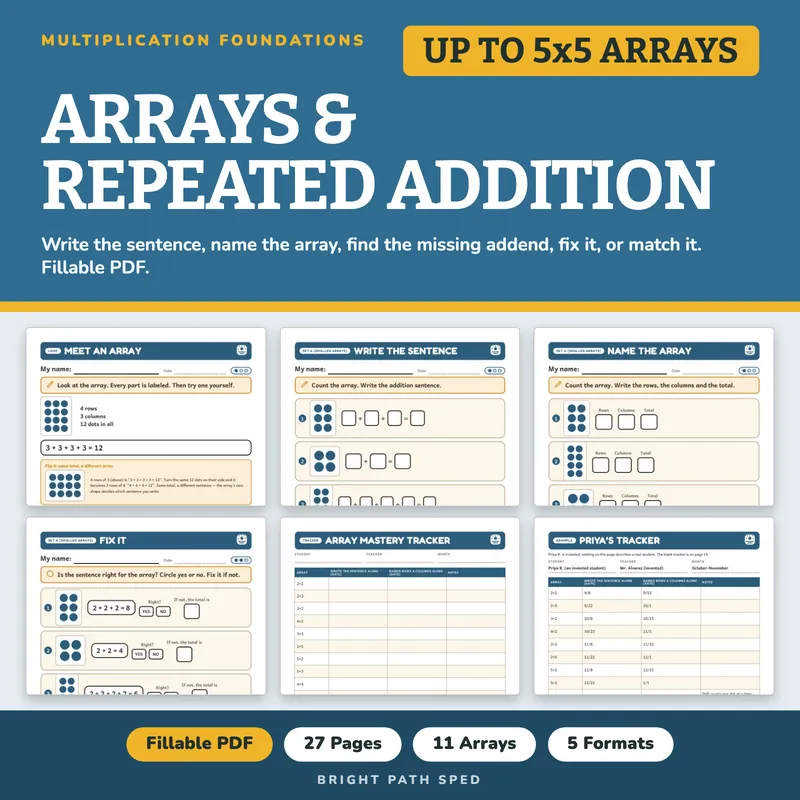
Arrays and Repeated Addition Worksheets
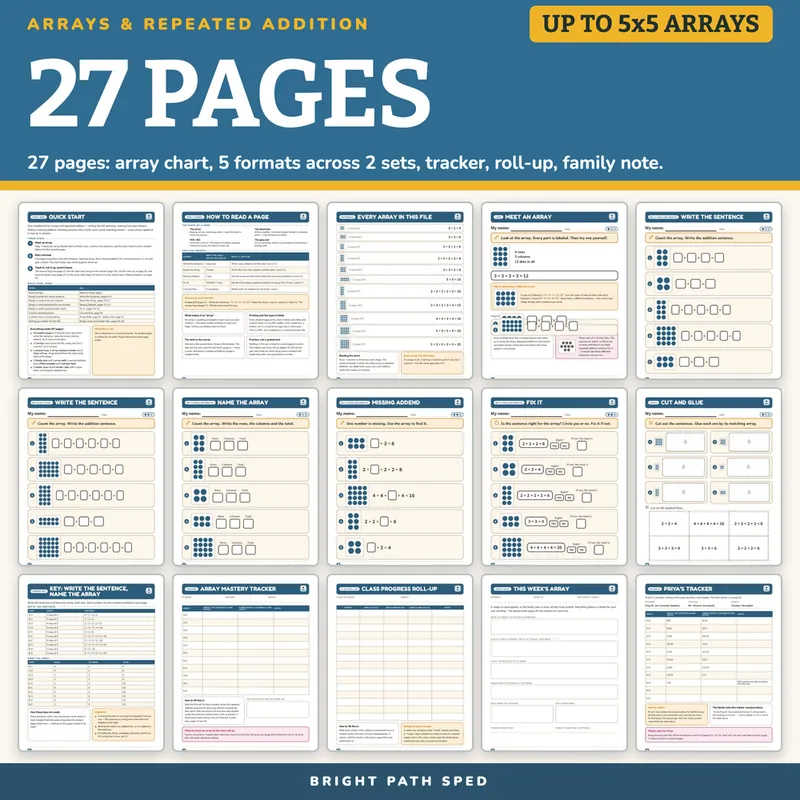
- 27 pages
- K, 1st, 2nd
$2.00 $4.00 on Teachers Pay Teachers
Half the Teachers Pay Teachers price. The same PDF, sold direct.
DownloadOr get it with All-Access: pick any 20 resources a month for $7.
New here? Your first month of All-Access is half off with code TEACHERTOK
Already bought this, or a member?
Instant download. One teacher's license: colleagues need their own copy. Each file carries a license number.
Also on Teachers Pay Teachers: see the Bright Path Sped store
About this resource
A dot array on its own does not teach repeated addition — a complete kit shows a student how to
read rows and columns as the same fact written as addition, in five genuinely different ways, with
the record-keeping already built in. This is a complete kit for arrays and repeated addition, K-2:
one labeled worked array, five practice formats across two leveled sets, an array-mastery tracker,
a class roll-up, a family note and a real-world array walk, so nothing has to be written from
scratch.
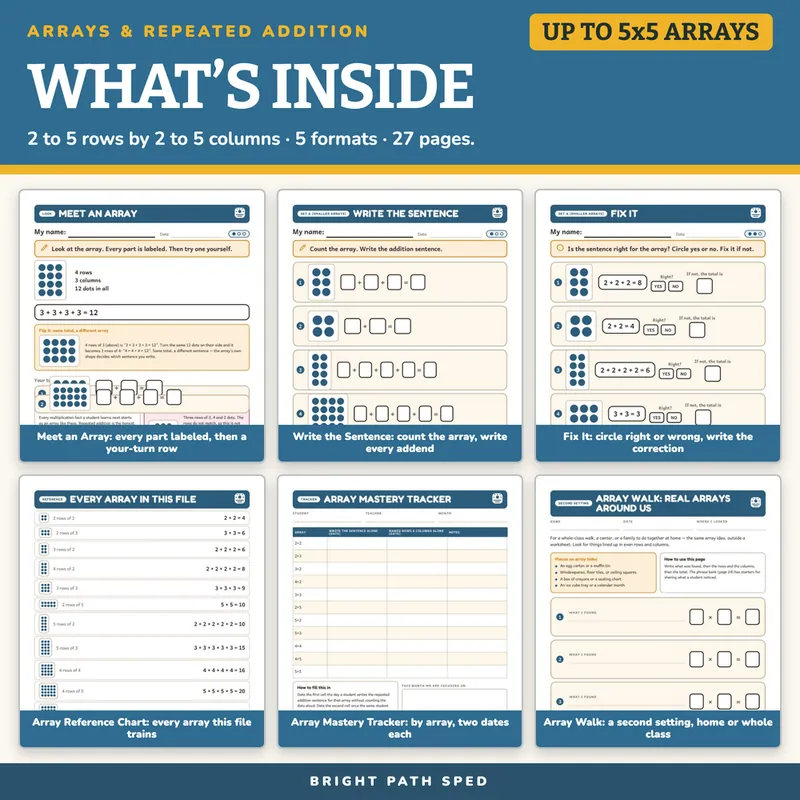
EVERYTHING INSIDE (27 pages)
- 1 Array Reference Chart: every array this file trains, smallest to largest, each beside its own
repeated addition sentence
- 1 Meet an Array page: one array labeled rows, columns, sentence and total, a "flip it" comparison
showing the same total written as a different sentence, a non-example of what is NOT an array, and
a first try
- 8 student pages in 4 leveled formats, two sets each (Set A: smaller arrays; Set B: up to 5x5):
Write the Sentence (every addend and the total), Name the Array (rows, columns, total), Missing
Addend (work backward from the total), and Fix It (circle right or wrong, write the correction)
- 1 Cut and Glue matching review: 6 arrays, 6 cut sentences, glue each to its match
- 11 unique arrays used across the file, every one checked against the pool's own 5x5 cap
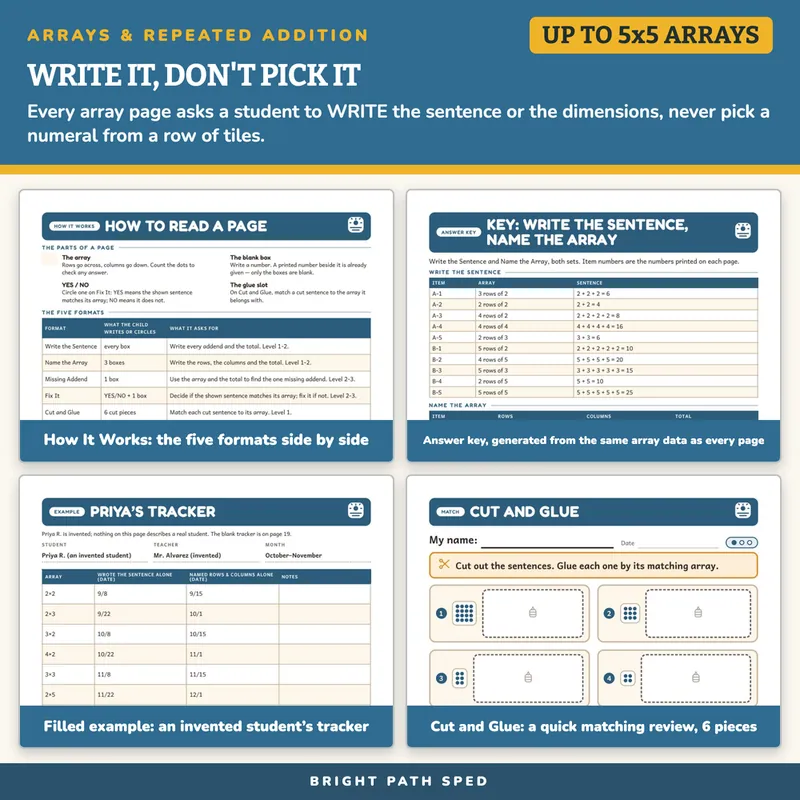
- 2 answer keys, generated from the same array data as the student pages
- 1 array-mastery tracker (wrote the sentence alone / named rows and columns alone, by array) and 1
whole-class progress roll-up (by array size)
- 1 family note (a ready-to-send update) and 1 Array Walk (a different setting — a whole-class or
home scavenger page, not individual seatwork)
- 1 filled example (an invented student), 1 phrase bank (14 observable-language starters), 1 binder
cover, and 5 divider tabs with a spine label to cut out
- Start Here, a how-to-read-a-page page, and a contents page that gives every page number
The Five Formats, Easiest To Hardest
1. Write the Sentence (starting-building) — the array only; write every addend and the total.
2. Name the Array (starting-building) — the array only; write the rows, the columns and the total.
3. Missing Addend (building-stretching) — most of the sentence is already there; use the array and
the total to find the one missing number.
4. Fix It (building-stretching) — a shown sentence may or may not match its array; circle right or
wrong, and write the correct total if it is wrong.
5. Cut and Glue (starting, review) — match each of 6 cut sentences to the array it belongs with.
Built For The Child Holding The Page
A big "My name" line, one short instruction, large rounded letters, real room to write, and dots
(not words) to show which level a page is. Nothing on a student page is written for an adult.
Every Number Is Generated, Never Typed
Every array, sentence, total and missing addend on every page — practice page, answer key, tracker
and filled example alike — is computed from the same (rows, columns) data at build time. Nothing is
hand-typed, so the pages and the keys can never drift apart.
Type In, Or Print
The name and date lines, the tracker, the class roll-up, the family note and the array walk are
type-in fields in any PDF reader. The numbers a student writes are pencil work. This is a fillable
PDF; it is not a Google Slides or PowerPoint file.
Who This Is For
Kindergarten through 2nd grade classrooms, self-contained and resource rooms, and any teacher
building early multiplication foundations before the times symbol is introduced. The Array Walk
sends the same idea to a whole-class center or home; the family note sends it home in writing.
What This Is, And What It Is Not
An array-and-repeated-addition worksheet set with the record-keeping around it. It is not a timed
test, a screener, a clinical or diagnostic tool, or a claim about any student's age or rate of
progress. There is no IEP goal language or eligibility wording anywhere in the file.