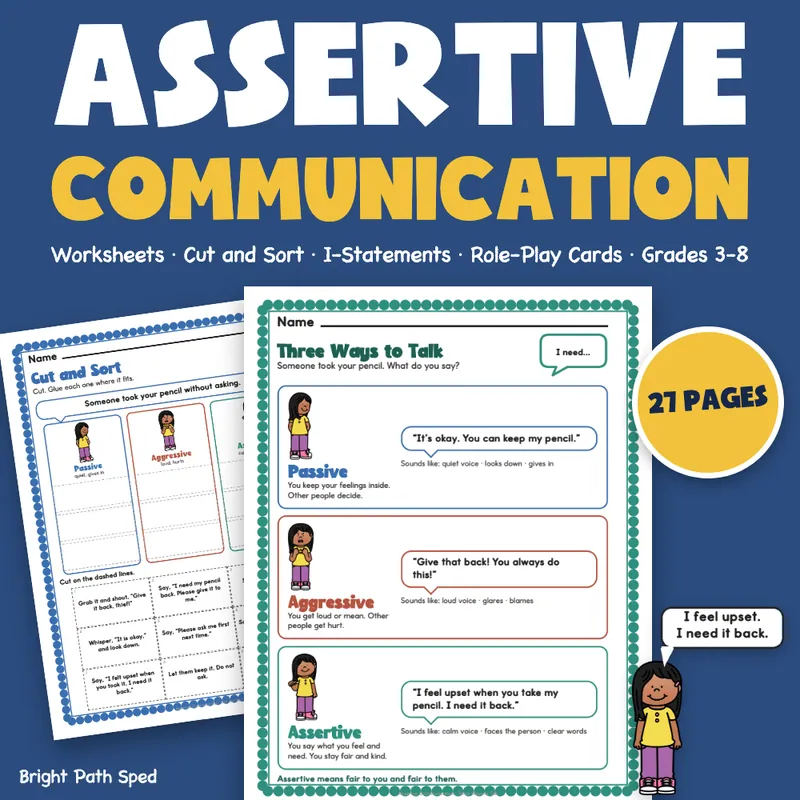
Assertive Communication Worksheets
- 27 pages
- 3rd, 4th, 5th, 6th, 7th, 8th
$2.00 $4.00 on Teachers Pay Teachers
Half the Teachers Pay Teachers price. The same PDF, sold direct.
DownloadOr get it with All-Access: pick any 20 resources a month for $7.
New here? Your first month of All-Access is half off with code TEACHERTOK
Already bought this, or a member?
Instant download. One teacher's license: colleagues need their own copy. Each file carries a license number.
Also on Teachers Pay Teachers: see the Bright Path Sped store
About this resource
Teaching passive, aggressive and assertive communication usually means making the sort, the frames and the role-play cards yourself. This pack has them ready: cut-and-sort pages, I-statement frames, ways to say no, 16 role-play cards, a practice log and a filled example. One friendly kid guide, clean pages, big type and speech bubbles, with every story and name invented.
EVERYTHING INSIDE (27 pages)
- A page that explains the three ways to talk with one situation said three ways (passive, aggressive, assertive).
- A voice, face and body chart (words only) with a check list the student fills in.
- Name That Style: 10 statements, and the student marks passive, aggressive or assertive.
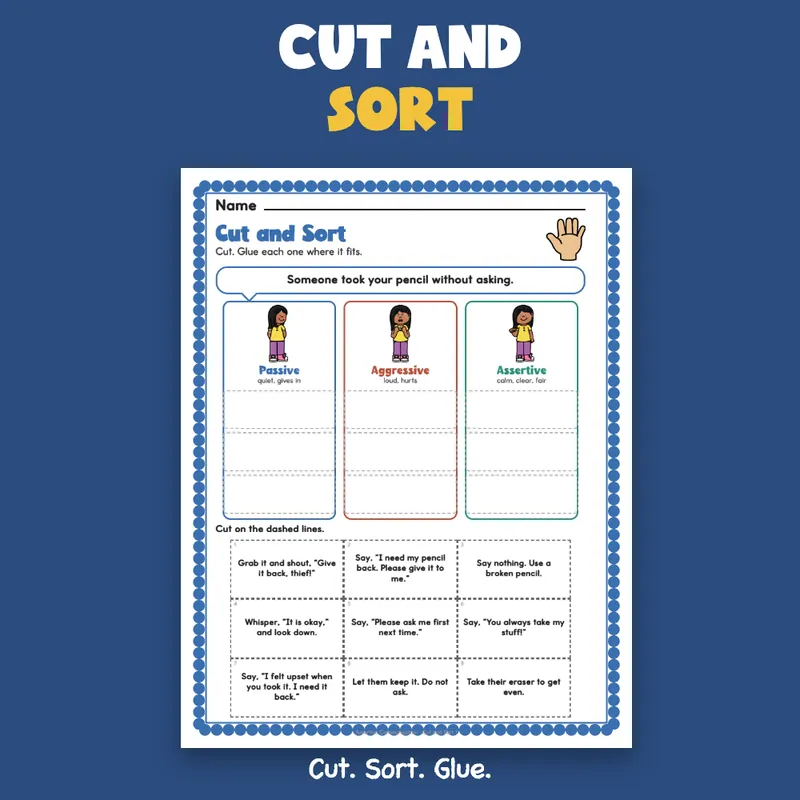
- 3 cut-and-sort pages with 9 strips each (27 strips in all). The student cuts the strips and glues each one under Passive, Aggressive or Assertive.
- 2 Say It Three Ways pages: write a passive, an aggressive and an assertive answer to a new situation.
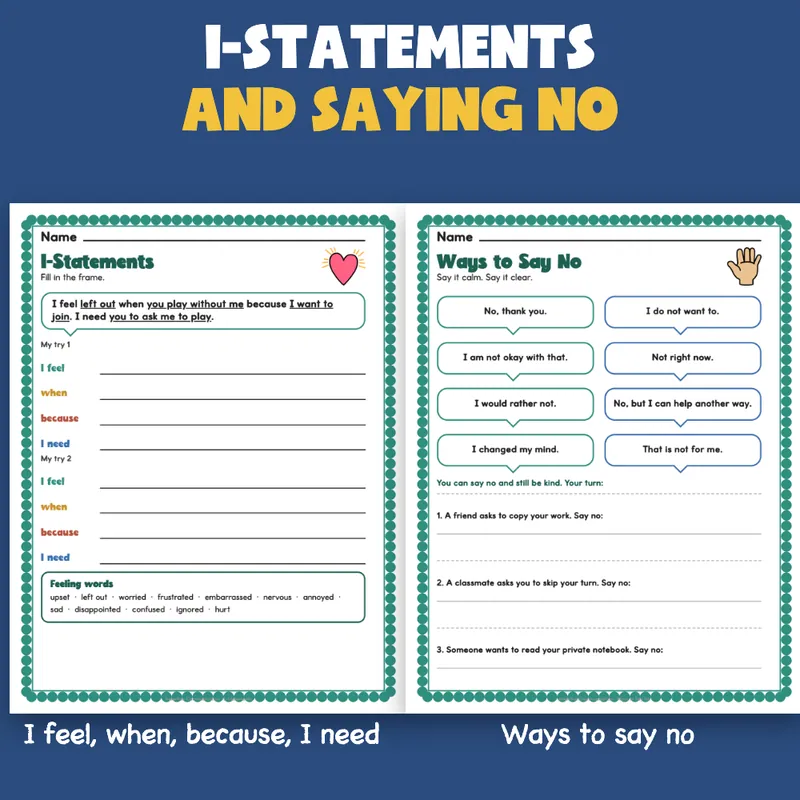
- An I-statement frame page (I feel ___ when ___ because ___. I need ___.) with a feeling-word bank and room for two tries.
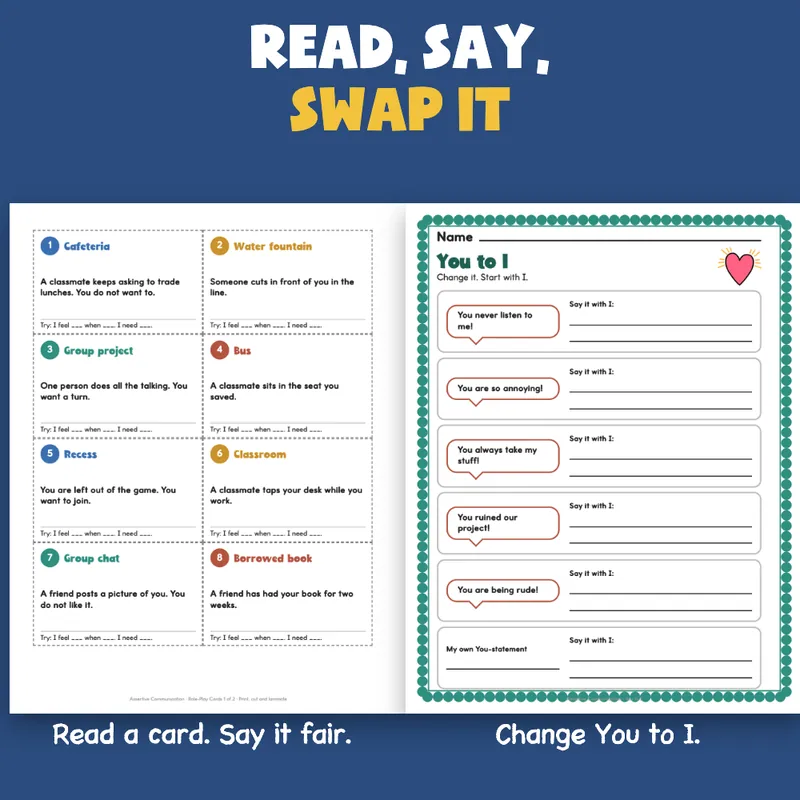
- A You to I page: turn 5 You-statements into I-statements, plus a row for your own.
- 16 role-play scenario cards on 2 pages (8 per page), everyday school and peer situations, to print, cut and laminate.
- A role-play plan page, a ways-to-say-no page (8 speech bubbles of ways to say no, plus 3 to try), and a My Talk Check reflection page.
- A phrase bank with 6 lists of starters and words, and a practice log with 10 rows and a count box.
- A filled-in practice log for an invented student, with the counts worked out.
- A family note and team handoff page, teacher notes with the answer key, a binder cover with 6 divider tabs.
- Start Here, a pack-at-a-glance page, terms of use, a What's Next page and a credits page.
How To Use It
Start with the explainer page and the voice, face and body chart. Then name the style, sort the strips, and write each situation three ways. Build I-statements with the frame, then act out the cards in pairs and log the practice. Use one page a day or the whole set over a few weeks. Type into the boxes in any PDF reader, or print the pages and write by hand. Print at 100 percent with fit-to-page turned off.
Built For The Student
Every student page has a name line, one short instruction, big type and room to write. The cut-and-sort strips are big, in a grid, so there are few cuts.
Type In, Or Print
This is a fillable PDF. It is not a Google Slides, Google Docs or PowerPoint file. The boxes work in Adobe Acrobat Reader, Preview and browser PDF viewers, offline.
Who This Is For
School counselors, special education teachers, general education teachers and paraprofessionals who teach assertive communication to students in grades 3-8, and families who practice at home.
What This Is, And What It Is Not
A practice and record set for talking skills. It is not a test, a screening or a counseling program. It has no scores to compare against and does not label any student. It does not replace the plan or advice of a school counselor or other licensed professional. Your own training, your school's rules and your team decide what the log means; there are blank lines for them.