Beginning Sounds Picture Worksheets A-Z
- 39 pages
- Kindergarten, 1st
$4.00
DownloadOr get it with All-Access: pick any 20 resources a month for $7.
New here? Your first month of All-Access is half off with code TEACHERTOK
Already bought this, or a member?
Instant download. One teacher's license: colleagues need their own copy. Each file carries a license number.
Also on Teachers Pay Teachers: see the Bright Path Sped store
About this resource
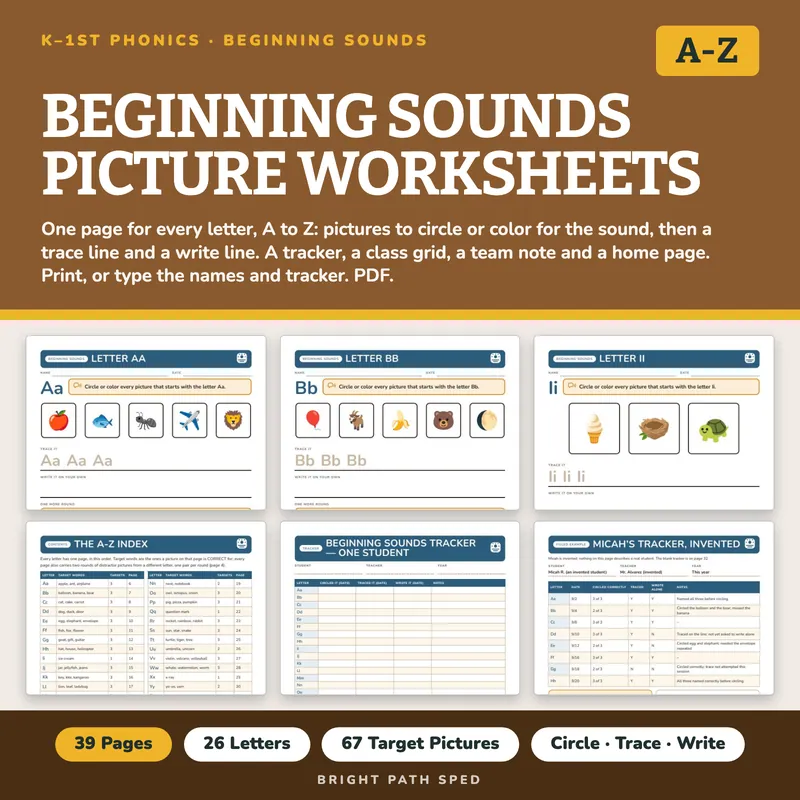
Twenty-six letters, twenty-six pages: a picture set to circle or color for the sound, a light trace of
the letter, a blank line to write it alone, then a second round with a fresh set of pictures and two
more lines to write more words.
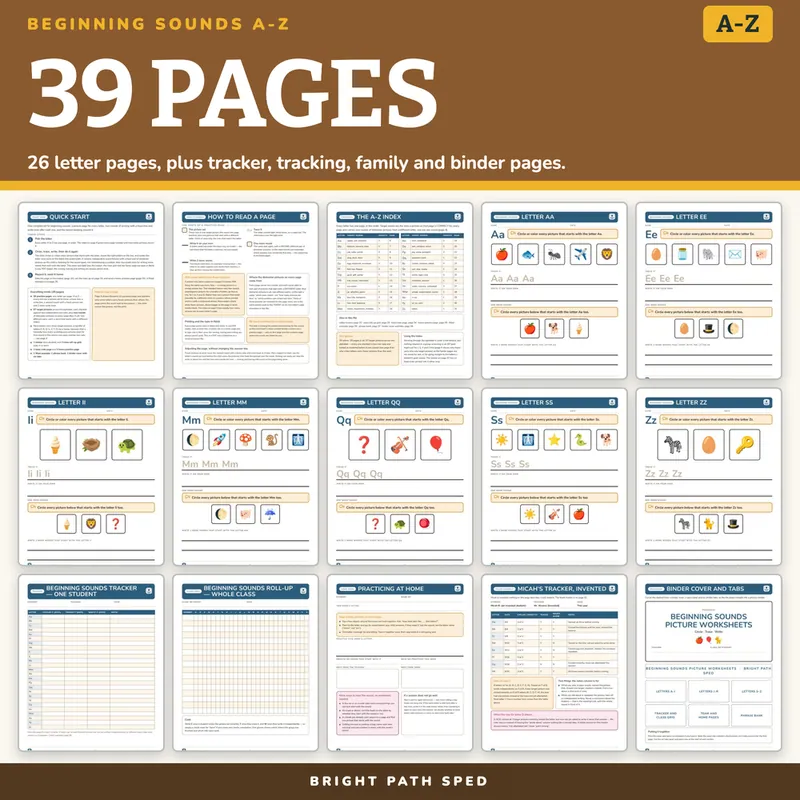
EVERYTHING INSIDE (39 pages)
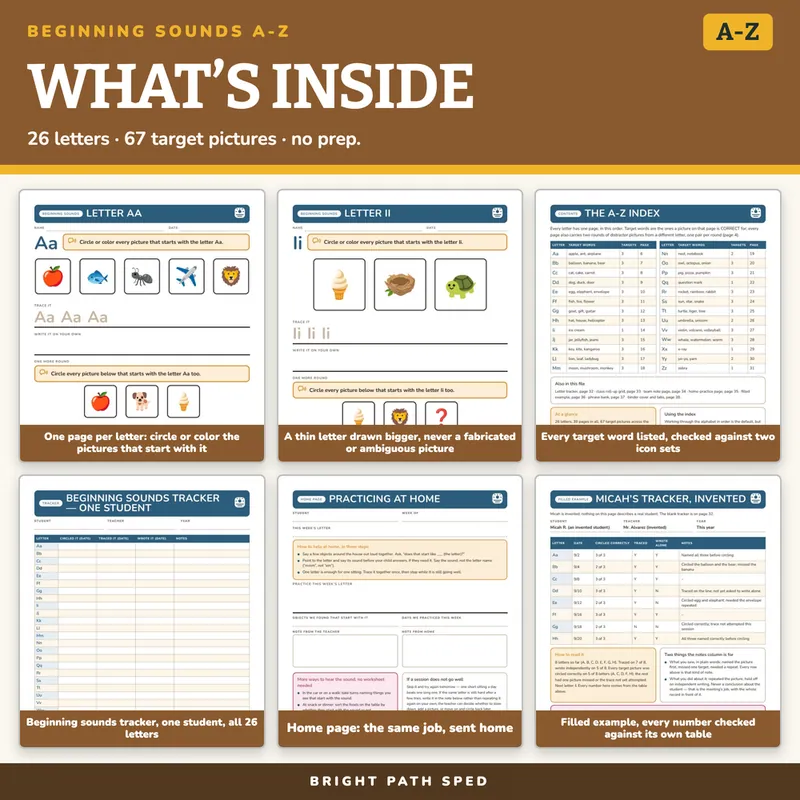
- 26 practice pages, one per letter A-Z, each with a picture set to circle, a trace line, a write
line, a second round with a fresh picture set, and 2 more write lines
- 67 target pictures across the alphabet, every one checked against two independent icon sets (Google
Noto and Microsoft Fluent High Contrast) so a wrong picture never becomes a wrong answer key, plus
two rounds of distractor pictures on every page (four in all: two different pairs, each a real
target word from a different letter's own page, never invented)
- 1 beginning-sounds tracker (one student, all 26 letters) and 1 class roll-up grid, type-in or print
- 1 team note page and 1 home-practice page
- 1 filled example, 1 phrase bank, 1 binder cover with a spine label and six divider tabs
- Start Here, a how-to-read-a-page key that explains why some letters carry fewer pictures, and a
contents page listing every target word and page number
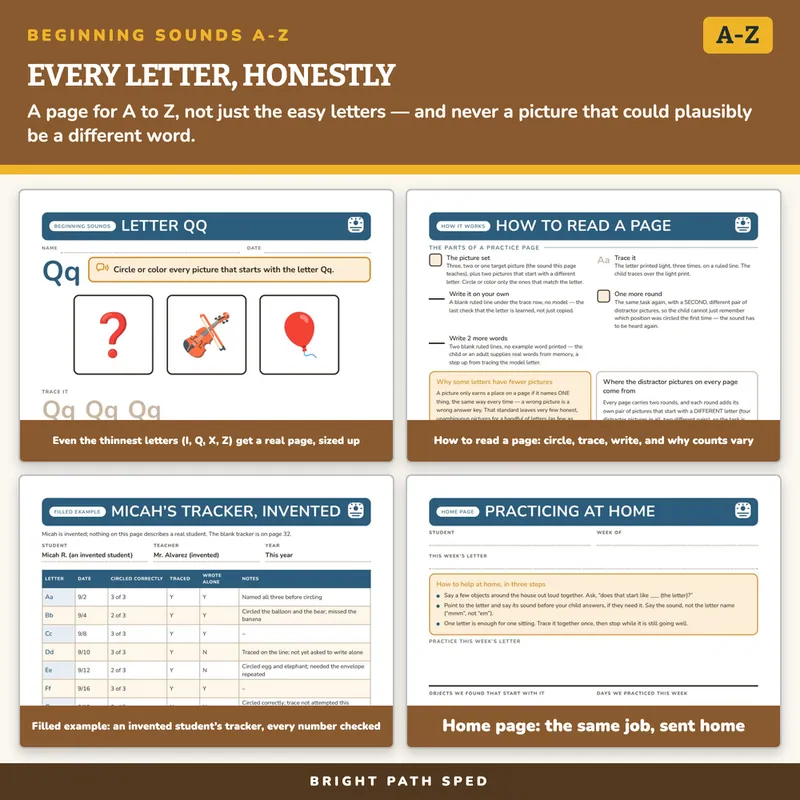
Why Some Letters Have Fewer Pictures
A picture only earns a place on a page if it names one thing, the same way every time — a wrong
picture is a wrong answer key. Most letters carry three target pictures; I, N, Q, U, X, Y and Z carry
fewer (as few as one, for I, Q, X and Z) because that is honestly how many unambiguous pictures exist
for that sound across this store's two open-licence icon sets. Those pages are never padded with a
repeated or ambiguous picture — the picture tiles are simply drawn bigger, so the page is never mostly
blank. The contents page (page 5) lists exactly how many target pictures are on every letter's page.
Circle, Trace, Write, Again — Every Page
1. Circle or color every picture that starts with the letter's sound (target pictures plus two
distractors from a different letter).
2. Trace the letter, printed light, three times on a ruled line.
3. Write the letter once more, independently, on a blank ruled line — no model.
4. One more round: circle every picture in a fresh set, with a different pair of distractors, so the
child is listening for the sound again, not remembering a position.
5. Write two more words that start with the letter, on two blank ruled lines — no example word
printed.
No word is printed beside a picture on a practice page: the task is naming the picture and listening
for the sound, not reading print.
Type In, Or Print
The name and date lines, the tracker, the class grid, the team note and the home page are type-in
fields in any PDF reader. The circling, coloring, tracing and writing are always pencil work. This is
a fillable PDF; it is not a Google Slides or PowerPoint file.
Who This Is For
Kindergarten and first-grade classrooms, self-contained and resource rooms, and any teacher building
phonemic awareness one letter at a time. The home page sends the same job to a family; the team note
hands off what changed since the last meeting.
What This Is, And What It Is Not
A beginning-sounds practice set with the record-keeping around it. It is not a reading assessment, not
a speech-language evaluation tool, and not a claim about any student's age or rate of progress. The
how-it-works page explains the picture choices in full.