Biomolecules Worksheets
- 34 pages
- 9th, 10th
$2.25 $4.50 on Teachers Pay Teachers
Half the Teachers Pay Teachers price. The same PDF, sold direct.
DownloadOr get it with All-Access: pick any 20 resources a month for $7.
New here? Your first month of All-Access is half off with code TEACHERTOK
Already bought this, or a member?
Instant download. One teacher's license: colleagues need their own copy. Each file carries a license number.
Also on Teachers Pay Teachers: see the Bright Path Sped store
About this resource
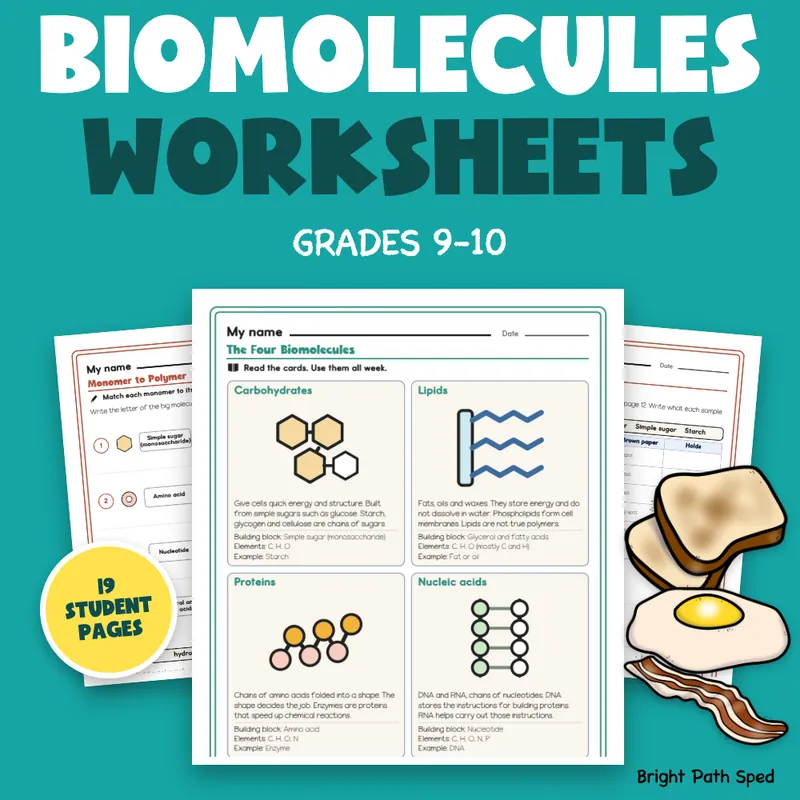
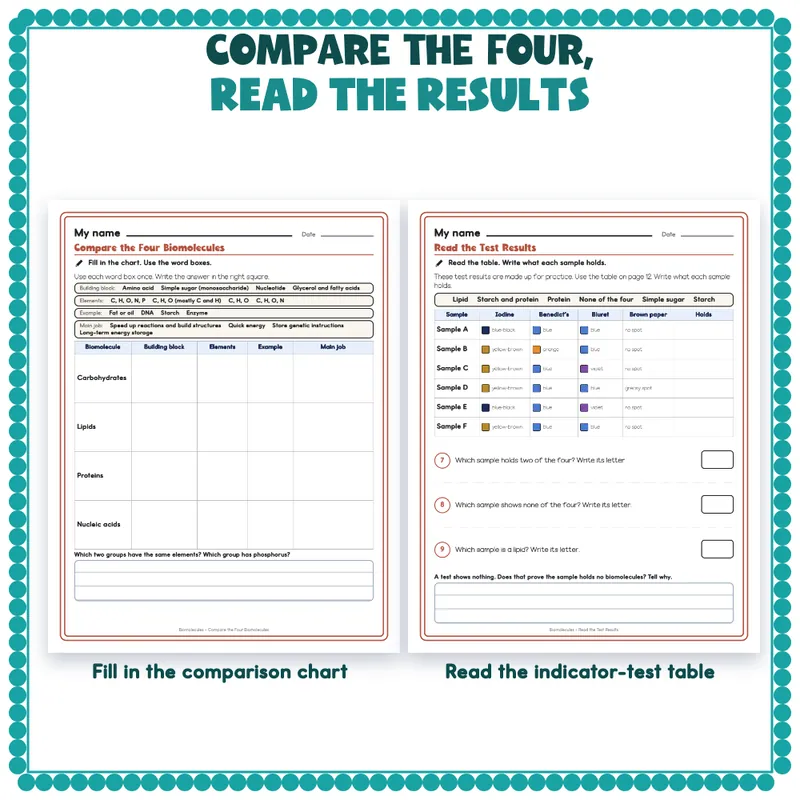
Teaching the four groups of biomolecules and want pages students can actually work on? This is a complete unit for grades 9-10 on carbohydrates, lipids, proteins and nucleic acids. It starts with two short readings with checks and four biomolecule cards, then moves to a fill-in comparison chart, monomer-to-polymer matching, indicator-test colors and a table of test results to read. Every student page has a "My name" line, one short instruction and real room to write. Answer keys cover every item, and a tracker, class grid and family page are included.
EVERYTHING INSIDE (34 sheets)
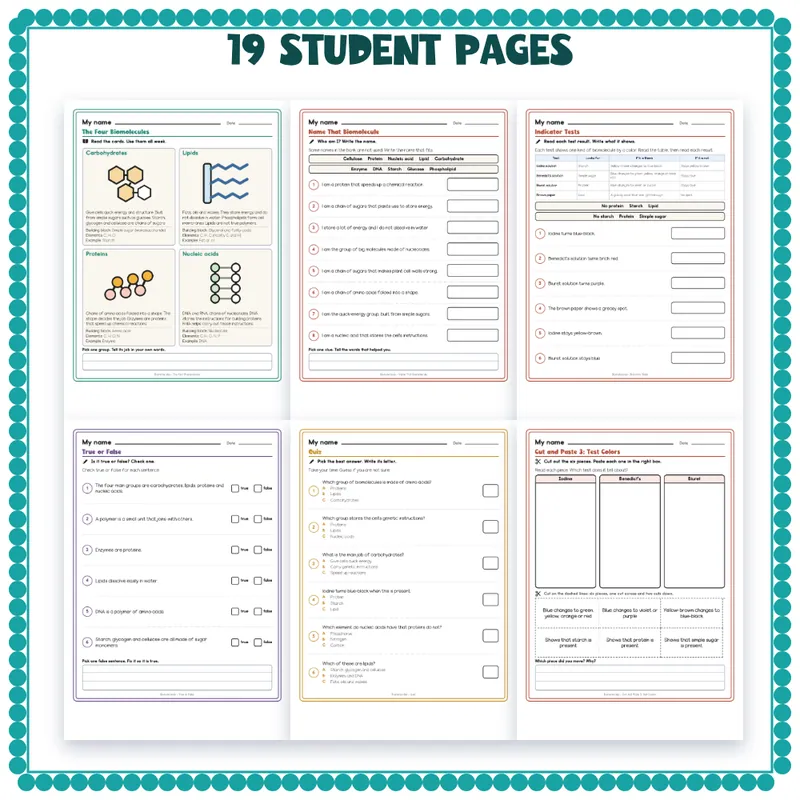
- 19 student sheets in 14 kinds of sheet, each with a name line and one short instruction
- 93 scored items on 14 sheets, every key built from the same lists that draw the page
- 2 readings with 3 multiple-choice questions each
- 4 biomolecule cards on 1 sheet: building block, elements, example and job for carbohydrates, lipids, proteins and nucleic acids, each with a plain geometric drawing
- 1 comparison chart: 4 groups by 4 columns (building block, elements, example, main job), 16 cells to fill from word boxes
- 1 vocabulary match: 6 words (monomer, polymer, enzyme, glucose, nucleotide, lipid)
- 1 worked example (which biomolecule?) with a guided copy to fill in
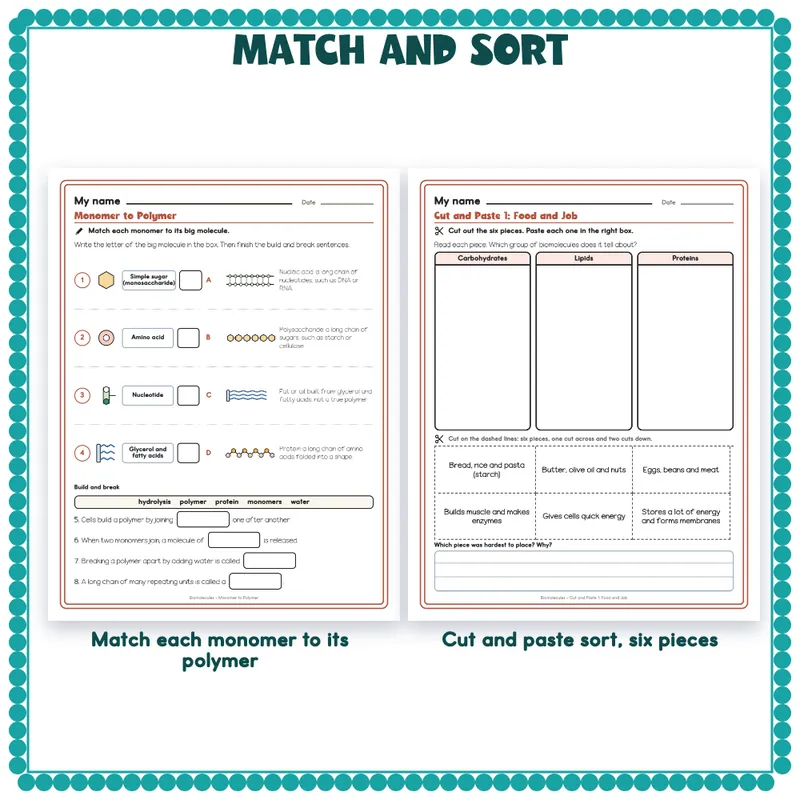
- 1 monomer-to-polymer sheet: match 4 monomers to their big molecules, then 4 build-and-break sentences (joining monomers, water released, hydrolysis, polymer)
- 1 name-that-biomolecule sheet: 8 "I am" clues (each fits one answer) and a bank of 10 names
- 2 indicator-test sheets: a reference table of four tests (iodine, Benedict's, Biuret, brown paper) with 6 color results to read, then a table of 6 samples with invented results and 3 questions
- 1 true-or-false sheet (6 sentences) with a fix-it box
- 1 Find the Mistake sheet (4 sentences from an invented student)
- 1 short-answer sheet: 3 questions with at least 5 ruled lines each
- 1 quiz (6 items); 1 exit-ticket sheet (3 tickets); 1 self check (8 statements)
- 18 cut-and-paste pieces on 3 sort mats (6 pieces into 3 boxes each: food and job for carbohydrates, lipids and proteins; building blocks; test colors)
- 4 answer key sheets; 1 tracker, 1 class grid, 1 family page
- 1 filled example (an invented student), 1 phrase bank (17 starters in 6 groups)
- 1 binder cover and 1 divider-tabs-and-spine page (6 tabs and a spine label, 7 pieces cut in straight lines)
- Start Here and Terms of Use
Built For The Student Holding The Page
A "My name" line, one short instruction with a small picture cue, and a plain double-rule border. Nothing on a student page is written for an adult: the keys and records are on separate teacher sheets. Writing boxes hold at least two ruled lines, and the short-answer boxes hold at least five. The molecule pictures are drawn in the file as plain shapes; the cover uses Educlips clip art. The file prints clean in black and white.
Invented Examples And Results
The student in the filled example, the student on the mistake sheet and every indicator-test result are made up and say so. The short-answer and writing boxes have no single right sentence: the key says what to look for.
Type In, Or Print
The name line, every answer box, every check box, every table cell to fill and every ruled work box are type-in fields in any PDF reader: click one, type, then save. You can also print any page. This is a fillable PDF; it is not a Google Slides or PowerPoint file.
What This Is, And What It Is Not
A biomolecules practice set with the record-keeping around it. It is not a lab manual: there is no lab procedure and no safety steps, so your own lab rules stay yours. It is not a nutrition or diet unit and gives no food or health advice (the food examples only show which group a molecule belongs to). It is not a timed test, a screener or a claim about any student's age or rate of progress, and it does not claim to match any one state's standards: there is a line on the tracker for your own.
If You Want More
Plant and Animal Cells Worksheets | Diagram, Sort, Compare, Write 6th-8th Grade; Levels of Biological Organization Worksheets | Cell to Organism Grades 6-8.