Candy Heart Graphing
- 37 pages
- Kindergarten, 1st, 2nd
$2.00 $4.00 on Teachers Pay Teachers
Half the Teachers Pay Teachers price. The same PDF, sold direct.
DownloadOr get it with All-Access: pick any 20 resources a month for $7.
New here? Your first month of All-Access is half off with code TEACHERTOK
Already bought this, or a member?
Instant download. One teacher's license: colleagues need their own copy. Each file carries a license number.
Also on Teachers Pay Teachers: see the Bright Path Sped store
About this resource
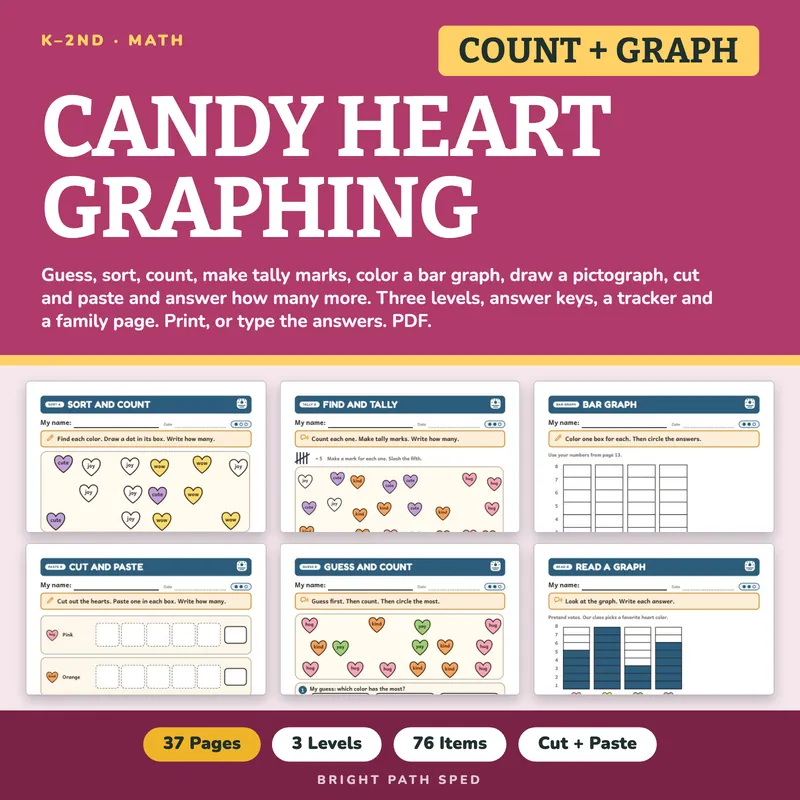
How many pink hearts? Which color has the most? Guess first, then count. This is a complete kit for candy heart graphing. Children guess, sort a pile of candy hearts by color, count them, make tally marks, color a bar graph, draw a pictograph, cut and paste hearts into boxes and answer how many more, on pages with room to work. Every kind of page comes in three levels, so one table of children can all graph the same week. It comes with a worked page, answer keys, a tracker, a class grid, a family page and a binder cover with divider tabs, so nothing has to be written or made from scratch.
EVERYTHING INSIDE (37 pages)
- 20 student pages in 10 page types, in 3 levels
- 5 picture scenes with 13, 22, 30, 15 and 14 candy hearts to count (94 in all), every heart drawn for this set
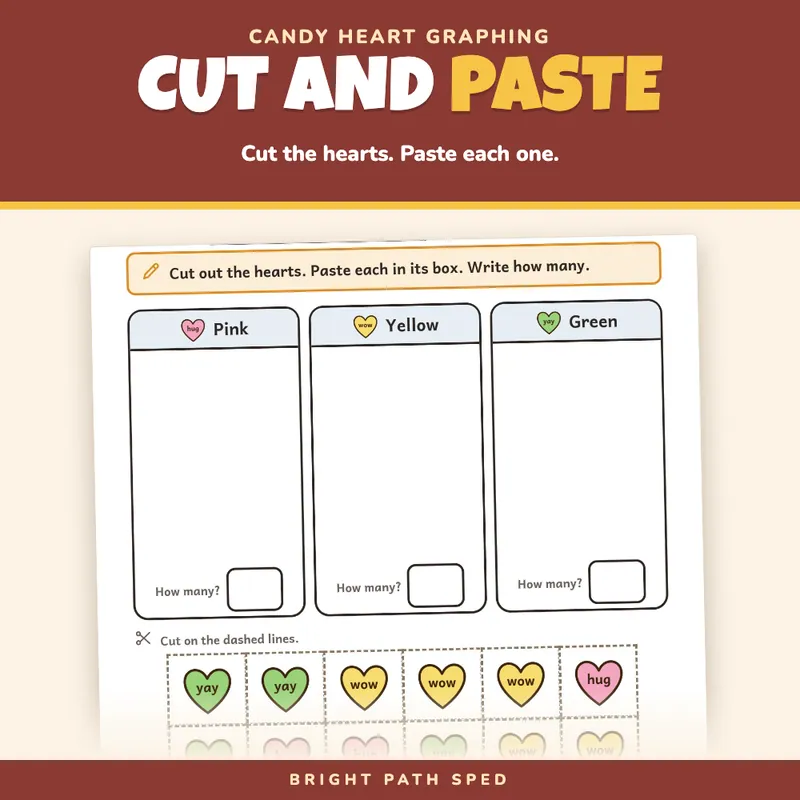
- 3 cut-and-paste pages with 30 hearts to cut out (12, 12 and 6), laid out edge to edge so the cutting is a few straight lines
- 76 scored items on 18 pages, every answer worked out from the scene or the table on the page
- 7 graph pages: 3 bar graphs, 2 pictographs, a finished graph to read and a blank class-vote graph
- 10 how-many-more questions across 3 pages, including a "show your work" page with a large work box for each question
- 4 questions on a finished class-vote graph, and 4 sentence frames on a graph
- 1 worked page to look at before starting
- 3 answer keys
- 1 tracker (page, page type, items right, date) and 1 whole-class progress grid
- 1 team note (a hand-off page between team meetings) and 1 home page
- 1 filled example (an invented student), 1 phrase bank (16 starters), 1 binder cover and 6 divider tabs with a spine label to cut out
- Start Here and a how-to-read-a-page page
The Page Types
1. Sort and Count, 1 page (1 dot): a pile of hearts and three color boxes. Draw a dot in a box for each heart, write how many, circle the color with the most.
2. Find and Tally, 3 pages (1, 2 and 3 dots): a scene of hearts. Count each color, make tally marks, write the number. The five-mark tally is shown on every page.
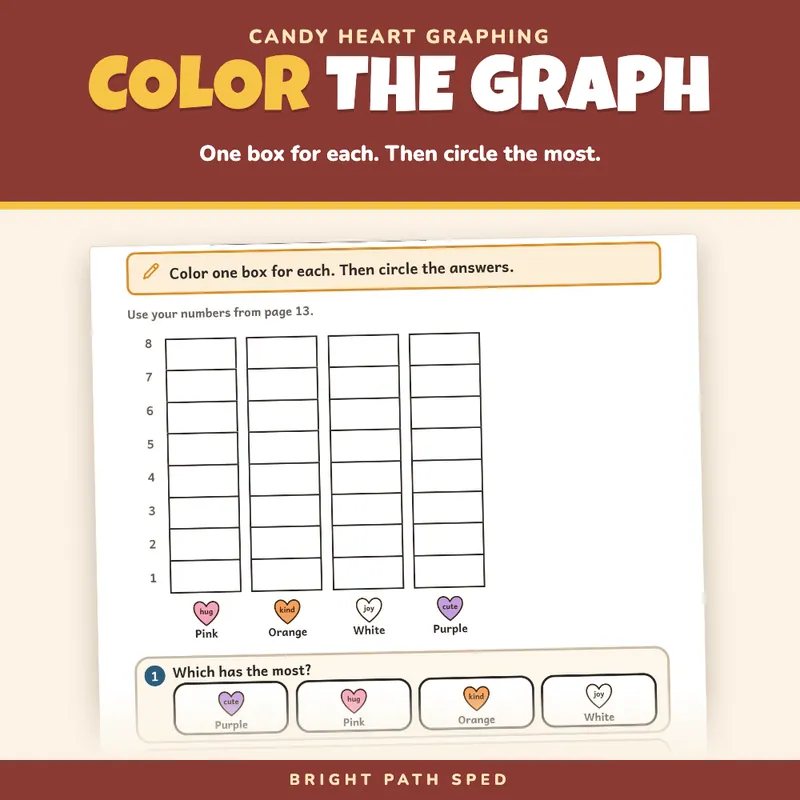
3. Bar Graph, 3 pages: color one box for each heart, then circle the color with the most and the color with the fewest. On the level-three page each box means 2.
4. Pictograph, 2 pages (2 and 3 dots): a row for each color. Draw one heart for each, write how many, then circle the most and the fewest. On the level-three page each heart means 2.
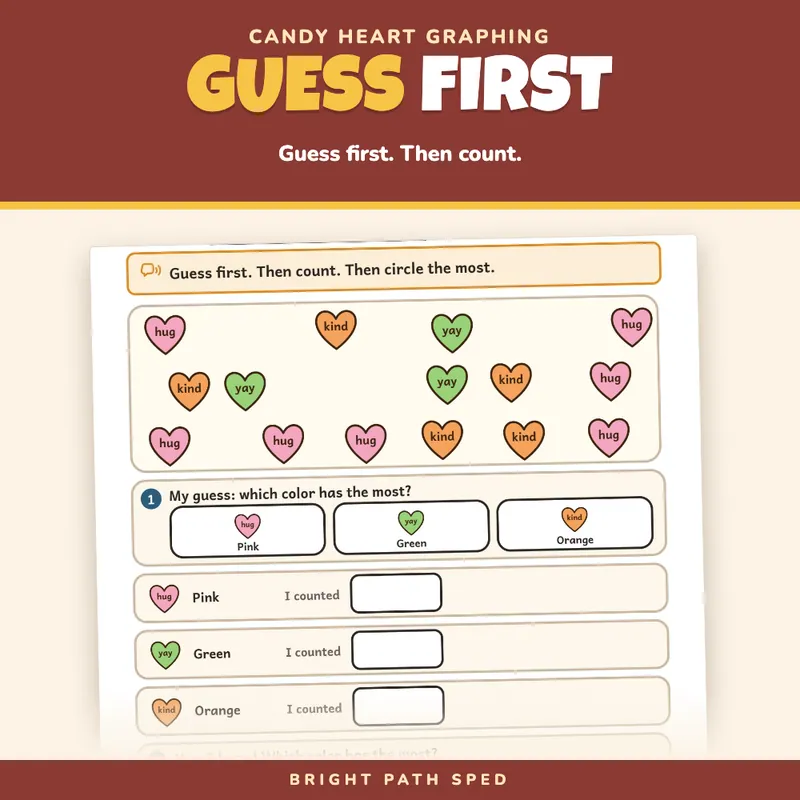
5. Guess and Count, 1 page (2 dots): guess which color has the most, count each color, then circle the real answer.
6. Cut and Paste, 3 pages (1, 2 and 3 dots): cut out the hearts and paste them in color boxes, in the boxes of a pictograph row and in the columns of a bar graph.
7. How Many More?, 3 pages: compare two rows, read a finished graph, then explain with a work box. 10 questions in all.
8. Write a Sentence A (1 dot) and C (3 dots): finish sentences from a graph.
9. Read a Graph (2 dots): a finished graph of a pretend class vote, 4 questions.
10. Make a Graph (2 dots): ask friends which heart color they like best, color a box for each, write three sentences. Not scored.
How To Use It
Look at the worked page together first. Then hand over a page. Every student page opens with a name line and one short instruction in kid words, so the child can start. The Start Here page has a chart that says which page for which child. Have crayons and glue ready. The tracker lists every scored page with its item count.
The Numbers Are Real
The count on every scene page is the number of hearts drawn on it, and the answer keys, the questions and the graphs are all worked out from the same numbers, so a page and its key always agree. The only made-up numbers are the votes on the Read a Graph page, and that page says they are pretend.
Easy Cutting
The hearts on the cut pages touch edge to edge in one strip or a short grid (6 across, 1 or 2 rows), so the cutting is a few straight lines, and every cut page has at least 5 pieces to choose from. Each piece is the size of its box.
No Guessing The Answer
Wherever a child circles one color (the most, the fewest), the color tiles are in a different order on each page, so the right tile is not always in the same spot. Every heart has a short word on it, so the sorting works in black and white too.
Built For The Child Holding The Page
A big "My name" line, one short instruction, large rounded type, big answer boxes, and dots (not words or colors) to show which level a page is. Nothing on a student page is written for an adult. The file prints clean in black and white.
Type In, Or Print
The name line and every answer box are type-in fields in any PDF reader: click one, type, then save. The same goes for the tracker, the class grid, the team note and the home page. This is a fillable PDF; it is not a Google Slides or PowerPoint file.
Who This Is For
Kindergarten to 2nd grade classrooms, self-contained and resource rooms, and any teacher building a February math center, a small group or a morning work folder.
What This Is, And What It Is Not
A candy heart graphing worksheet set with the record-keeping around it. It uses invented hearts with generic words and is not made by or connected to any candy company. It is not a timed test, a screener, a clinical tool, or a claim about any student's age or rate of progress. There is no IEP goal language or eligibility wording anywhere in the file.
More From This Store
Valentine Math K-1 Cut and Paste is also in the store.