City State Country Continent Sort Task Box
- 22 pages
- 2nd, 3rd, 4th
$1.50 $3.00 on Teachers Pay Teachers
Half the Teachers Pay Teachers price. The same PDF, sold direct.
DownloadOr get it with All-Access: pick any 20 resources a month for $7.
New here? Your first month of All-Access is half off with code TEACHERTOK
Already bought this, or a member?
Instant download. One teacher's license: colleagues need their own copy. Each file carries a license number.
Also on Teachers Pay Teachers: see the Bright Path Sped store
About this resource
EVERYTHING INSIDE — 22 pages, 150 type-in fields
- 18 place cards in 3 levels (6 cards each). Every card prints ONE real place name (Chicago, Ohio, Canada, Asia and more) and the child marks the word that says what it is: city, state, country or continent
- Level 1 has 2 words on a card, Level 2 has 3, Level 3 has all 4 in the same order every time
- A place ladder page: what each of the four words means in plain kid language, with the places from this box that belong to each word
- Every card twice: accent-colored cards for a laminated box and black-on-white ink-saver cards for the copier
- An answer key listing every card, its place and its one right word
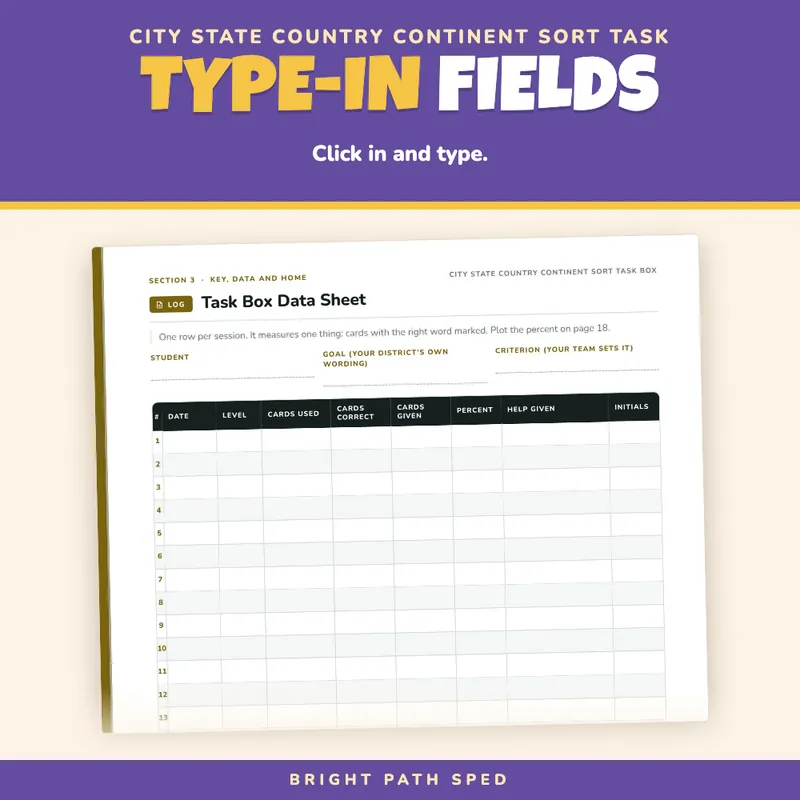
- A task box data sheet (16 rows: date, level, cards used, cards correct, cards given, percent, help given, initials)
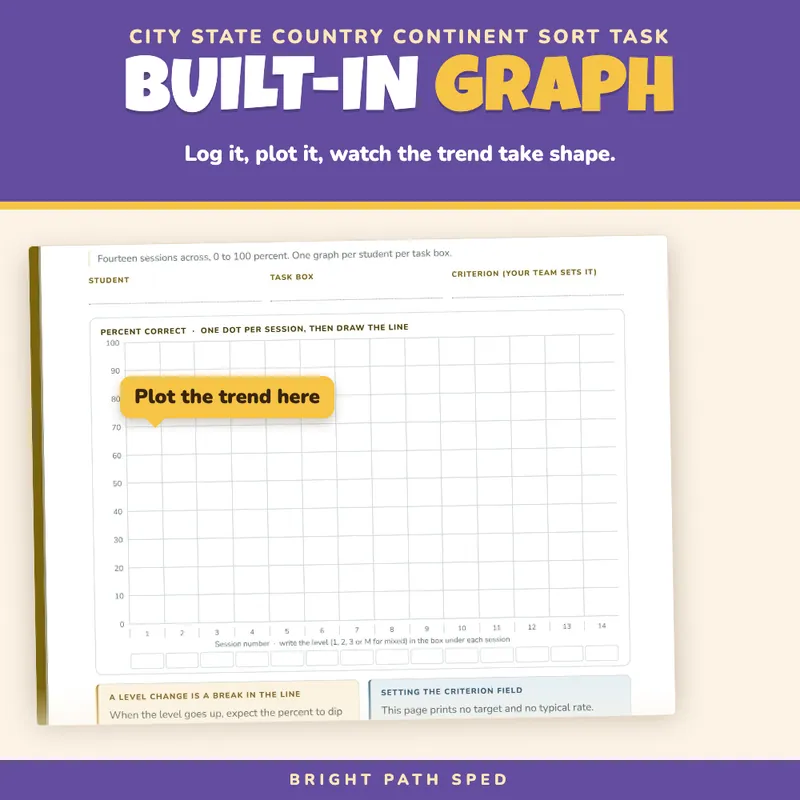
- A percent graph with a level box under each session
- A filled example with an invented student, 8 sessions, every percent re-counted from its own row
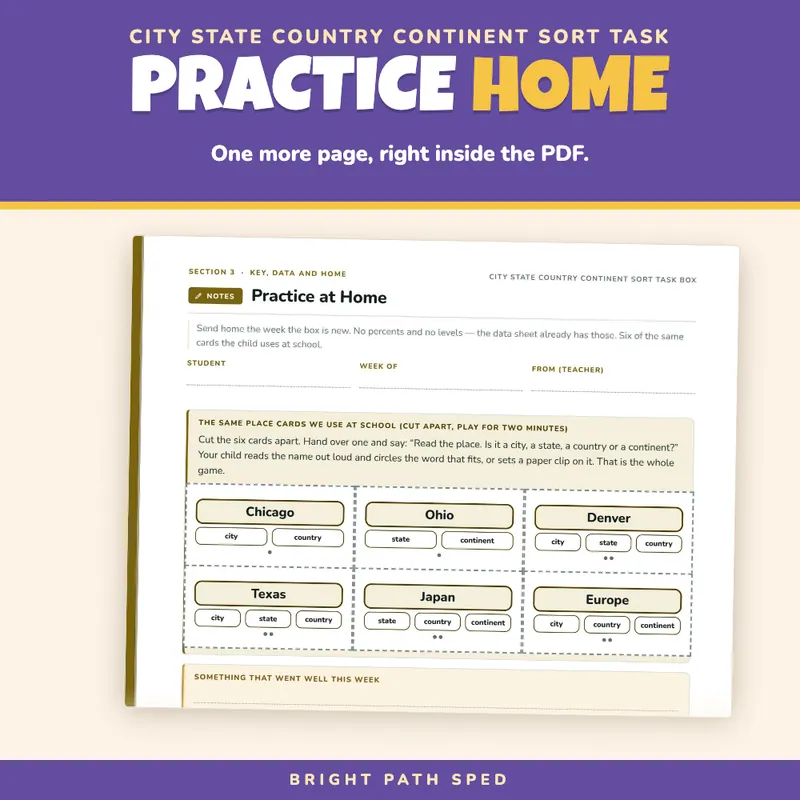
- A family practice page with six of the same cards
- A phrase bank: 25 lines in 6 groups (spoken lines for working the cards, written starters for the note afterward)
- Start Here, a contents page with page thumbnails, and a "what's next" back page
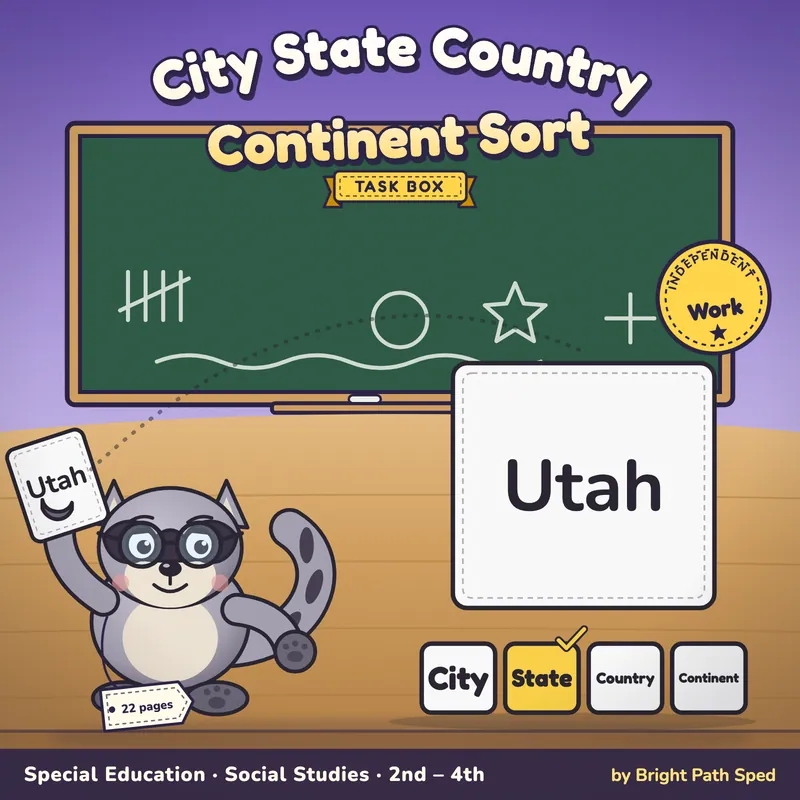
A city state country continent sort for the student who works best with a card in hand: read the place, decide what kind of place it is, mark one word. No maps and no pictures, so the only thing a child reads is the place name. The data sheet and graph turn the practice into a line on a page a case manager can bring to a meeting.
How To Use It
1. Print the ladder and the three card pages on cardstock (or the ink-saver set on plain paper) and cut along the dashed lines. Laminate if the box stays in a rotation.
2. Hand over one card and say the same short line each time. The child reads the place and marks one word with a circle, a sticky dot, a paper clip or a dry-erase marker.
3. Write the date, level, cards correct and cards given on the data sheet the same day, and plot the percent on the graph. Send the family page home the week the box is new.
Three Levels, One Skill
- Level 1, two words — 6 cards. The wrong word is always two or more steps away on the city, state, country, continent ladder, so the first set is forgiving.
- Level 2, three words — 6 cards. One of the four words is left off each card, and on 6 of the 6 cards a wrong word sits right next to the answer on the ladder.
- Level 3, four words — 6 cards. All four words on every card. Across the three levels the right answers are 6 city, 4 state, 4 country and 4 continent.
Every place on a card is one thing only. Names that are two kinds of place at once (the ones you would argue about at the table) were left out on purpose, so no card has two right answers.
What This Is, And What It Is Not
It is a fillable PDF: type into the data sheet, the graph header, and the family page, or print and use a pen. The card pages and ladder print on cardstock or plain paper; cut along the dashed lines. It works offline with no account or subscription. It is NOT an editable online slideshow or word-processor document, it has no maps, and it is not a test of anything.
It carries no prompt hierarchy, fading schedule or mastery rule, and it does not decide what a percent means for a student or when to move to the next level. The goal line and the criterion field are blanks for your district's own wording and your team's own number. It measures one thing: cards with the right word marked. It is practice with place names; it does not teach map skills or standards.
Who This Is For
Special education teachers and paraprofessionals running independent work stations or task box rotations for students in grades 2 to 4 (and older students working on this skill), case managers who need that practice to show up as data, and the families who get the practice page sent home.
More In The Collection
This is one set in the Task Box Collection. Every box in the collection is also sold together in the Task Box Mega Bundle, one purchase for the whole sort-and-data system.