Classification of Living Things Worksheets
- 47 pages
- 6th, 7th, 8th, 9th
$2.50 $5.00 on Teachers Pay Teachers
Half the Teachers Pay Teachers price. The same PDF, sold direct.
DownloadOr get it with All-Access: pick any 20 resources a month for $7.
New here? Your first month of All-Access is half off with code TEACHERTOK
Already bought this, or a member?
Instant download. One teacher's license: colleagues need their own copy. Each file carries a license number.
Also on Teachers Pay Teachers: see the Bright Path Sped store
About this resource
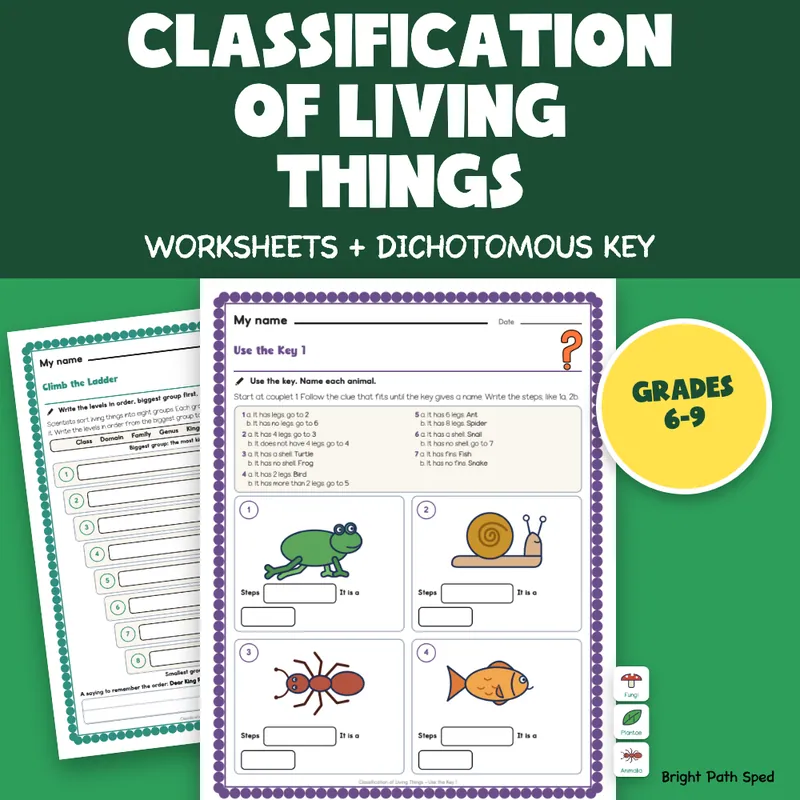
How do scientists sort millions of kinds of living things? This is a complete classification unit for grades 6-9: the eight levels from Domain to Species, two-part scientific names, the three domains and six kingdoms, and a dichotomous key that students use on drawn animals and then write themselves. Students climb the ladder, classify a human, a gray wolf, a lion and a house cat, count how many levels two animals share, fix scientific names, fill in a kingdom chart, sort pieces by cutting and pasting, read three short passages and check their own work.
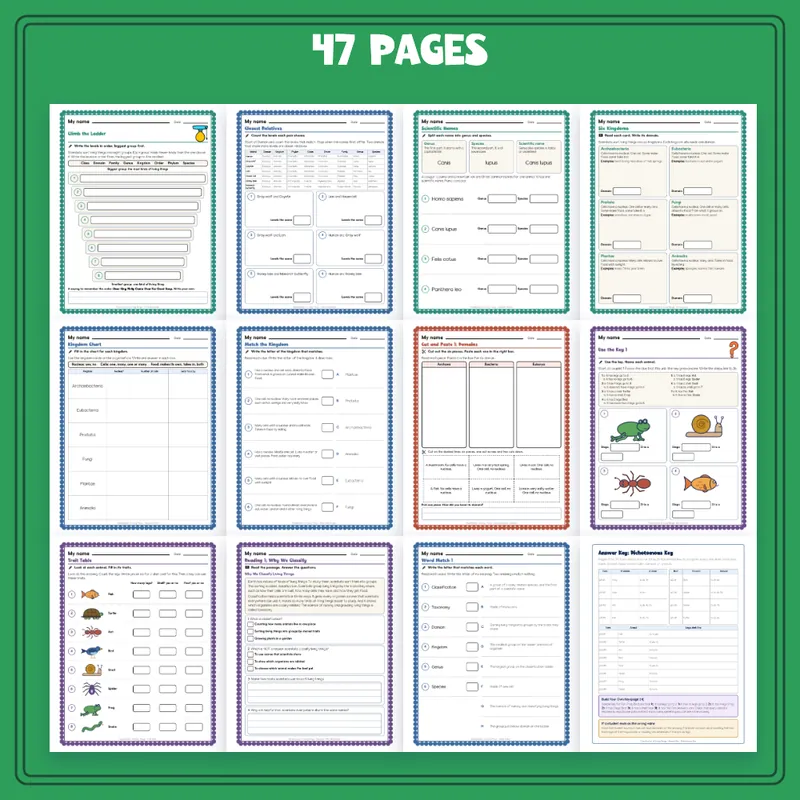
WHAT IS INCLUDED (47 pages)
- 29 student pages in 15 kinds of page, each with a name line and one short instruction
- 185 scored items on 26 sheets, each with an answer on the key pages
- Climb the Ladder: the eight levels in order, Domain to Species, with a word box and a saying to remember the order (8 blanks)
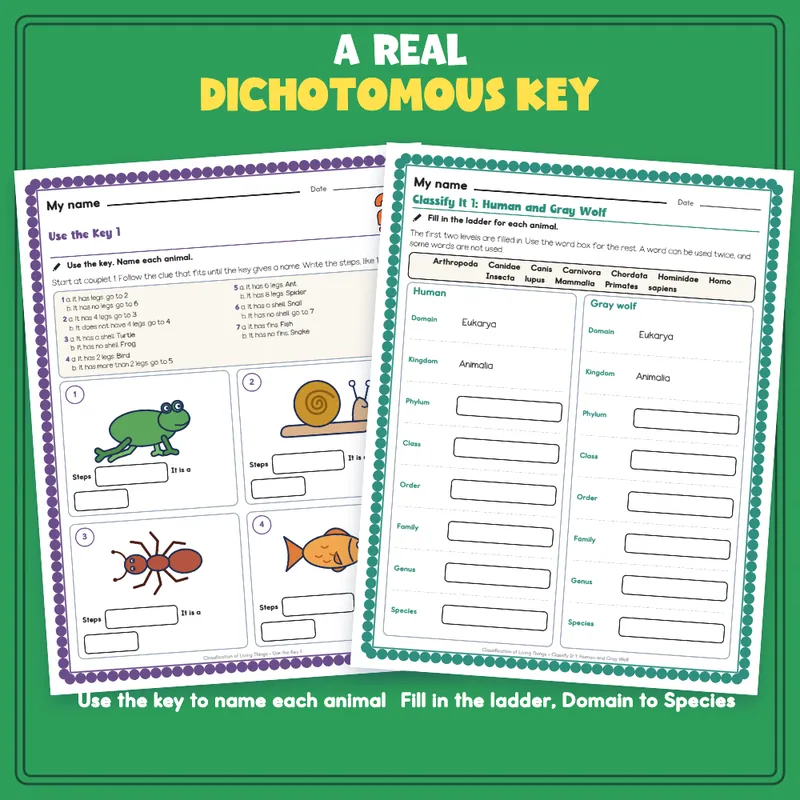
- 2 classify-it pages: the full ladder for a human, a gray wolf, a lion and a house cat (24 blanks)
- Closest Relatives: a table of seven animals' ladders, then 6 pairs where students count the levels the two animals share
- Scientific names: 4 names to split into genus and species, and 6 names to fix (capital letters)
- Three Domains: 3 reference cards and 4 try-it items
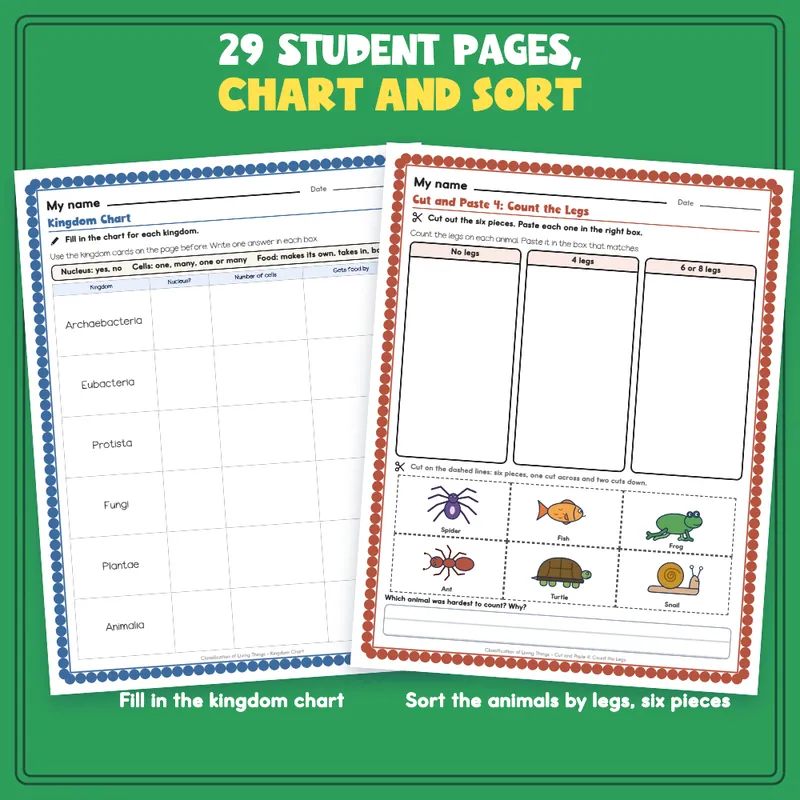
- Six Kingdoms: 6 kingdom cards (nucleus, cells, how it gets food, examples), a kingdom chart with 18 boxes to fill, and a match page with 6 clues
- 4 cut-and-paste sorts, 24 pieces: domains, kingdoms, true or false statements about kingdoms, and animals sorted by number of legs
- Dichotomous key: a 7-couplet key to 8 animals drawn in the file; two pages that use the key (8 animals), a trait table (8 animals, legs, shell, fins) and a Build Your Own Key page
- 3 reading passages, each with 2 check-box questions and 2 short-answer questions (12 questions)
- 20 vocabulary items: 2 word-match pages (12 words, with 2 spare meanings on each) and a word-box sentence page (8 sentences)
- 1 short answer page with 3 prompts, 2 quizzes (12 questions), 1 exit ticket page (3 tickets), 1 self check (8 statements)
- 5 answer key pages; 1 binder cover and spine, 6 divider tabs, 1 tracker, 1 class grid, 1 team note, 1 family page
- 1 filled example (an invented student), 1 phrase bank (17 starters in 6 groups)
- Start Here and a how-to-read-a-page page
Built For The Student Holding The Page
A "My name" line, one short instruction with a small picture cue, and a plain scalloped border. Nothing on a student page is written for an adult: the keys and records are on separate teacher pages. The animals are drawn in the file, not copied from a photo. Every cut piece is a large card.
The Key Is Checked
The dichotomous key was run on every drawn animal to make sure each one ends on its own name, and the key pages list the steps for each. The ladders, kingdom traits and quiz answers on the keys come from the same tables the student pages are printed from.
Invented Examples
The filled example names an invented student and says so. The Build Your Own Key page has more than one correct answer, and the key shows a sample.
Type In, Or Print
The name line, every answer box, every check box and every ruled work box are type-in fields in any PDF reader: click one, type, then save. You can also print any page. This is a fillable PDF, not a slideshow or a word-processor file.
What This Is, And What It Is Not
A classification practice set with the record-keeping around it. It is not a timed test, a screener, a clinical tool, or a claim about any student's age or rate of progress. It does not claim to match any one state's standards: there is a line on the tracker to write your own standard. It uses the six-kingdom and three-domain systems and does not include a cladogram page.
Who This Is For
Science teachers in grades 6-9 who want a unit on classification, and special education teachers who want the same work in a form a student can finish.