Compare and Order Decimals Worksheets
- 29 pages
- 4th, 5th
$2.00 $4.00 on Teachers Pay Teachers
Half the Teachers Pay Teachers price. The same PDF, sold direct.
DownloadOr get it with All-Access: pick any 20 resources a month for $7.
New here? Your first month of All-Access is half off with code TEACHERTOK
Already bought this, or a member?
Instant download. One teacher's license: colleagues need their own copy. Each file carries a license number.
Also on Teachers Pay Teachers: see the Bright Path Sped store
About this resource
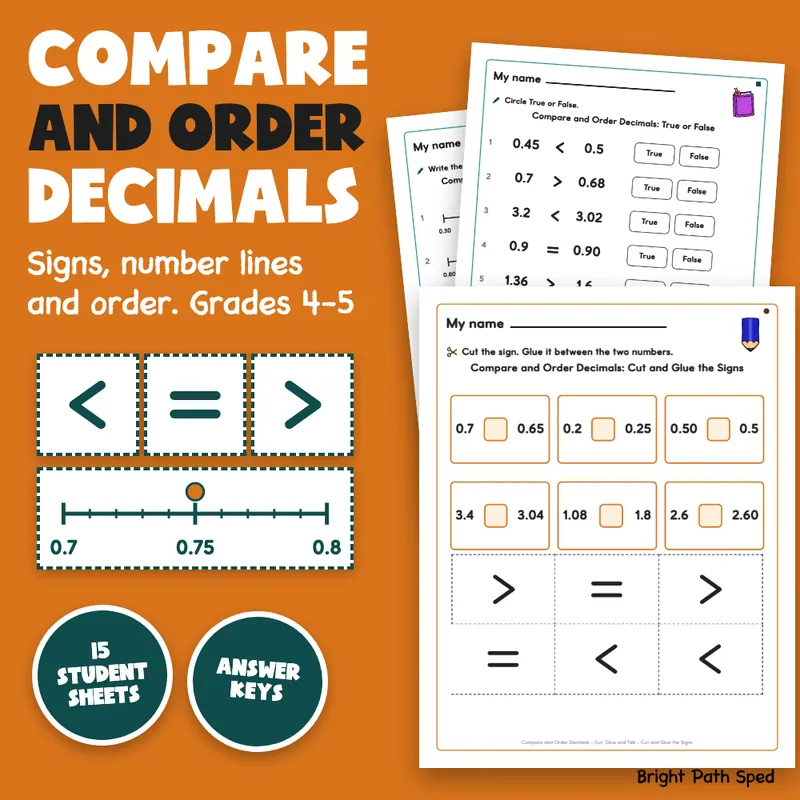
Looking for compare and order decimals worksheets your fourth and fifth graders can do on paper, with room to write? This set has 15 student sheets for one job: decide which decimal is greater, put a group of decimals in order, and place a decimal on a number line. Students line up the digits in a place value grid, compare numbers in standard form with the zeros in, and circle the sign that makes each statement true. Every sheet has a big "My name" line, one short instruction with a small picture, and big boxes or circles to answer in. Print and go, or type the answers on screen.
The skills match Common Core 4.NF.7 (comparing decimals to hundredths) and 5.NBT.3 (comparing decimals to thousandths).
EVERYTHING INSIDE (29 sheets)
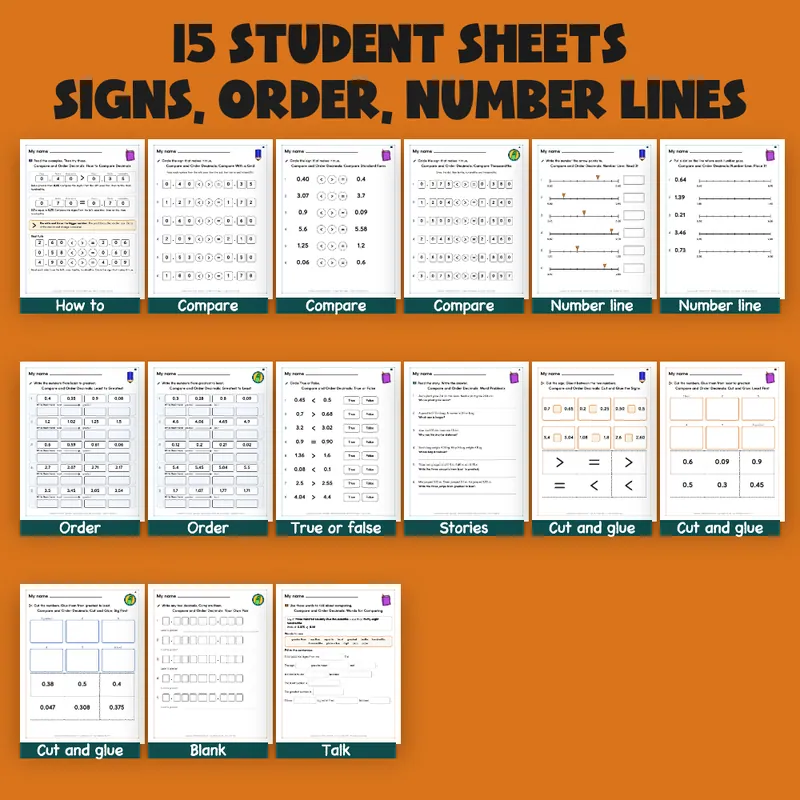
- 1 reference sheet: two worked examples (0.4 and 0.35; 0.7 and 0.70) in a place value grid, a tip about the sign, then one pair to try
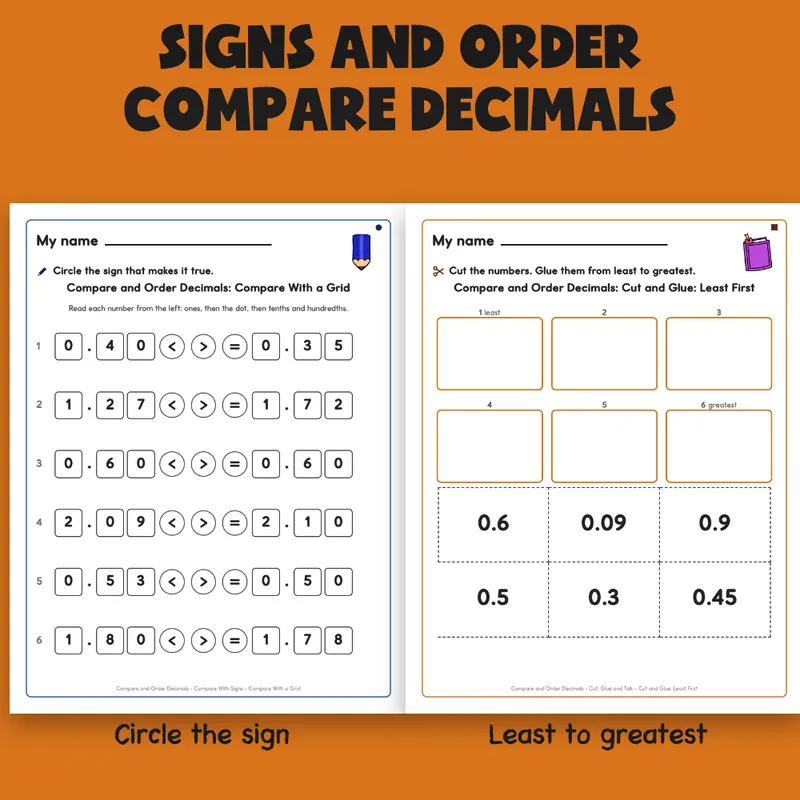
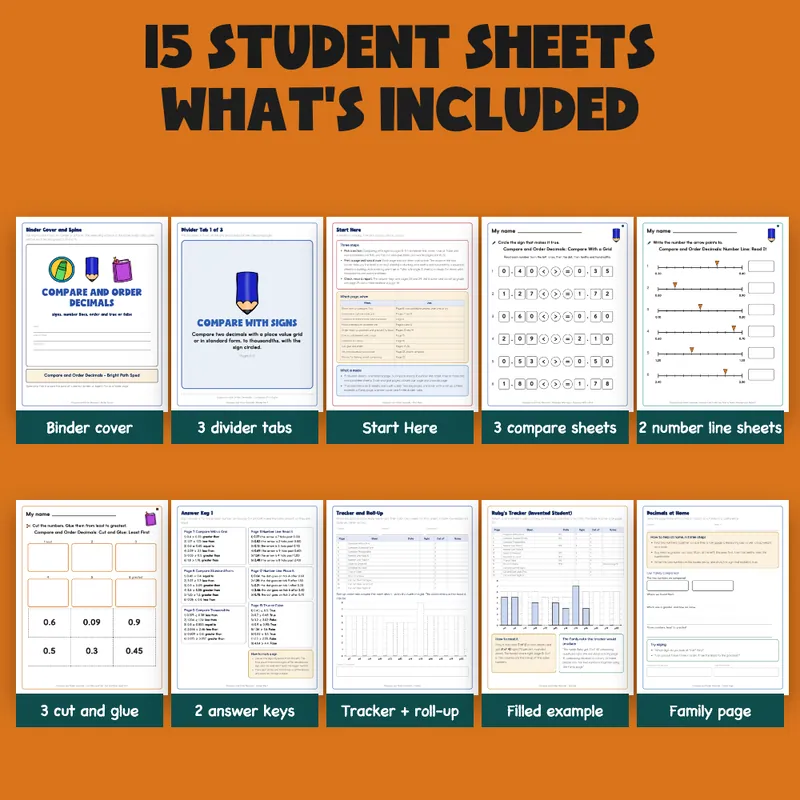
- 3 compare sheets: circle the sign in a place value grid to hundredths (6 pairs), compare standard form with zeros in (6 pairs), compare thousandths in a grid (6 pairs)
- 2 number line sheets: write the number an arrow points to (6), put a dot where each number goes (5). Each line is zoomed to ten hundredths, one tick per hundredth
- 2 order sheets: write 4 numbers from least to greatest (5 sets), and from greatest to least (5 sets)
- 1 true or false sheet: 8 statements with a sign, circle True or False
- 1 word problem sheet: 6 short stories about length, distance and weight, with invented students
- 3 cut-and-glue sheets, 6 pieces each: glue the sign between each pair (6), glue 6 numbers from least to greatest (6), glue 6 thousandths from greatest to least (6)
- 1 blank pair sheet: 5 rows for any two decimals, a box for the sign and a line for the order
- 1 words sheet: a word box, a worked example, and 6 sentence frames
- 2 answer-key sheets covering all 12 scored sheets, with each answer written out
- a tracker with a roll-up graph (12 scored sheets, 71 problems), a filled example (an invented student), a family page, a binder cover with a spine strip, 3 divider tabs, a Start Here sheet and a What's Next sheet
Three Levels
A small shape in the top corner of 12 student sheets tells you the level: a circle (3 sheets) is starting, with the grid and tenths and hundredths; a square (6 sheets) is building, with ordering, number line placement and true or false; a triangle (3 sheets) is ready for more, with thousandths and word problems. The reference sheet, the blank pair sheet and the words sheet carry no level shape.
How It Works
1. Pick a section: compare with signs; number line, order and true or false; or cut, glue and talk.
2. Print a sheet and hand it over. One short instruction, one job. Students circle, write or cut and glue.
3. Check with the key, write the date and score on the tracker, and color the roll-up column.
Built For The Child Holding The Page
A big "My name" line, big digits, circles big enough to circle with a pencil, and boxes big enough for a child's handwriting. On the cutting sheets the pieces sit edge to edge in a strip of two rows of three, so a child makes as few cuts as possible, and each glue box is the size of its piece. The signs are drawn shapes, so a < or > looks the same on every sheet. Nothing on a student sheet is written for an adult; the keys, tracker and notes are on separate teacher sheets. Every answer comes from the same numbers as its sheet, checked in code.
What This Is, And What It Is Not
Who This Is For
Fourth and fifth grade teachers, interventionists, special education teachers and families who want to compare and order decimals to thousandths, with signs, number lines and cut-and-glue practice.