Comparing 3-Digit Numbers Worksheets
- 24 pages
- 1st, 2nd
$4.00
DownloadOr get it with All-Access: pick any 20 resources a month for $7.
New here? Your first month of All-Access is half off with code TEACHERTOK
Already bought this, or a member?
Instant download. One teacher's license: colleagues need their own copy. Each file carries a license number.
Also on Teachers Pay Teachers: see the Bright Path Sped store
About this resource
A comparing-numbers kit for second grade (and a first-grade stretch): greater than, less than and
equal to, practiced five genuinely different ways with real 3-digit numbers (100–999 throughout),
plus the record-keeping a classroom or small group needs around it.
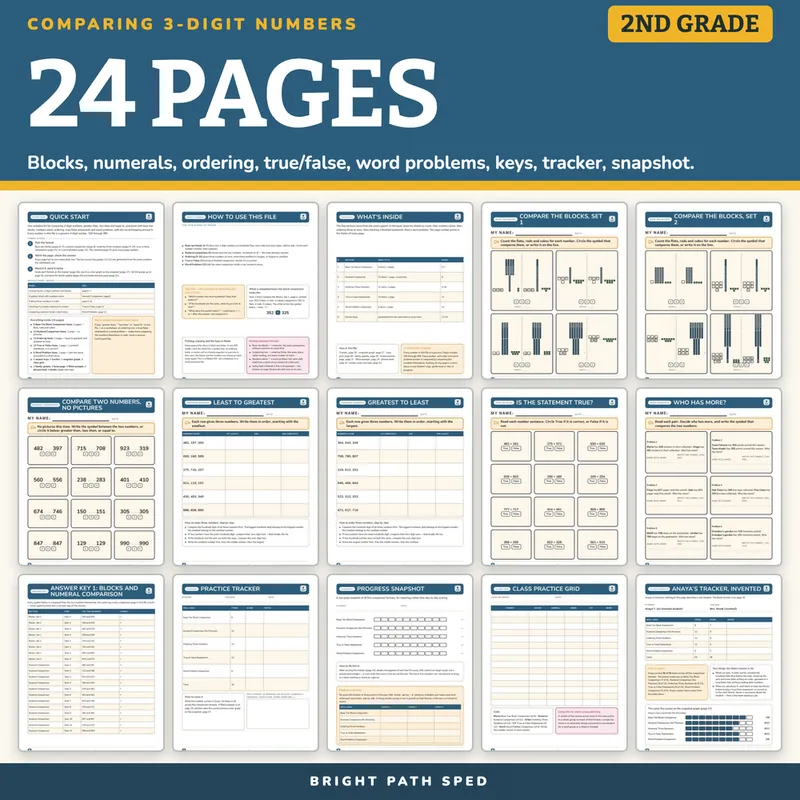
EVERYTHING INSIDE (24 pages)
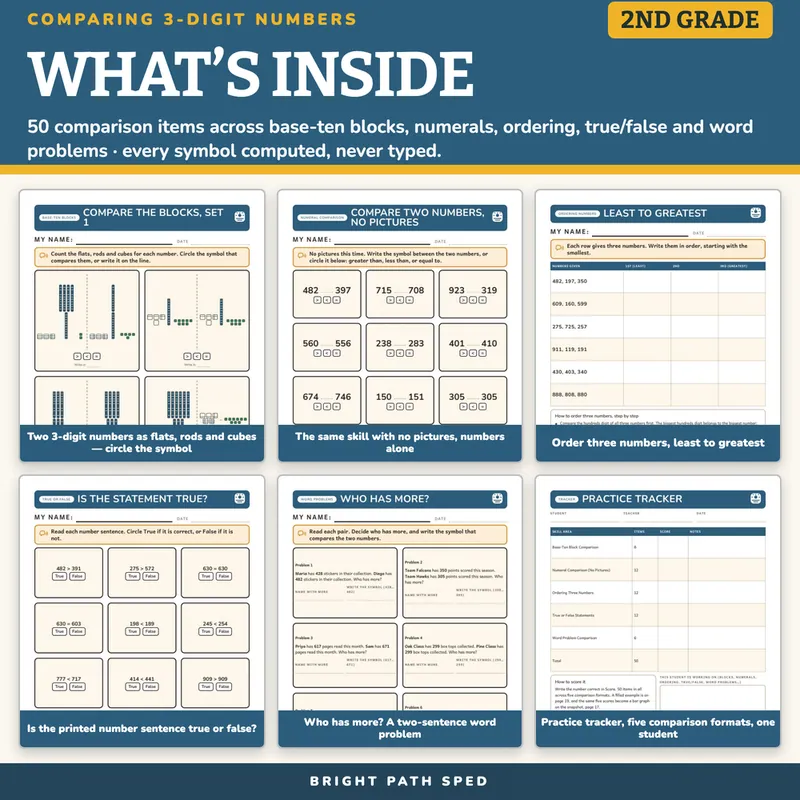
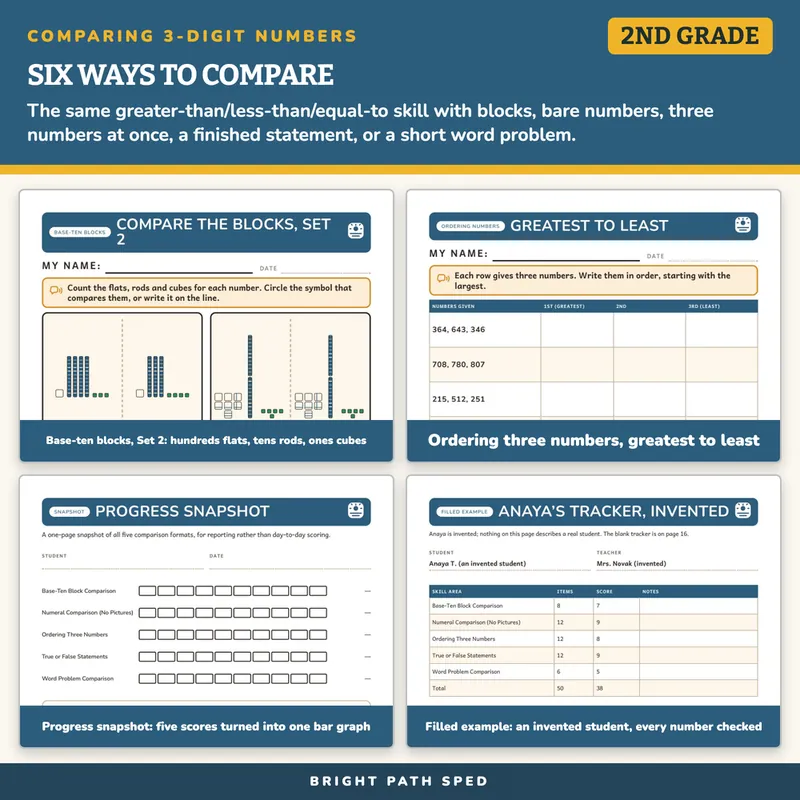
- 8 Base-Ten Block Comparison items across 2 pages — two 3-digit numbers shown as hundreds flats,
tens rods and ones cubes, side by side; circle or write the symbol
- 12 Numeral Comparison items on 1 page — no pictures at all, the quick, abstract version
- 12 Ordering items across 2 pages — six triples least to greatest, six triples greatest to least
- 12 True or False items on 1 page — a printed number sentence; decide if it is correct
- 6 Word Problem items on 1 page — two invented people or groups, a 3-digit count of plain
countable things, who has more
- 3 answer keys, generated from the same numbers every worksheet uses
- 1 practice tracker (one student, five comparison formats), 1 progress snapshot (a bar graph
rolling the five scores into one picture), and 1 class grid (whole class), type-in or print
- 1 family update — a note home with blanks for the week's formats and the district's own wording
- 1 home practice page — a second, self-contained practice set for a family to use together, with
no school materials needed
- 1 filled example — an invented student, every number checked against its own table
- 1 phrase bank — progress-note, family-note, next-step and talk-first starters
- 1 binder cover with a spine label and six divider tabs
- Start Here, a how-it-works page, and a contents page that gives every page number
Every Number Is A Genuine 3-Digit Number
Every number in this file is checked at build time to fall between 100 and 999 — on the
worksheets, the answer keys, the filled example and the tracker. Nothing drifts to a 2-digit or
4-digit number anywhere.
Every Symbol, Order And Answer Computed, Never Typed
Every "greater than," "less than" or "equal to" in this file comes from comparing the two numbers
themselves in code. The ordering pages' correct order is Python's own sort on the same triples
printed. The true/false page's answer is the same comparison function checked against the symbol
actually printed — so some statements are deliberately false, not all true. The word problems'
"who has more" is the same function, applied to the two counts named in each story. There is no
second, hand-typed key anywhere in this file.
Five Ways To Compare
Base-ten blocks show two numbers as hundreds flats, tens rods and ones cubes — count each number's
blocks, then compare. Numeral comparison drops the picture. Ordering asks for three numbers at
once, in both directions. True or false flips the task around: is a finished statement correct?
Word problems ground the same comparison in a two-sentence story about an invented person or group.
Type In, Or Print
The name and date lines, the symbol lines, the ordering blanks, the tracker, the snapshot, the
class grid, the family update and the home page are type-in fields in any PDF reader; every block
and every number is always printed, never typed. This is a fillable PDF; it is not a Google
Slides, Google Docs or PowerPoint file.
Who This Is For
Second-grade classrooms (and first-grade classrooms ready for 3-digit numbers), self-contained and
resource rooms, and any small group working on comparing 3-digit numbers below or above grade
level.
What This Is, And What It Is Not
A comparing-3-digit-numbers practice set with the record-keeping around it. It is not a full math
curriculum, not an assessment, and not a claim about any student's age, grade level or rate of
progress. The tracker has a blank line for your own scoring criteria.