Coping Skills Toolbox
- 28 pages
- 2nd, 3rd, 4th, 5th, 6th
$1.75 $3.50 on Teachers Pay Teachers
Half the Teachers Pay Teachers price. The same PDF, sold direct.
DownloadOr get it with All-Access: pick any 20 resources a month for $7.
New here? Your first month of All-Access is half off with code TEACHERTOK
Already bought this, or a member?
Instant download. One teacher's license: colleagues need their own copy. Each file carries a license number.
Also on Teachers Pay Teachers: see the Bright Path Sped store
About this resource
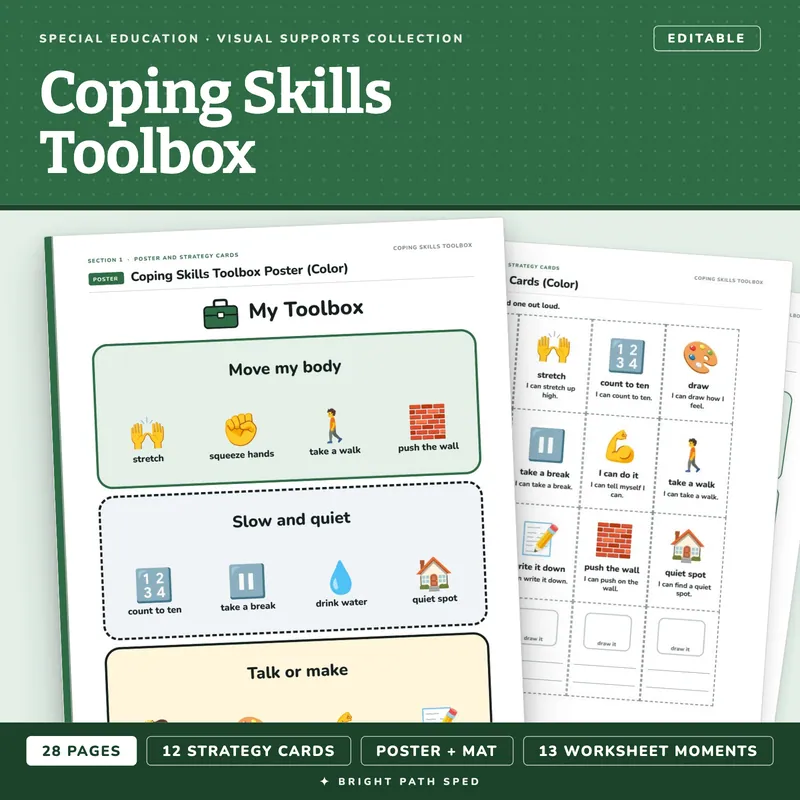
Print-and-go coping skills toolbox for grades 2-6. A toolbox is a set of things a student can try when a problem feels big. Students look at a poster of 12 tools, sort 12 strategy cards into three rows, circle a tool that could help on everyday problems, then pick five tools for their own toolbox. A tool check to color and a log turn it into something a student practices all week.
EVERYTHING INSIDE — 28 pages
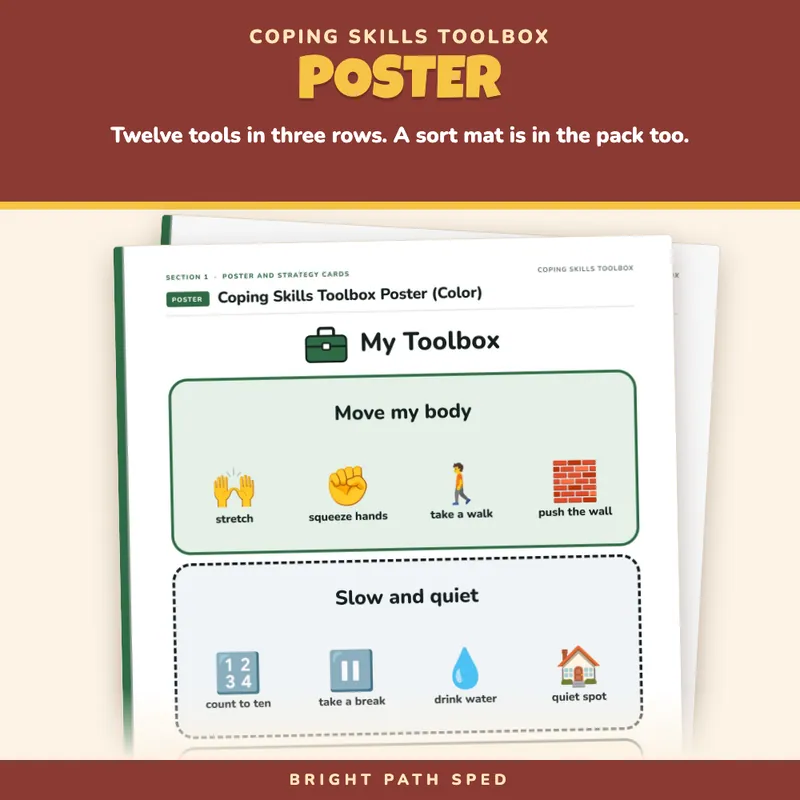
- A Coping Skills Toolbox poster: 12 tools in 3 rows of 4, with a picture and a few words for each (color page and black-and-white ink-saver page)
- A sort mat: three rows (Move my body, Slow and quiet, Talk or make), with 12 card-sized boxes the cards sit in
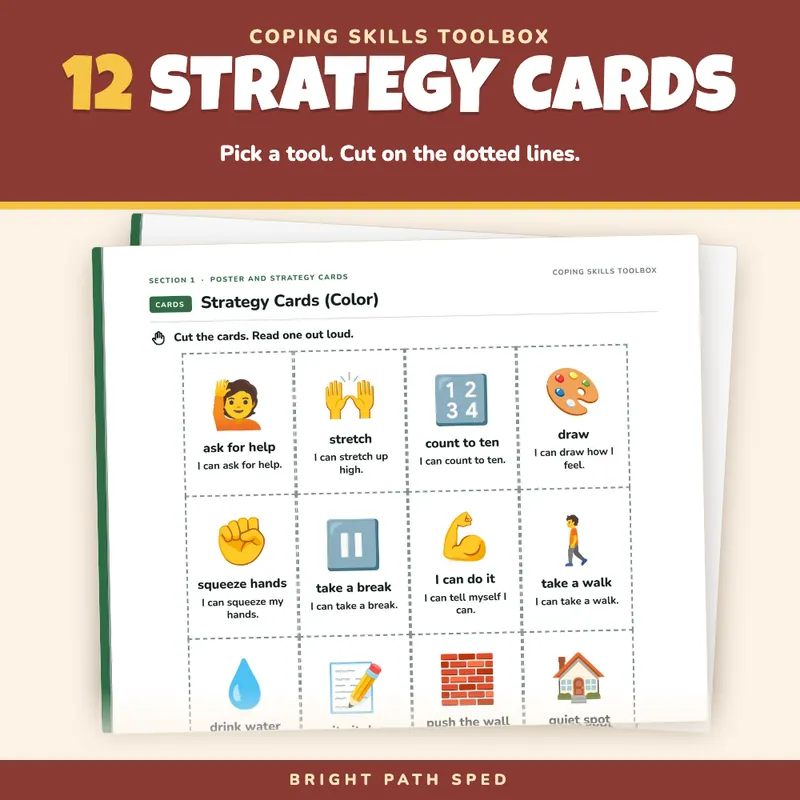
- 12 strategy cards to cut, 4 across and 3 down, cut on the dotted lines. Each has a small picture, a few words and a short "I can" line the student reads: ask for help, stretch, count to ten, draw, squeeze hands, take a break, I can do it, take a walk, drink water, write it down, push the wall and quiet spot
- The same 12 cards in black-and-white ink-saver
- 24 blank strategy cards (16 on a page of their own, plus a row of 4 under the cards on the color page and on the ink-saver page): the student draws a picture and writes their own tool
- Which Tool Could Help? 8 everyday problems on 2 pages, 4 tools to look at on each: the student reads the problem and circles a tool that could help
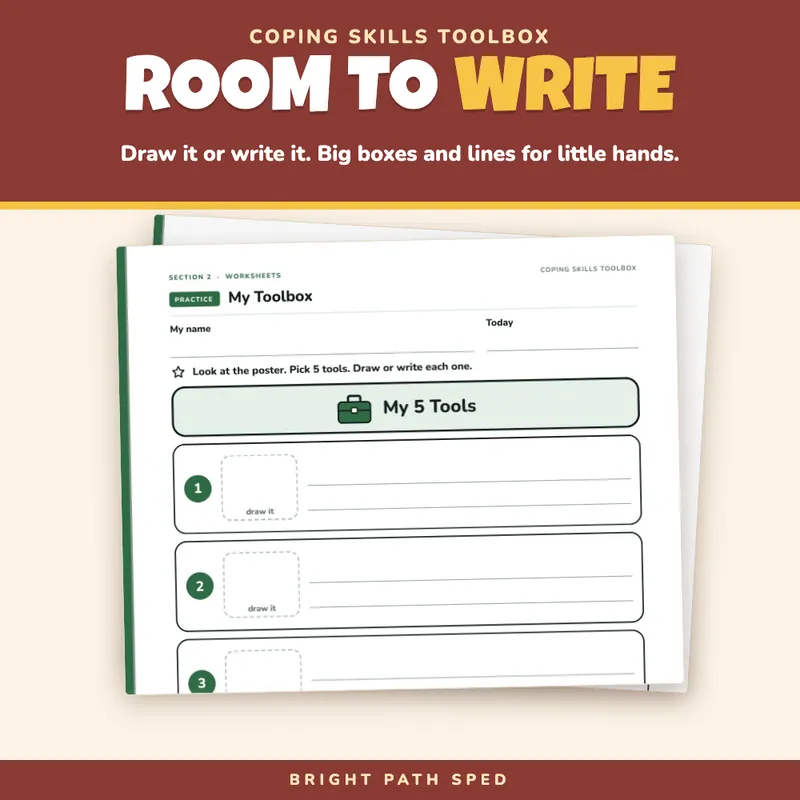
- My Toolbox: pick 5 tools from the poster and draw or write each one
- My Plan: draw a time I needed a tool, then write my first tool, what I will do if that is not enough and a grown-up who can help
- My Tool Check: 15 circles (5 days, 3 times a day) to color each time the student used a tool
- A how-to page and an answer key for the cards and the 8 problems, with a space for your school's own words
- A Tool Log (20 rows: date, when, tool, tried it Y/N, initials)
- A weekly roll-up (8 weeks) with a percent graph
- A filled example: an invented student, one week on the log, three weeks on the roll-up and the kinds of tools that came up across all three
- A family page with 6 small cards to cut apart and a note home
- A hand-off page so a paraprofessional or another classroom uses the same tools the same way
- A phrase bank: 23 lines in 6 groups (spoken lines for the poster, cards and worksheets; written starters for the log, the roll-up and the note home)
- A storage and binder label sheet: 12 labels and a spine strip
- Start Here, a contents page that maps every page, and a "what's next" back page
The Student Pages
Every student page has a "My name" line, one short instruction with a picture, big pictures and big rounded words, and room to circle, color, draw or write. The problems are everyday ones from the classroom and the playground. The student in the filled example is invented.
The Strategy Cards
Twelve cards in three rows of four. Use them on the mat, in a small group, as a quick sort at the desk, or hand a student two or three at a time. A blank card holds any tool that is not printed here, and your classroom's own rules come first.
What This Is, And What It Is Not
It is a fillable PDF: type into the name lines, the log, the roll-up, the family page, the hand-off page and the blank cards, or print and use a pen. It works offline with no account or subscription. It is NOT an editable online slideshow or word-processor document.
Who This Is For
Teachers, counselors, special education teachers and paraprofessionals who want a concrete, picture-based way to talk about tools a student can try, for grades 2-6, and the families who get the home page.
More In The Collection
This set is in the Visual Supports Collection, alongside Self Control Worksheets, Positive Self Talk Swap Cards, Poster and Tracker and Circle of Control Activity. Free to try first: Visual Supports Starter Set FREE.
Pictures (color pages): Noto Emoji by Google, Apache License 2.0. Pictures (ink-saver pages): Fluent Emoji, Copyright (c) Microsoft Corporation, MIT License.