Cutting Practice Preschool Binder
- 150 pages
- PreK, Kindergarten, 1st
$7.50 $15.00 on Teachers Pay Teachers
Half the Teachers Pay Teachers price. The same PDF, sold direct.
DownloadOr get it with All-Access: pick any 20 resources a month for $7.
New here? Your first month of All-Access is half off with code TEACHERTOK
Already bought this, or a member?
Instant download. One teacher's license: colleagues need their own copy. Each file carries a license number.
Also on Teachers Pay Teachers: see the Bright Path Sped store
About this resource
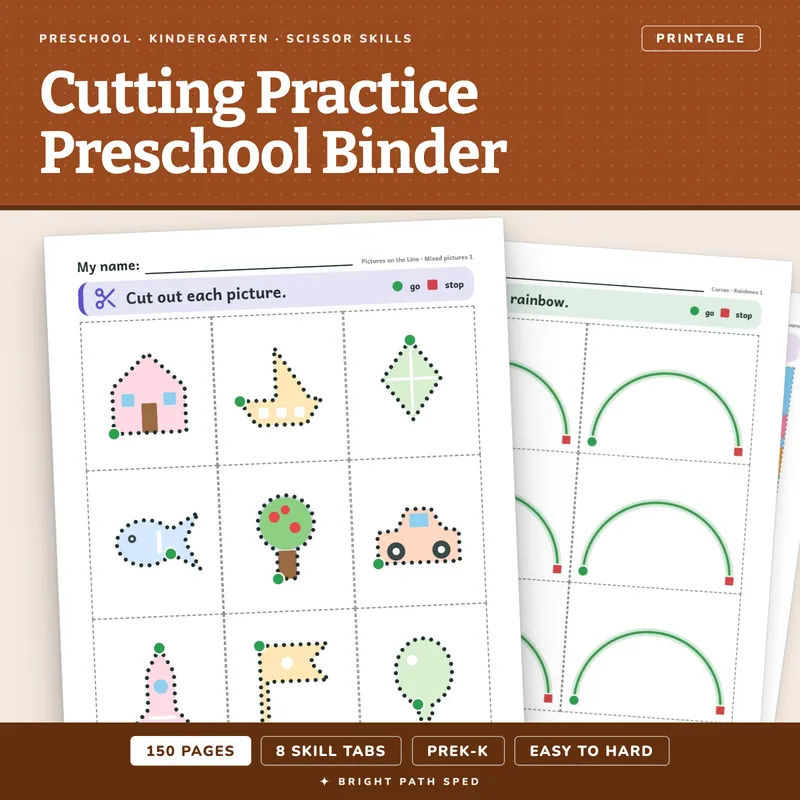
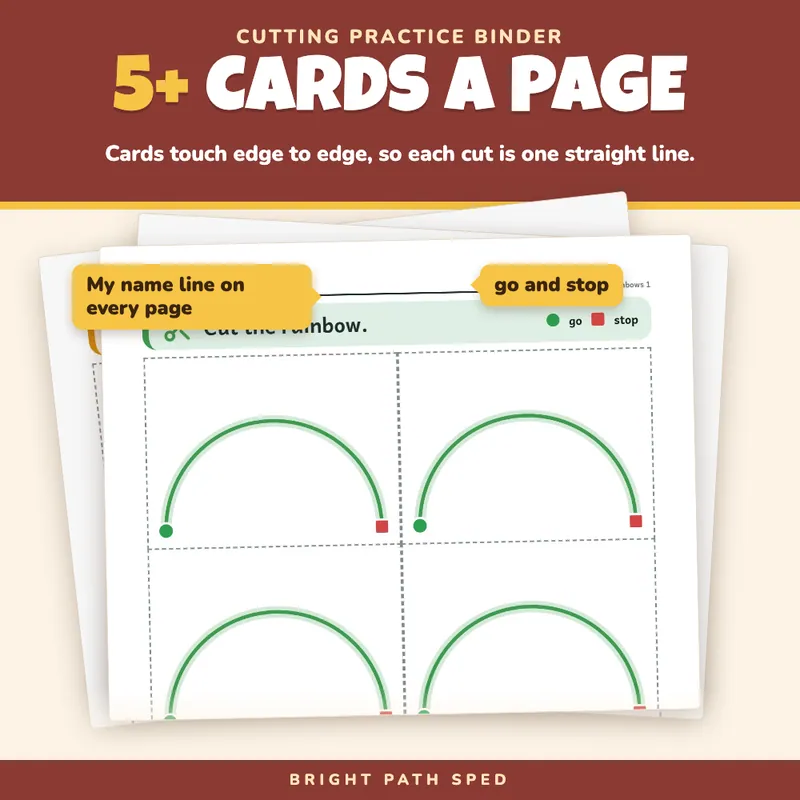
Cutting practice for preschool and kindergarten that goes from the easiest cut to the hardest, in one binder. Eight tabs, 150 pages, 850 cards to cut. A child starts with short straight lines and ends with picture puzzles to cut apart and paste. Every student page has a My name line, one short instruction with a picture of scissors, and big cards that touch edge to edge, so the first cuts are straight lines and each page is easy to cut.
How A Cutting Page Works
Each cutting page is a grid of 5 to 16 cards. The child cuts the page into cards along straight edges, then cuts the line on each card. A round dot says where to start and a square says where to stop. A circle or a shape has only a dot: cut all the way around and come back to it. Every card is at least an inch on each side, and none floats loose on the page.
EVERYTHING INSIDE (150 pages)
- 8 tabs of 17 pages each = 136 pages: 8 dividers, 8 teacher pages, 112 practice pages, 8 progress checks.
- 112 practice pages: 105 cutting pages and 7 paste pages. The 105 cutting pages hold 850 cards (5 on the pages with the longest lines, up to 16 on the small-shape pages).
- 13 front pages: a binder cover, terms of use, two contents pages, Start Here (three steps, what is in each tab), Before You Cut (how a page works, setting up), a week-by-week plan and a year plan, a progress tracker, a filled-in example for an invented child, a family update, a hand-off note, a page of words to use while cutting, and a page of spine and tab labels to cut out.
- 1 back page with four next products in this collection.
THE EIGHT TABS, EASIEST TO HARDEST (pages)
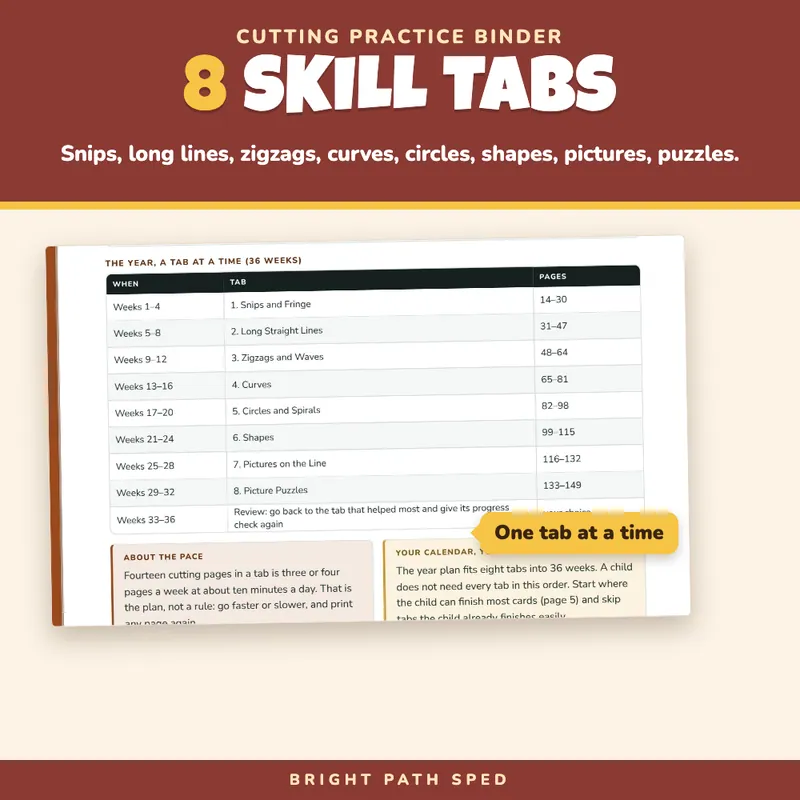
1. Snips and Fringe (14-30): short lines across, up and down and slanted, two and three lines, then fringe from every side. 14 cutting pages, 125 cards.
2. Long Straight Lines (31-47): long lines across, up and down and slanted, corner to corner, then corners, steps and rectangles. 14 cutting pages, 105 cards.
3. Zigzags and Waves (48-64): zigzags with more and more points, teeth, steps, and waves. 14 cutting pages, 96 cards.
4. Curves (65-81): smiles and hills, rainbows with one, two and three arcs, S curves, corner curves and hooks. 14 cutting pages, 108 cards.
5. Circles and Spirals (82-98): big and small circles, ovals, rings, and spirals with one and a half to three turns. 14 cutting pages, 118 cards.
6. Shapes (99-115): squares, rectangles, triangles, circles, diamonds, ovals, half circles and hexagons on dotted lines, then mixed shapes and shapes inside shapes. 14 cutting pages, 131 cards.
7. Pictures on the Line (116-132): simple pictures made of plain shapes, cut out along a dotted outline: straight sides first, then curves, then mixed pages. 14 cutting pages, 105 cards.
8. Picture Puzzles (133-149): seven pictures, each a pair of pages. Cut the page into squares, then paste each square on the mat on the next page. From 6 squares to 12. 7 cutting pages, 62 squares, and 7 paste pages. The first four mats show a faint copy of the picture; the last three show only a small picture.
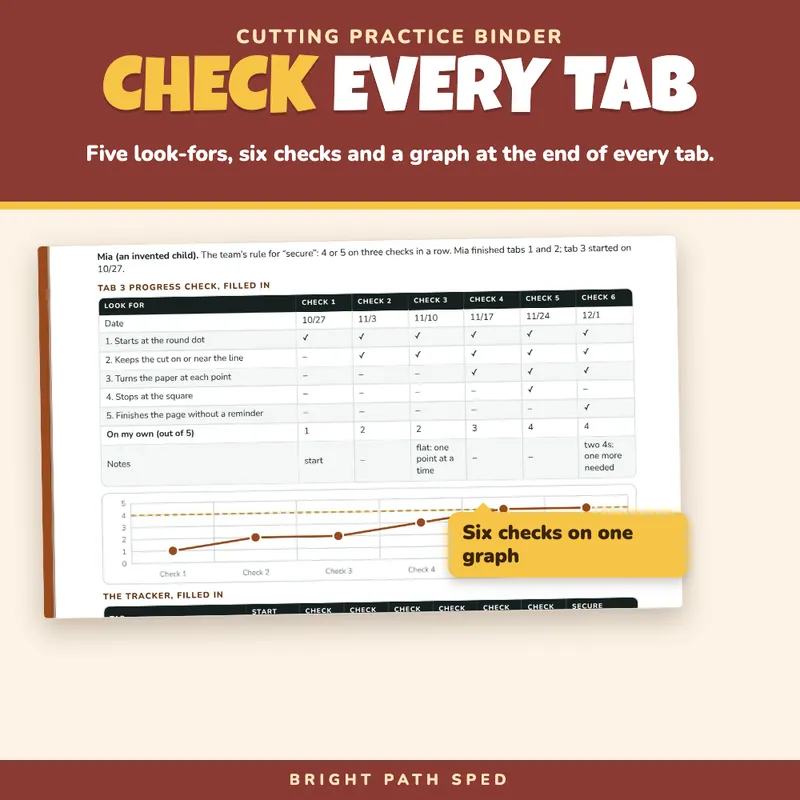
Every tab has the same shape: a divider that lists its pages, a teacher page (how to show it, try it together, try it alone, what to say, easier and harder), 14 practice pages, and a one-page progress check with five look-fors, six checks and a graph.
How To Use It: A Four-Week Tab
- Week 1, show it: read the teacher page, cut the first card together, cut the second side by side.
- Week 2, try it with help: two or three pages, a few cards at a time.
- Week 3, try it alone: the child cuts without help; keep the cuts in a folder.
- Week 4, check and decide: the last pages, the progress check and its graph, then copy the score to the tracker and pick the next tab.
A 36-week year plan for all eight tabs is on page 7. Ten minutes a day works in a classroom, a fine motor center, one-to-one time or at home.
What This Is, And What It Is Not
This is a practice binder for scissor skills with a progress check for each tab. It is a PDF: print it. The cutting pages are made to be printed and cut; the name lines, tracker, check pages and notes can also be typed into. It is not a curriculum, not a test, not therapy or a treatment plan, and not Google Slides, Google Docs or PowerPoint. The progress checks carry no benchmark score; your team decides what counts as secure. For how to hold scissors or help a child who finds cutting hard, ask your school OT or your district. The example child is invented. No clip art: every line and picture is drawn for this file, and no picture has a word on it.
Who This Is For
Preschool and kindergarten teachers, early childhood special education teachers, paraprofessionals, tutors, homeschool families and anyone who runs a fine motor center and wants cutting practice that gets harder one small step at a time.
More From This Collection
Cutting Practice | Scissor Skills Worksheets, Lines, Shapes, Spirals PreK-K is a shorter set of cutting worksheets. Alphabet Tracing | Uppercase and Lowercase A-Z Trace and Write Worksheets PreK-K goes with the same young learners. OT Fine Motor and Sensory Progress Monitoring Data Sheets and Handwriting Fluency Progress Monitoring Probes are for teams that keep records.