Daily Routine Sequencing Cut and Paste 3 Levels
- 26 pages
- PreK, Kindergarten, 1st, 2nd
$4.00
DownloadOr get it with All-Access: pick any 20 resources a month for $7.
New here? Your first month of All-Access is half off with code TEACHERTOK
Already bought this, or a member?
Instant download. One teacher's license: colleagues need their own copy. Each file carries a license number.
Also on Teachers Pay Teachers: see the Bright Path Sped store
About this resource
"Sequences the steps of a familiar routine" is on the IEP of nearly every K–2 student in a self-contained
room and on most speech caseloads as a first-next-last goal. This is the pack for that goal: six routines from the
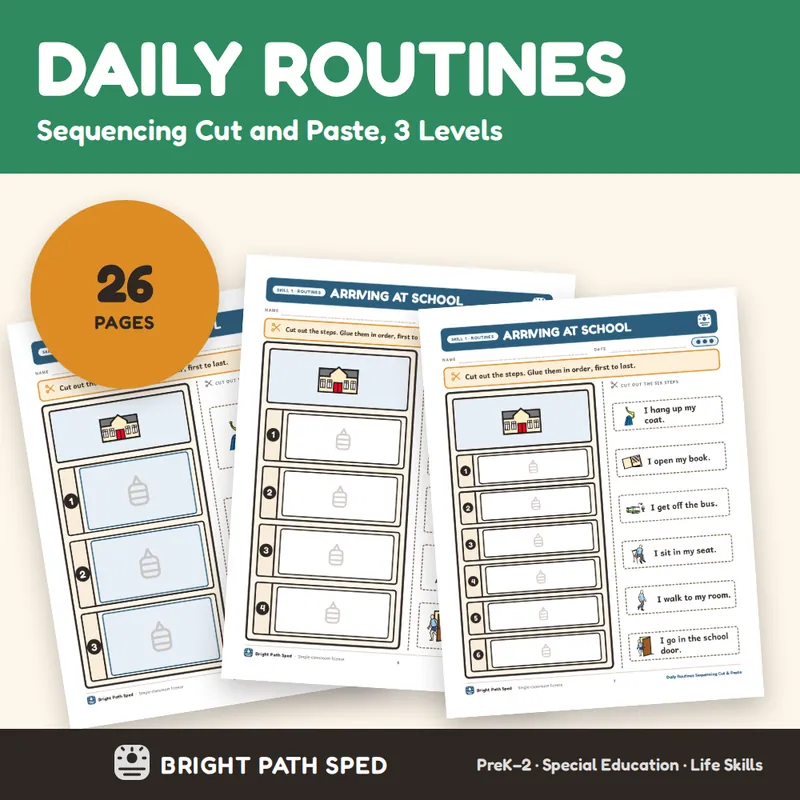
school day and self-care, every step a picture symbol with its sentence printed beside it, cut out and glued in
order on a numbered board. Five skills, three levels of every one.
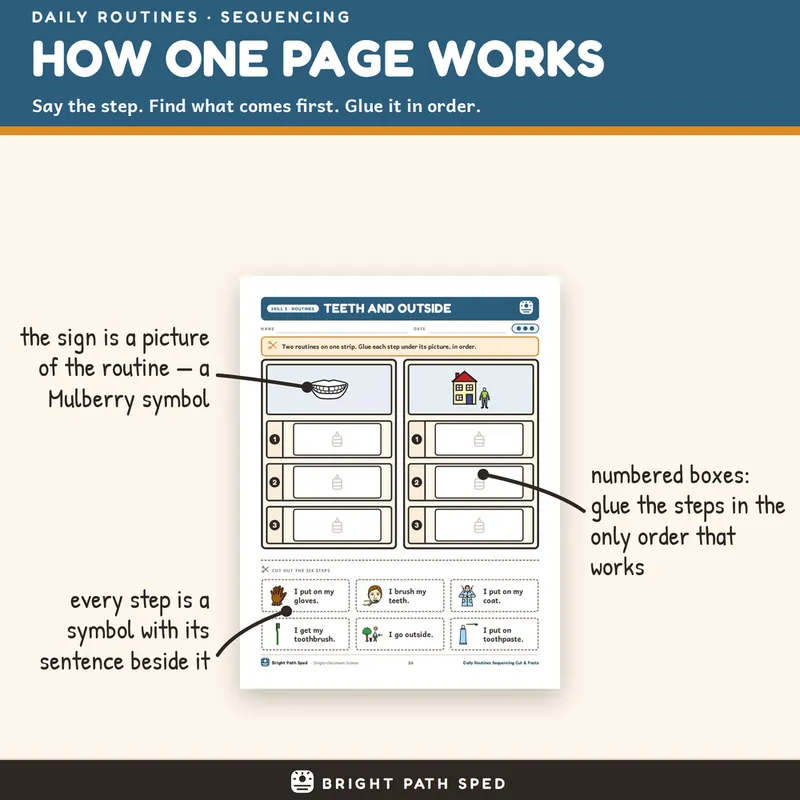
The page is a board with the routine's picture on its sign and numbered boxes down it. The cut strip holds
the steps, scrambled: a symbol and a short sentence on each card — "I get off the bus." "I hang up my coat."
"I sit in my seat." Say the step, ask what has to happen first, glue it in box 1, and keep going.
The Pictures Are Mulberry Symbols
Every picture in this pack is a Mulberry symbol, the open AAC symbol set (CC BY-SA 4.0), printed exactly as
that set draws it. That matters for a routine: a symbol set draws the verbs — getting off a bus, hanging up a
coat, washing hands, brushing teeth — that emoji cannot. Every symbol was rendered at the size it prints, in
color and in grayscale, and looked at before it was allowed on a card, and for every one I wrote down the
other names a five-year-old might give it and checked that each name still names the same step.
The Order Is The Only Order
Every routine here was chosen so that no two of its steps could honestly be swapped: each step makes the
next one possible. The backpack goes on over the coat. The towel is no use to wet hands that have not been
washed. The trash exists only after the eating. A student who glues two steps the other way round has built
something that cannot happen, and that is what makes the answer key a key and not an opinion.
How The Three Levels Work
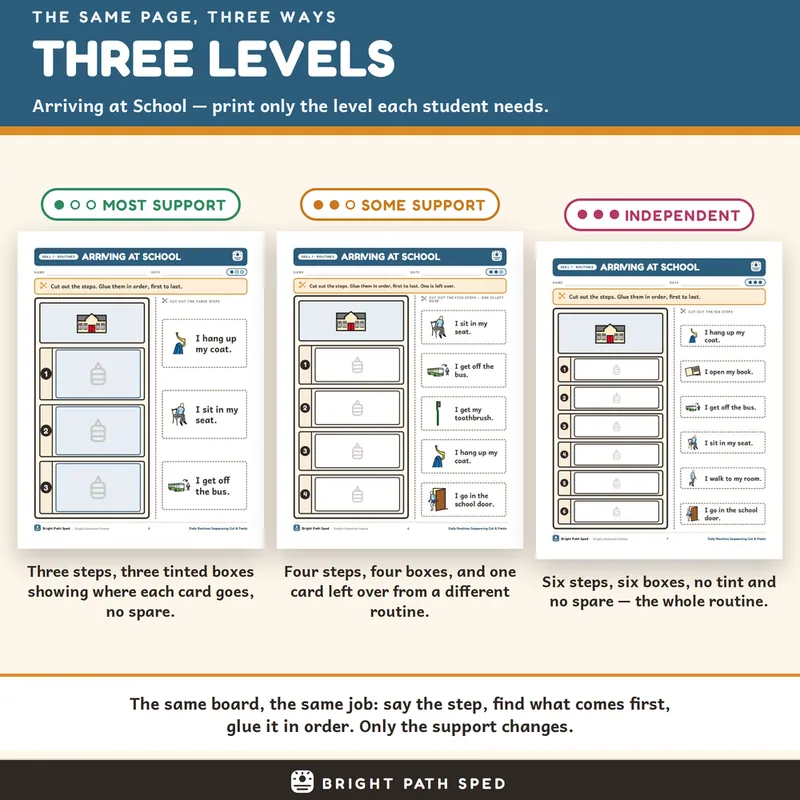
Level 1 — three steps, three tinted boxes showing where each card goes, and no spare piece.
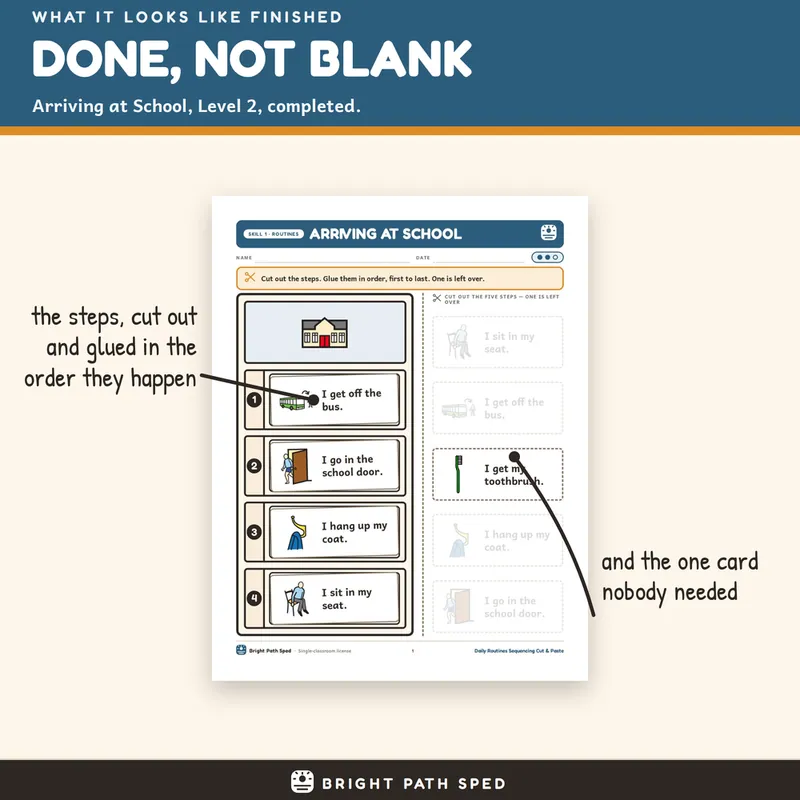
Level 2 — four steps and one card left over: a step from a routine that is not on the page, so a student
who uses every card up has put one somewhere wrong. The page says so: one is left over.
Level 3 — six steps of the whole routine, no tint and no spare; on the last skill, two routines of three
steps each, mixed on one strip, sorted onto two signed boards and then put in order.
On every one of the 15 worksheets the cut strip is scrambled: a student who cuts the cards in order and glues
them top to bottom without deciding scores at most half the boxes on any page.
The Five Skills
1. Arriving at School — off the bus, in the door, coat on the hook, sit down, open the book
2. Washing Hands — water on, soap, wash, paper towel, dry, towel in the trash
3. Going Home — coat on, backpack on, line up, walk to the bus, get on, sit down
4. Eating Lunch — lunch box, open it, eat, trash, wipe the table, out to play
5. Teeth and Outside — brushing teeth, then going outside, then both routines on one strip
What Is In The File
- 26 pages, one PDF
- 5 scripted lesson plan pages — a script in quotation marks a substitute could read cold, three level
notes, three "if a student is stuck" tips with the likely cause named, a try-it-today idea and a data
box on every plan
- 15 student worksheets (5 skills x 3 levels)
- 2 pages of answer keys, recomputed from the same data that draws the worksheets
- 1-page "how to use this packet" guide that says exactly what is printed on a student page
- A name and date line, a big direction line and a cut rule on every worksheet
- No level word and no teacher note anywhere on a student page: the three dots on the name line are the
level code, and they are there for you, not for the child
Who This Is For
What This Is, And What It Is Not
A print-and-cut worksheet packet with a scripted plan page in front of each skill. It is not a fillable
form, not a visual schedule, not a full curriculum, and not a claim about how quickly any student will learn
a routine — every objective is written the way a classroom goal is written, with no clinical or legal claim
attached to it.