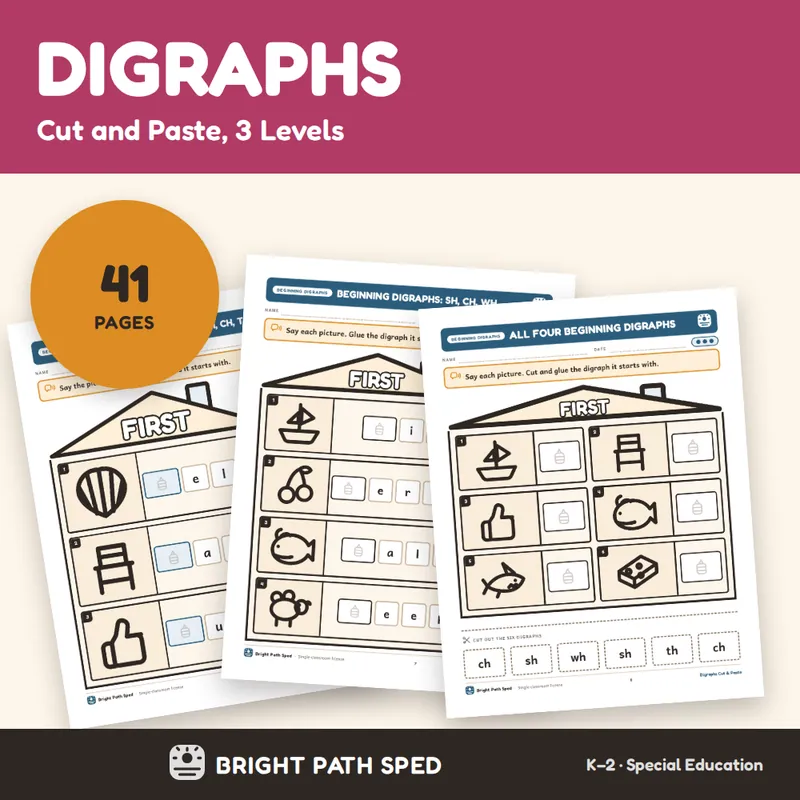
Digraphs Cut and Paste Worksheets 3 Levels Differentiated Phonics SPED
- 41 pages
$4.00
DownloadOr get it with All-Access: pick any 20 resources a month for $7.
New here? Your first month of All-Access is half off with code TEACHERTOK
Already bought this, or a member?
Instant download. One teacher's license: colleagues need their own copy. Each file carries a license number.
Also on Teachers Pay Teachers: see the Bright Path Sped store
About this resource
Nine digraph skills. Every one of them printed three times, at three levels of support, so the whole room can work the same page at the same time.
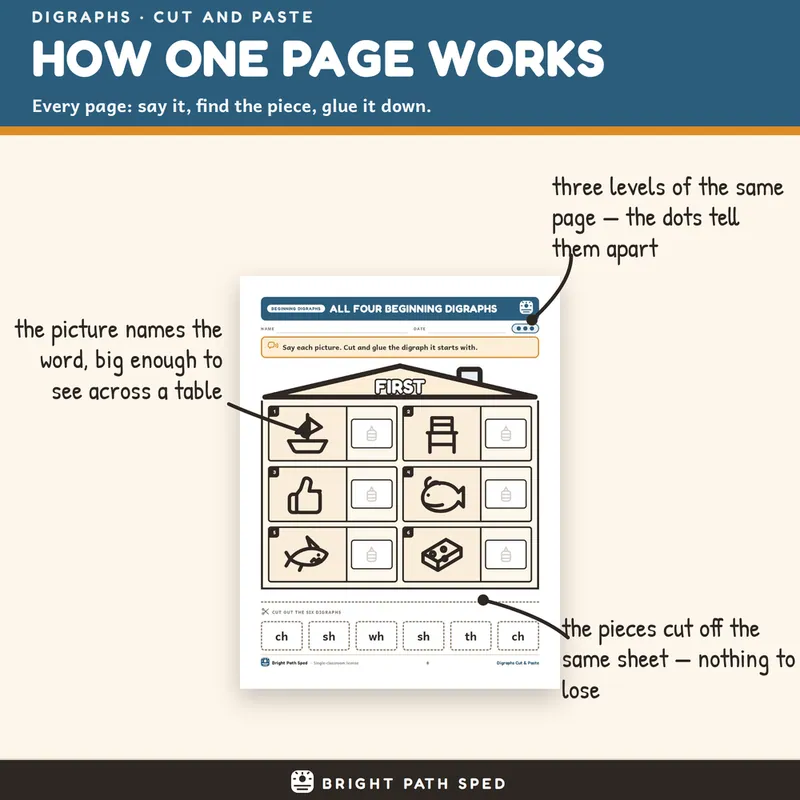
Twenty-seven cut-and-paste worksheets in one PDF. The cut strip sits on the same page as the work, so nothing gets separated on the way to the desk. Nothing in here is seasonal, so it prints in September and it prints in April.
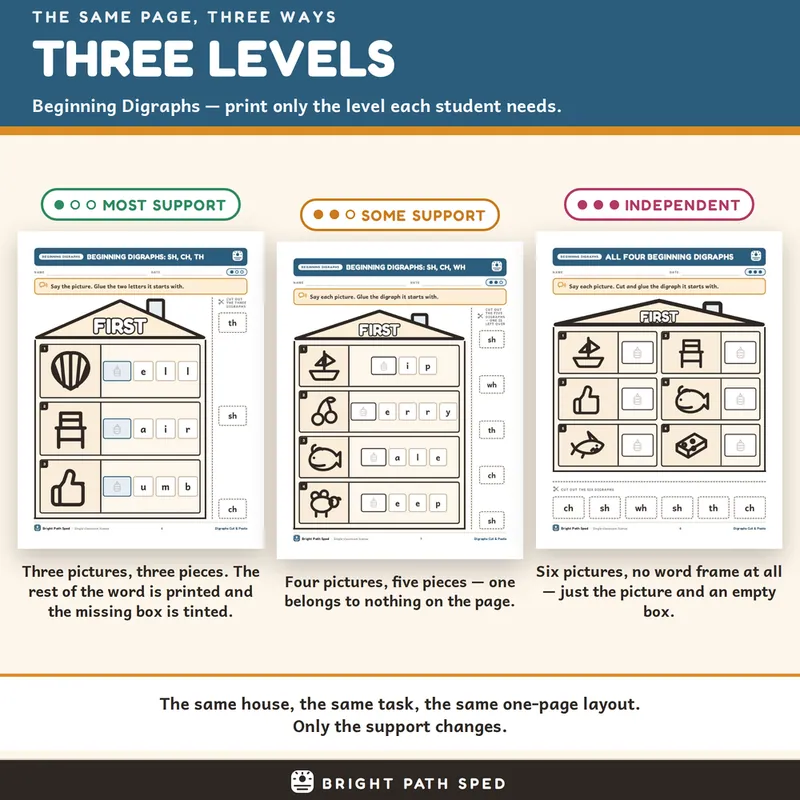
How The Three Levels Work
Level 1 — two or three pictures. The rest of the word is printed and the missing slot is tinted, so the student can see exactly where the digraph goes. There are exactly as many pieces on the strip as there are slots, so there is no wrong piece to pick up.
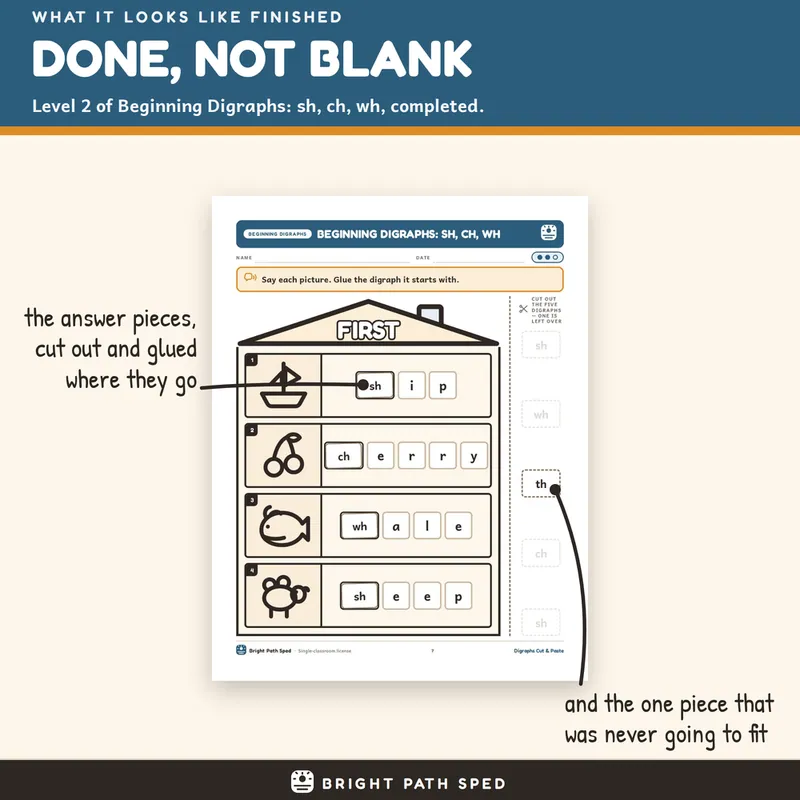
Level 2 — four pictures and five pieces. The tint is gone and one piece belongs to nothing on the page, so the student has to reject something instead of matching everything.
Level 3 — six pictures, a full strip and no word frame at all. Beginning and ending digraphs are mixed instead of blocked, so a student cannot ride one position down the page.
Every Slot Is The Same Width
Three of these worksheets ask the hardest question in the unit: is that one letter or two? On those pages the empty slot is exactly as wide for sun as it is for ship, and every cut piece is the same size. If the one-letter box were narrower, a student could finish the page by measuring instead of listening, and the score would tell you nothing.
The Nine Skills
1. Beginning digraphs — sh, ch, th, wh
2. Ending digraphs — sh, ch, th, ck, ng
3. Digraph or single letter? — s against sh, c against ch, t against th
4. Beginning or ending? — sorting the same words by where the digraph sits
5. Building digraph words from three pieces
6. Matching the word to the picture
7. Reading the word and choosing the picture
8. Sorting pictures onto sh, ch, th and ck mats
9. Building the whole word from its digraph and a printed rime
Three Boxes For A Five-Letter Word
On the building pages chick gets three boxes, not five, because ch is one sound and ck is one sound. Counting boxes instead of letters is the entire idea, and it is the thing that transfers to spelling.
ck NEVER STARTS A WORD
That is worth a whole minute of teaching, so it is built into a page: on one Level 2 strip the leftover piece is ck, and it cannot be the answer anywhere because it cannot begin an English word. The answer key says so in as many words.
Why The Spare Piece Cannot Be Forced In
Every Level 2 strip has one leftover, and none of them can be made to fit: th makes nothing with ip, erry, ale or eep. ch makes nothing with di, so, swi or mo. th makes nothing with chi, du or fi. Checked one by one, not assumed.
About The Pictures
A picture a child could name three ways is a broken phonics item. Every picture on a page that prints no word has one obvious name — ship, shell, shark, sheep, fish, chair, cheese, chick, bench, thumb, teeth, whale, wheel, duck, sock, clock, ring, swing, brush, cat, sun, tent. The ones that could go two ways (the dish, the cherries, the moth that might be a butterfly) only appear where the word, the rime or the letter frame is printed beside them.
What Is In The File
- 41 pages, one PDF
- 27 worksheets (9 skills x 3 levels)
- 6 colour section dividers for your binder
- 1-page teacher guide to the three levels, with what to do when a student is stuck
- 3 pages of answer keys, with the spare Level 2 piece named on every line
- Name and date line and a scissors rule line on every worksheet
- Black-line art with a colour accent on the level banner only, so a grayscale copy works exactly as well as a colour one. There is no separate B&W file because you do not need one.
Who This Is For
Self-contained, resource and intervention classrooms, and any elementary room with a wide reading range in it. Also a progress-monitoring set: a clean Level 3 in March beside a Level 1 in October is a data point you can put in a report.
Pairs With
CVC Words Cut and Paste, Blends Cut and Paste, and Silent E Cut and Paste — same page anatomy, same three levels, same picture style.