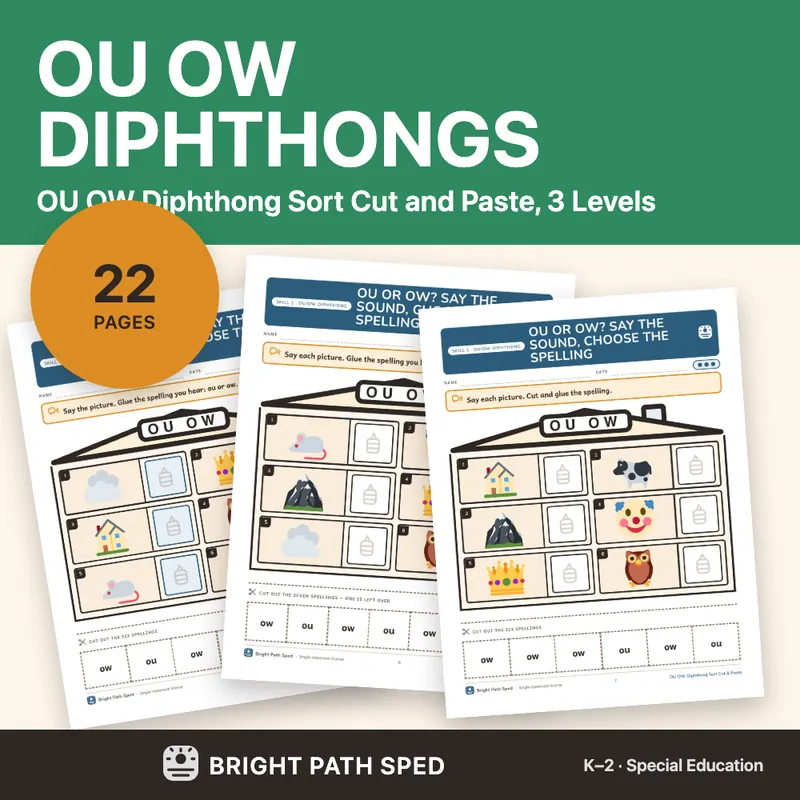
Diphthongs OU OW Sort Cut and Paste 3 Levels
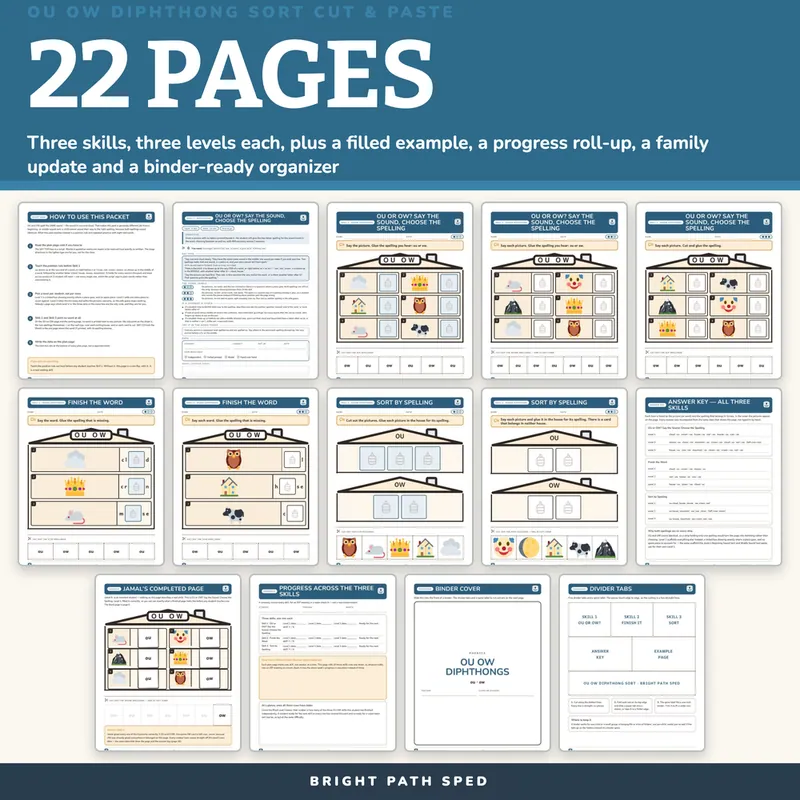
- 22 pages
- Kindergarten, 1st, 2nd
$2.00 $4.00 on Teachers Pay Teachers
Half the Teachers Pay Teachers price. The same PDF, sold direct.
DownloadOr get it with All-Access: pick any 20 resources a month for $7.
New here? Your first month of All-Access is half off with code TEACHERTOK
Already bought this, or a member?
Instant download. One teacher's license: colleagues need their own copy. Each file carries a license number.
Also on Teachers Pay Teachers: see the Bright Path Sped store
About this resource
Three skills, one OU/OW job each, three levels of every single one.
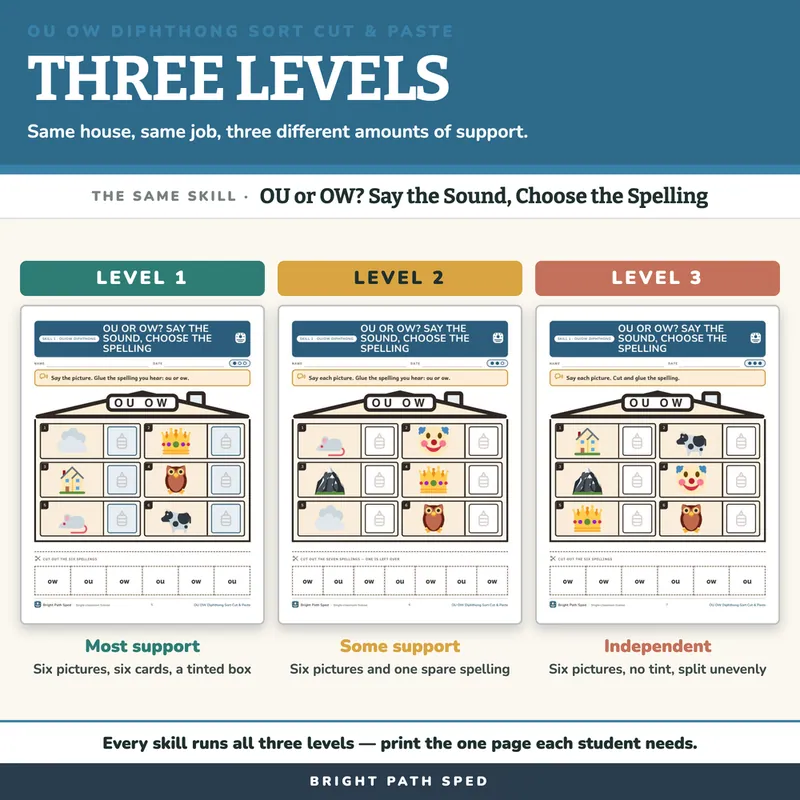
How The Three Levels Work
Level 1 — a tinted box showing exactly where the piece goes, and no spare piece to account
for. Both spellings are still on the strip, because choosing between them IS the skill.
Level 2 — the same job, no tint, and one spare piece: an extra copy of a spelling already in
play, so a student who counts the pieces instead of thinking about position gets the page wrong.
Level 3 — no tint, no spare (Skills 1-2) or a new mix of words for a second look (Skill 3);
every level draws from the same eight-word bank, with the specific subset rotated so a student who
sees more than one level still meets different words.
The Three Skills
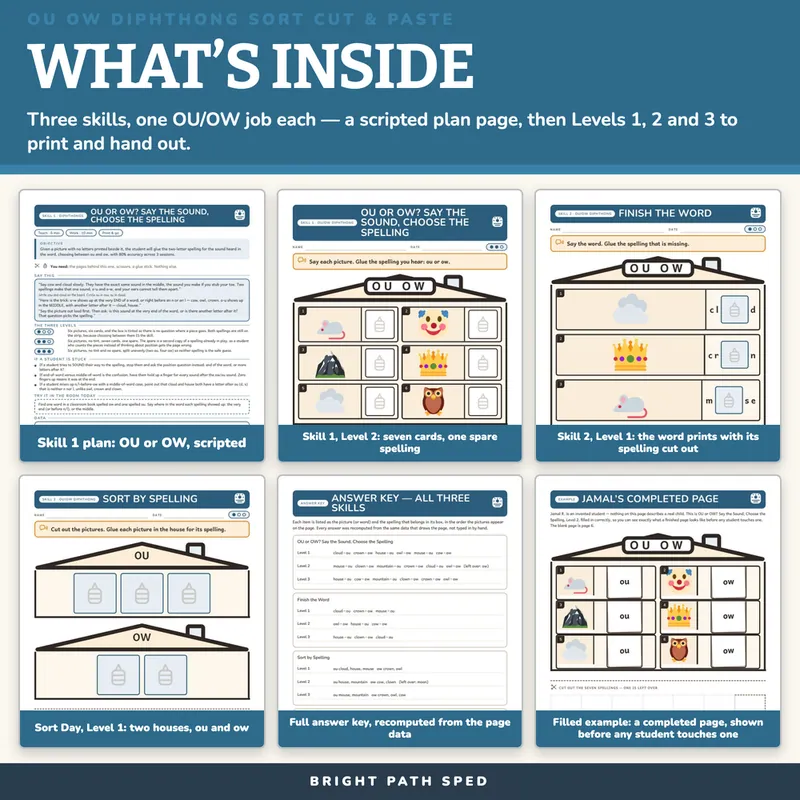
1. OU or OW? Say the Sound, Choose the Spelling — a picture only, nothing printed; glue the
spelling you hear, using the position rule
2. Finish the Word — the word is printed with its ou/ow spelling cut out of wherever it
actually falls (leading, trailing or in the middle), so reading the rest of the word is part of
the job
3. Sort by Spelling — picture cards into two houses, ou and ow
What This Is, And What It Is Not
A print-and-cut worksheet packet with a scripted plan page in front of each skill. It is not a
fillable form, not a full curriculum, and not a sound-discrimination pack the way this store's
Beginning Sound Sort or Middle Sound Sort packs are — OU and OW genuinely sound identical,
and the "How to Use" page and every plan script say so plainly rather than asking a child to guess
by ear. This pack covers the OU/OW pair only; it does not cover oi/oy or au/aw (see the scope note
above) and does not claim to. Nothing here is a timeline, an eligibility claim or a diagnosis —
every objective is written the way a classroom goal is written.
What Is In The File
- 22 pages, one PDF
- 3 scripted lesson plan pages — a script in quotation marks a substitute could read cold,
three level notes, three "if a student is stuck" tips with the likely cause named, a try-it-today
idea and a data box on every plan
- 9 student worksheets (3 skills x 3 levels)
- 1 answer-key page covering all three skills, recomputed from the same data that draws the
worksheets
- 1 filled example page — an invented student's completed page, so you can see exactly how
the position-rule mechanic works before any student touches one
- 1 progress roll-up page that turns all three skills into one sheet for an IEP meeting or a team
check-in
- 1 family-and-team update page — blanks for what you saw and what's next, plus three ways to
help at home, with no clinical or diagnostic language anywhere on it
- 1 binder cover and 1 page of 5 divider tabs (the three skills, the answer key and the example)
plus a spine label, so this drops straight into a binder, a hanging file or a bin of folders
- 1-page "how to use this packet" guide that teaches the position rule up front
- A name and date line, a big direction line and a cut rule on every worksheet
- Every cut piece sits edge to edge with its neighbor (one straight cut between pieces, never a
gap), at least five pieces on every page, in one or two short rows
- No level word and no teacher note anywhere on a student page: the three dots on the name line are
the only level code, and they are there for you, not for the child
Who This Is For
Self-contained, resource and early-intervention classrooms, and any 1st-2nd grade room moving past
short vowels into vowel-team spelling patterns. It works alongside this store's Beginning Sound
Sort and Middle Sound Sort packs (same shape, an earlier skill) once a student is ready for a
spelling-pattern decision instead of a pure listening one.
From Bright Path Sped, special education resources: teacherspayteachers.com/store/bright-path-sped