Distance Time Graphs Worksheets
- 31 pages
- 6th, 7th, 8th
$1.87 $3.75 on Teachers Pay Teachers
Half the Teachers Pay Teachers price. The same PDF, sold direct.
DownloadOr get it with All-Access: pick any 20 resources a month for $7.
New here? Your first month of All-Access is half off with code TEACHERTOK
Already bought this, or a member?
Instant download. One teacher's license: colleagues need their own copy. Each file carries a license number.
Also on Teachers Pay Teachers: see the Bright Path Sped store
About this resource
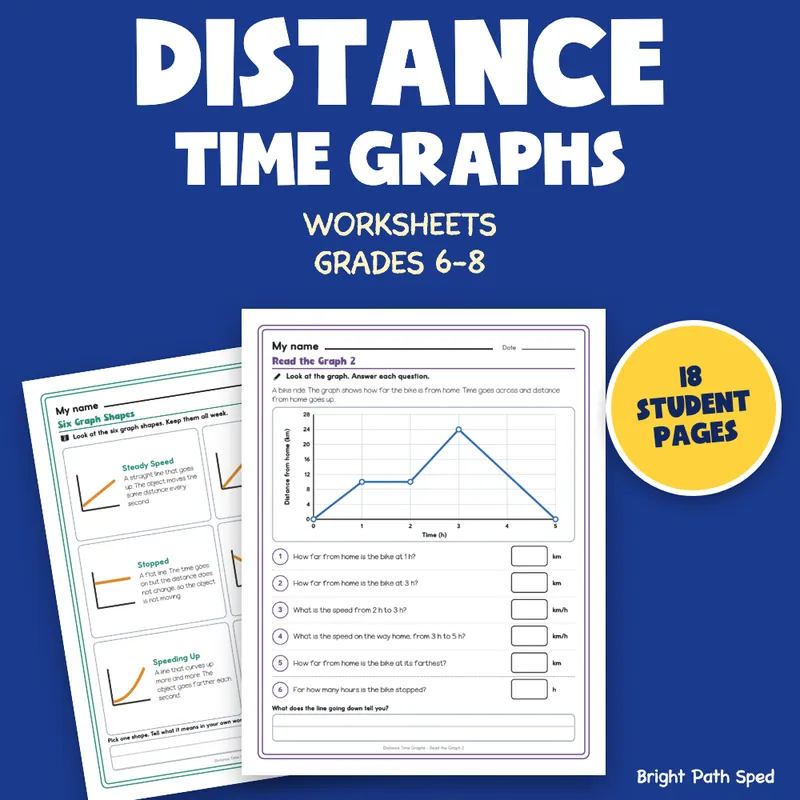
Teaching distance-time graphs and want pages students can actually work on? This is a complete unit for grades 6-8 physical science: time goes across, distance goes up, a flat line means the object is not moving, a steeper line is a faster speed, and the speed is the slope. It starts with guided notes on a labeled graph, a worked example of finding speed from two points on a line and six graph-shape cards, then moves to reading graphs, comparing two lines, matching stories to graphs (including lines that curve for speeding up and slowing down), drawing a graph from a table on a big grid, finding speed from slope, word problems, find the mistake, true or false, short answers and cut-and-paste sorts. Every student page has a "My name" line, one short instruction and real room to work. Answer keys cover every item, and a tracker, class grid and family page are included.
EVERYTHING INSIDE (31 sheets)
- 18 student sheets in 14 kinds of sheet, each with a name line and one short instruction
- 83 scored items on 15 sheets, every answer in the key computed from the same points that draw the graph
- 1 guided-notes sheet: a labeled graph and 8 fill-in-the-blank sentences with a word bank of 10 words (2 not used)
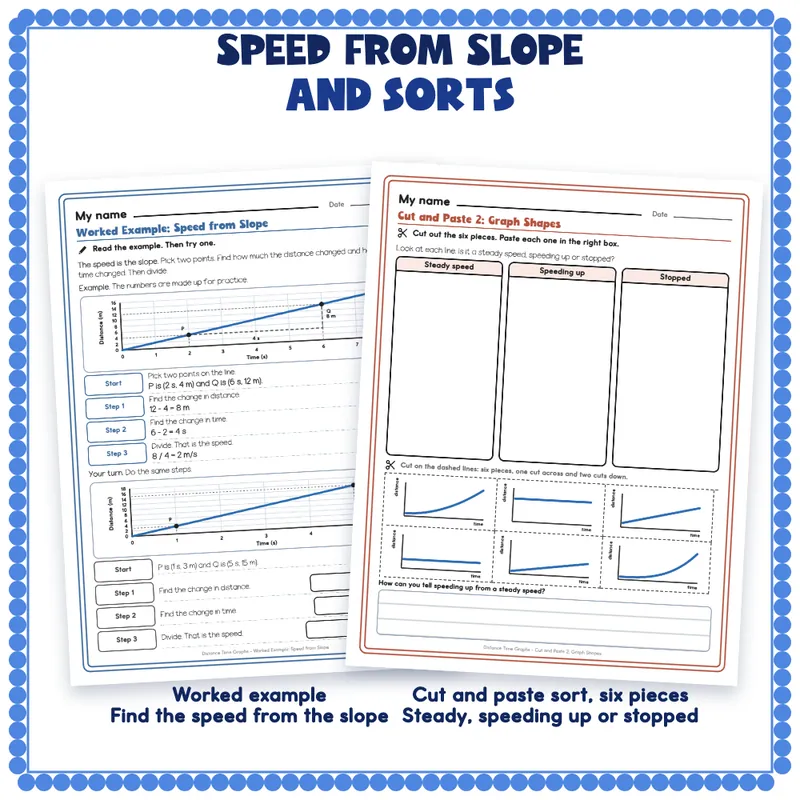
- 1 worked example: a model that finds speed from two points on a line, and a guided try-it row with its own graph
- 6 graph-shape cards on 1 sheet (steady speed, faster, stopped, coming back, speeding up, slowing down), each with a drawn picture
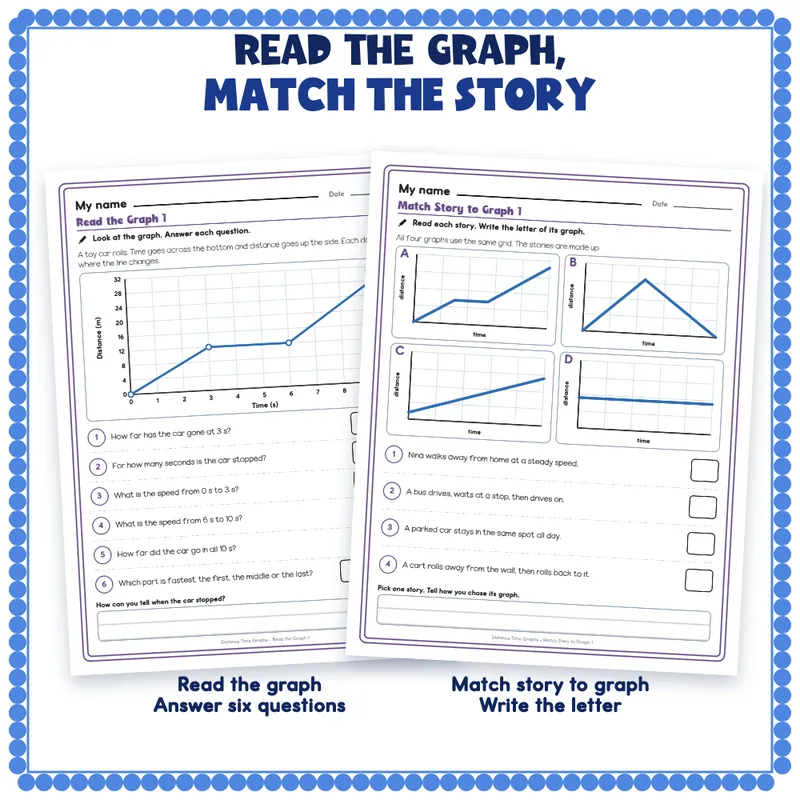
- 3 graph-reading sheets: 18 questions (a toy car with a stop, a bike ride that goes out and back, two carts compared)
- 2 match-story-to-graph sheets: 10 stories (4 with 4 graphs, 6 with 6 graphs including two curves)
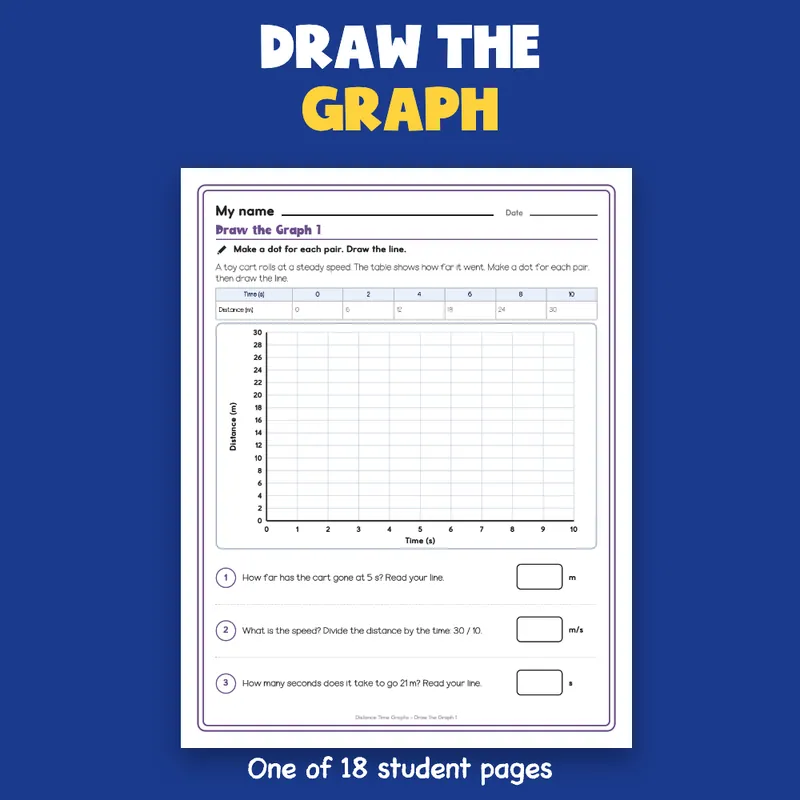
- 2 draw-the-graph sheets: a table of points and a big empty grid for each, 7 questions read off the student's own line (one steady line, one with a stop and a return)
- 2 speed-from-slope sheets: 4 lines with two marked points each, and 1 line with 4 parts (A to D) plus 2 questions, 10 items in all
- 1 word-problem sheet: 6 problems with a work box each
- 1 Find the Mistake sheet (4 items from an invented student, each with a small graph); 1 true-or-false sheet (8 sentences); 1 short-answer sheet (3 questions with a graph to describe)
- 12 cut-and-paste pieces on 2 sort mats (6 pieces each: line goes up, flat or down; steady speed, speeding up or stopped, with drawn graph pieces)
- 4 answer key sheets; 1 tracker, 1 class grid, 1 family page
- 1 filled example (an invented student), 1 phrase bank (17 starters in 6 groups)
- Start Here with a which-page-for-which-job chooser
Built For The Student Holding The Page
A "My name" line, one short instruction with a small picture cue, and a plain double-rule border. Nothing on a student page is written for an adult: the keys and records are on separate teacher sheets. The graphs are drawn large with a clear grid, and the two drawing pages give a full-width grid for pencil. Work boxes give two to four ruled lines. Every graph and diagram is drawn in the file; there are no photographs and no clip art. The file prints clean in black and white.
Invented Examples
The students in the filled example and the mistake sheet are made up and say so. The stories and scenarios are invented, and the numbers are practice numbers. The short-answer key says what to look for, not one right sentence.
Type In, Or Print
The name line, every answer box, every check box and every ruled work box are type-in fields in any PDF reader: click one, type, then save. The plotting grids are for pencil. You can also print any page. This is a fillable PDF, not a slideshow.
What This Is, And What It Is Not
A distance-time graph practice set with the record-keeping around it. It is not a lab kit, a timed test, a screener, a clinical tool, or a claim about any student's age or rate of progress. It does not claim to match any one state's or national standards: there is a line on the tracker for your own.
If You Want More
Plant and Animal Cells Worksheets | Diagram, Sort, Compare, Write 6th-8th Grade; Levels of Biological Organization Worksheets | Cell to Organism Grades 6-8.