Do I Have Enough Money? Worksheets
- 39 pages
- 6th, 7th, 8th, 9th, 10th, 11th, 12th
$2.50 $5.00 on Teachers Pay Teachers
Half the Teachers Pay Teachers price. The same PDF, sold direct.
DownloadOr get it with All-Access: pick any 20 resources a month for $7.
New here? Your first month of All-Access is half off with code TEACHERTOK
Already bought this, or a member?
Instant download. One teacher's license: colleagues need their own copy. Each file carries a license number.
Also on Teachers Pay Teachers: see the Bright Path Sped store
About this resource
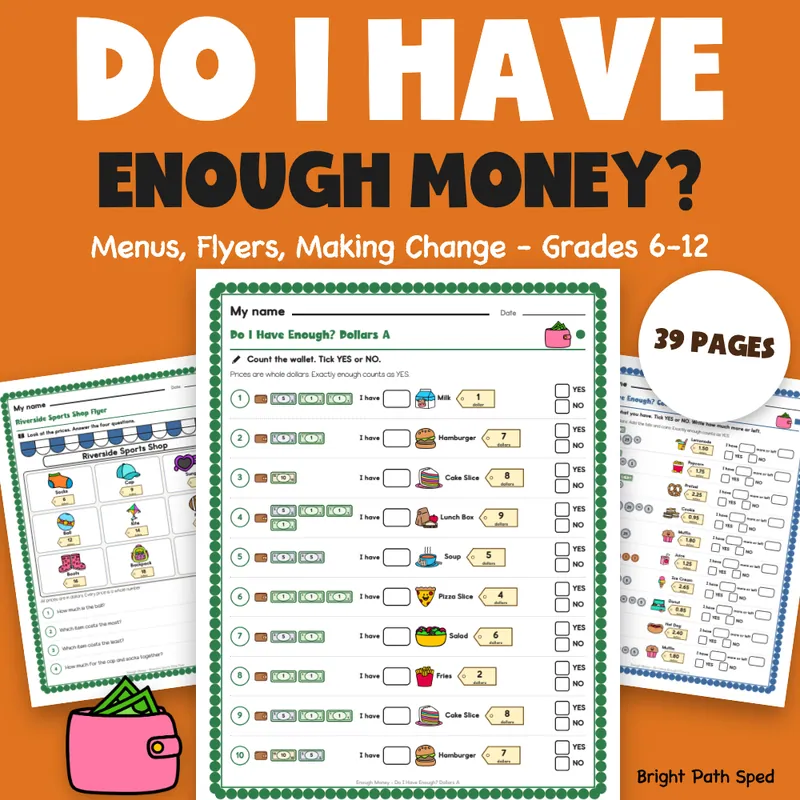
Teaching "do I have enough money?" and need pages students can actually work on? This is a complete set for grades 6-12 life skills and math: read a price on a menu or a store flyer, count the wallet, decide, and figure out how much more you need or how much change you get. Everything is practice with invented stores and made-up prices, in three levels. Level 1 is whole dollars: a wallet of bills against a price, tick YES or NO. Level 2 adds coins and cents: count what you have, tick YES or NO, and write how much more or how much is left. Level 3 adds several items and change: add the prices, count the wallet, find the change or the amount you still need. Answer keys give every answer.
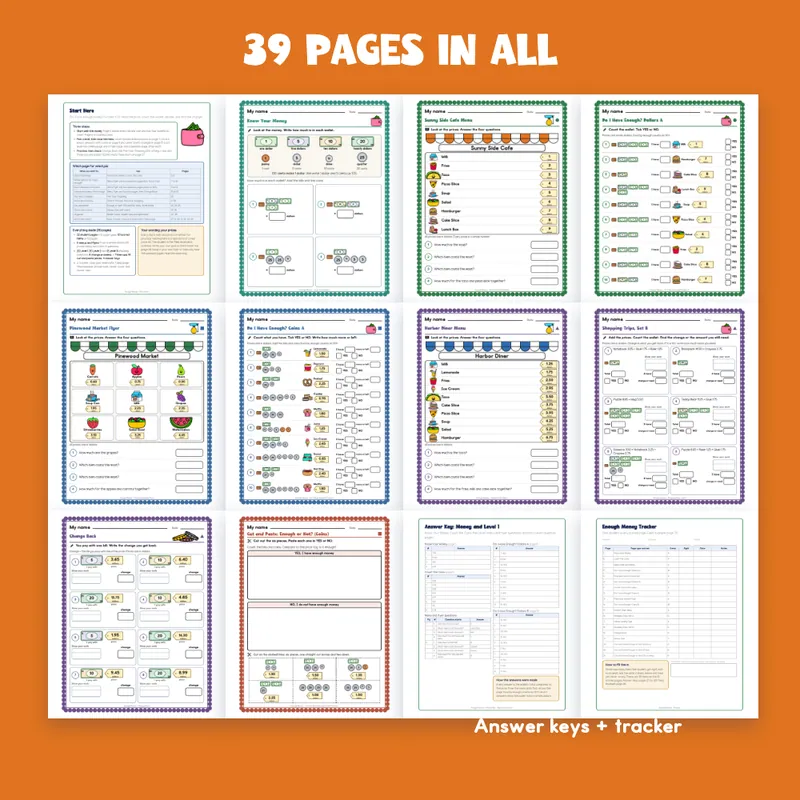
EVERYTHING INSIDE (39 pages)
- 22 student pages in ten kinds of page, each with a name line and one short instruction
- 121 scored items across 19 scored worksheets, every answer computed from the same wallet and price data that draws the page
- Know Your Money: 4 bills (one, five, ten, twenty) and 4 coins (penny, nickel, dime, quarter) shown with their values, plus 4 wallets to add up; Count the Coins: 8 piles to total
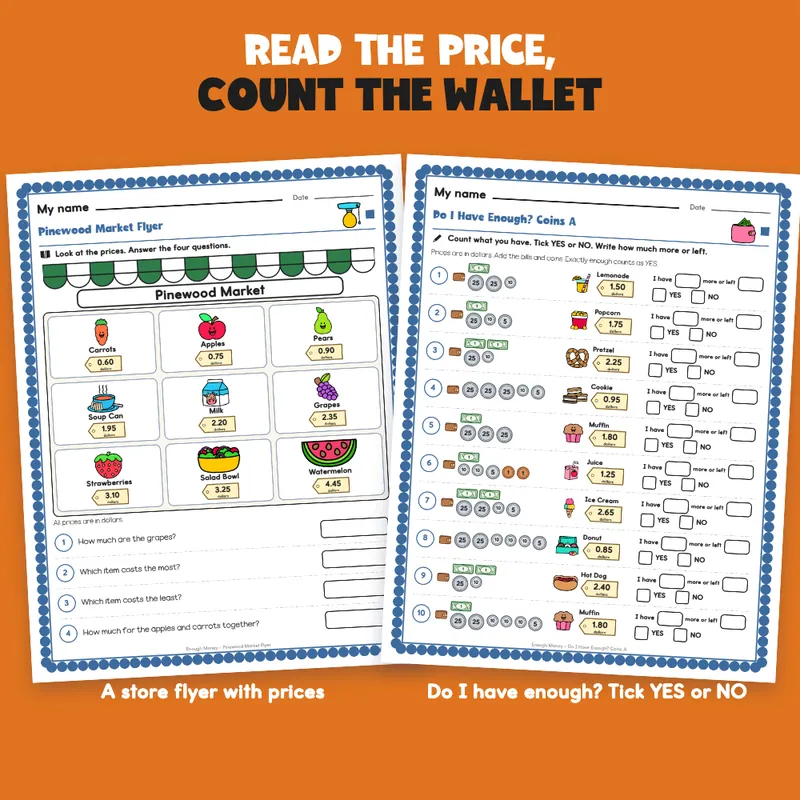
- 6 menus and flyers from invented stores (Sunny Side Cafe, Riverside Sports Shop, Corner Snack Bar, Pinewood Market, Harbor Diner, Hilltop Variety), 55 priced items in all, each page with 4 questions (24 in all): read a price, find the most and the least, add two or three items
- Level 1, whole dollars: 20 questions across a menu and a flyer (10 each), a wallet of bills beside the item and its price tag, an I-have box and YES / NO check boxes
- Level 2, exact amounts: 20 questions across a menu and a flyer (10 each), bills and coins in every wallet, an I-have box, YES / NO and a more-or-left box
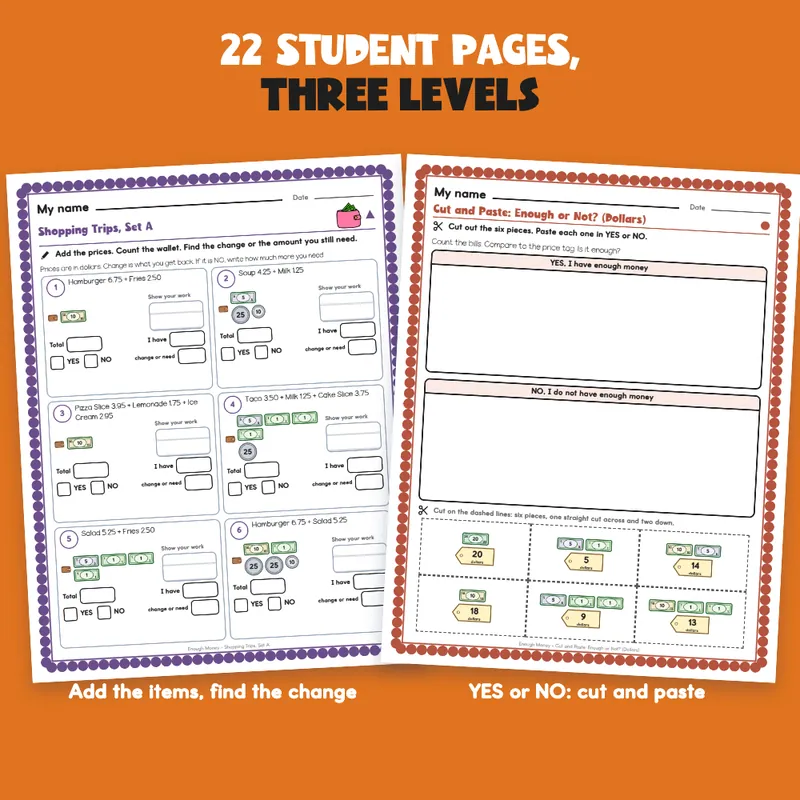
- Level 3, with change: 12 shopping trips across a menu and a flyer (6 each, 2 or 3 items each), with a show-your-work box, a total box, an I-have box, YES / NO and a change-or-need box; Change Back: 8 problems paying with a five, ten or twenty dollar bill, each with a work box
- 1 Plan Your Shopping page: a 9-item flyer, a 20 dollar budget, a 4-row list, total, left over and a YES / NO check, and 5 ruled lines to say why
- 1 Think It Through page: 3 written questions, 5 ruled lines each; 1 money quiz of 7 items (letters A to C); 1 self check (8 statements)
- 18 cut-and-paste pieces on 3 mats (dollars, coins, two items), 6 pieces each in a 3 by 2 grid, 3 YES and 3 NO on every mat
- 4 answer keys; 1 tracker (19 scored pages), 1 class grid (15 students, 7 skill columns), 1 team note, 1 family page
- 1 filled example (an invented student), 1 phrase bank (17 starters in 6 groups)
- A binder cover with type-in teacher and class fields, and a page of divider tabs (Know Your Money, Level 1: Dollars, Level 2: Coins, Level 3: Change, Keys) with a spine label to cut out
- Start Here and a how-to-read-a-page page
Built For The Student Holding The Page
A "My name" line, one short instruction with a small picture cue, a plain scalloped border and big boxes to write in. A small circle, square or triangle by the page title marks the level (a shape, never a number). Nothing on a student page is written for an adult: the keys and records are on separate teacher pages. The cut pages have six pieces in a strip-and-grid layout, edge to edge, so there are only a few straight cuts. Bills and coins are drawn at a size a student can count, and each one carries its number, so the file prints clean in black and white. The pictures of food and school items on the menus are clip art; the bills, coins, wallets, price tags and store awnings are drawn for this file.
Invented Stores And Prices
Every store, item and price is made up for practice. None is a real store, and the pictures do not say what anything costs anywhere. Prices are written the way a register shows them (2.35) with the word "dollars" on the tag, and no currency symbol is used anywhere in the file. Exactly enough counts as YES, and every page says so. The only student in the file is an invented example, and it says so.
Type In, Or Print
The name line, every answer box, every check box, every table cell and every ruled work box are type-in fields in any PDF reader: click one, type, then save. The pages also print, and the check boxes can be marked by hand. This is a fillable PDF; it is not a Google Slides or PowerPoint file.
What This Is, And What It Is Not
A set of money practice pages with the record-keeping around it: counting a wallet, comparing it to a price, finding how much more or left, adding items and finding change. It is not a timed test, a screener, a clinical tool, or a claim about any student's age or rate of progress. There is no IEP goal language or eligibility wording anywhere in the file, and no claim of alignment to any standard. The tracker has a blank line for your own goal wording.
Who This Is For
Teachers of life-skills and special education classes, math intervention and transition programs for grades 6-12, and families who want real-world money practice that does not look like it was made for little kids.
If You Want More
Enough Money or Not Enough? Task Box | Special Education Life Skills Money; Adding and Subtracting Money Amounts Progress Monitoring Probes; Money Word Problems Single-Step Progress Monitoring Probes.