Earth Day Matching Binder
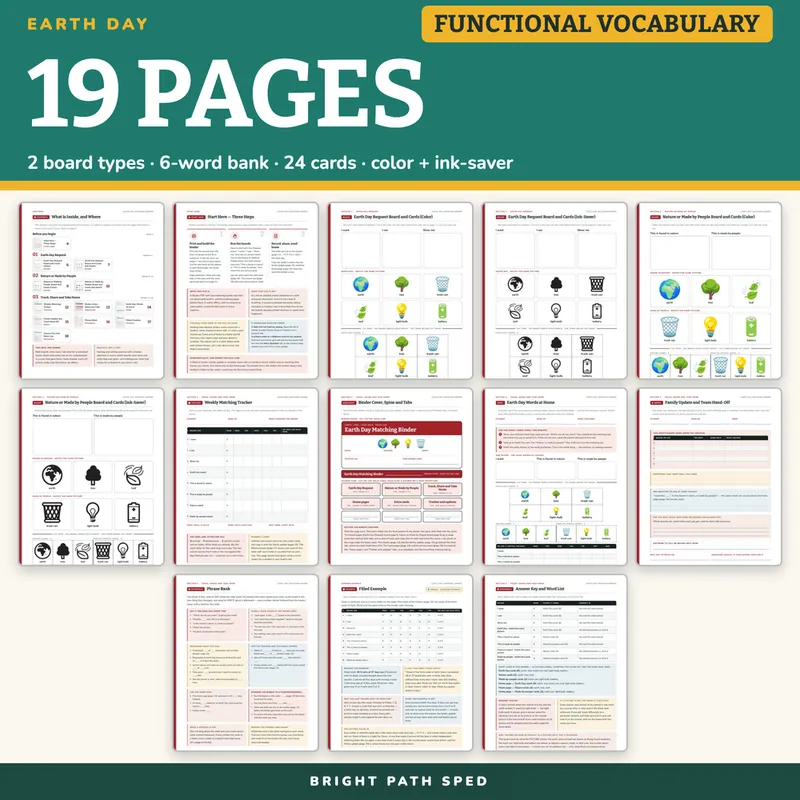
- 19 pages
- PreK, Kindergarten, 1st, 2nd
$5.00
DownloadOr get it with All-Access: pick any 20 resources a month for $7.
New here? Your first month of All-Access is half off with code TEACHERTOK
Already bought this, or a member?
Instant download. One teacher's license: colleagues need their own copy. Each file carries a license number.
Also on Teachers Pay Teachers: see the Bright Path Sped store
About this resource
EVERYTHING INSIDE — 19 pages, 120 type-in fields
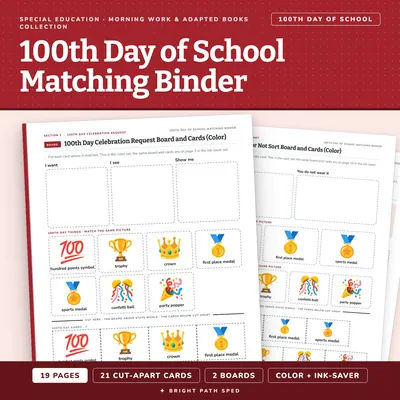
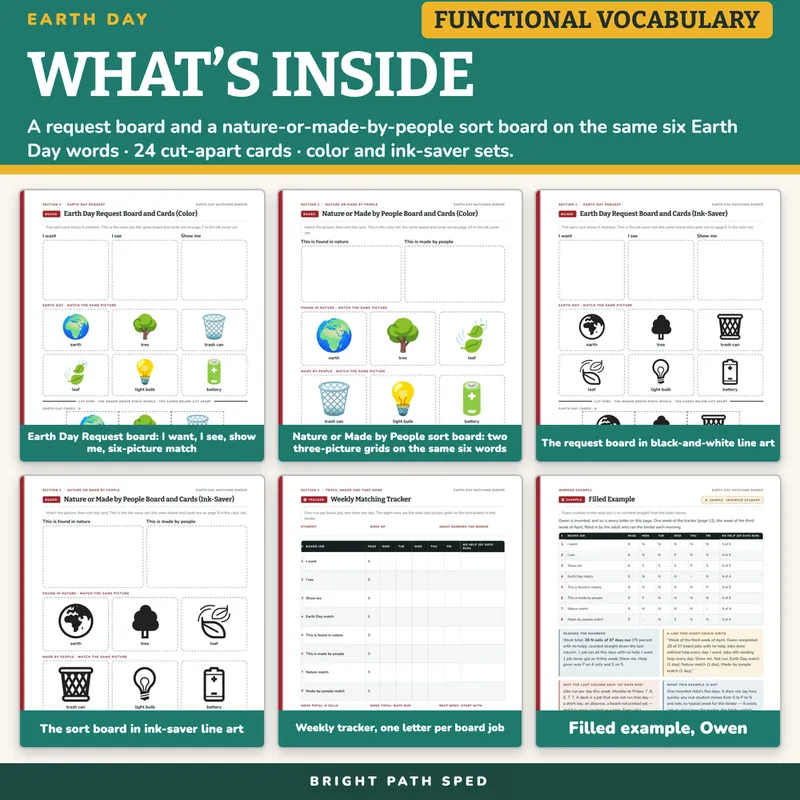
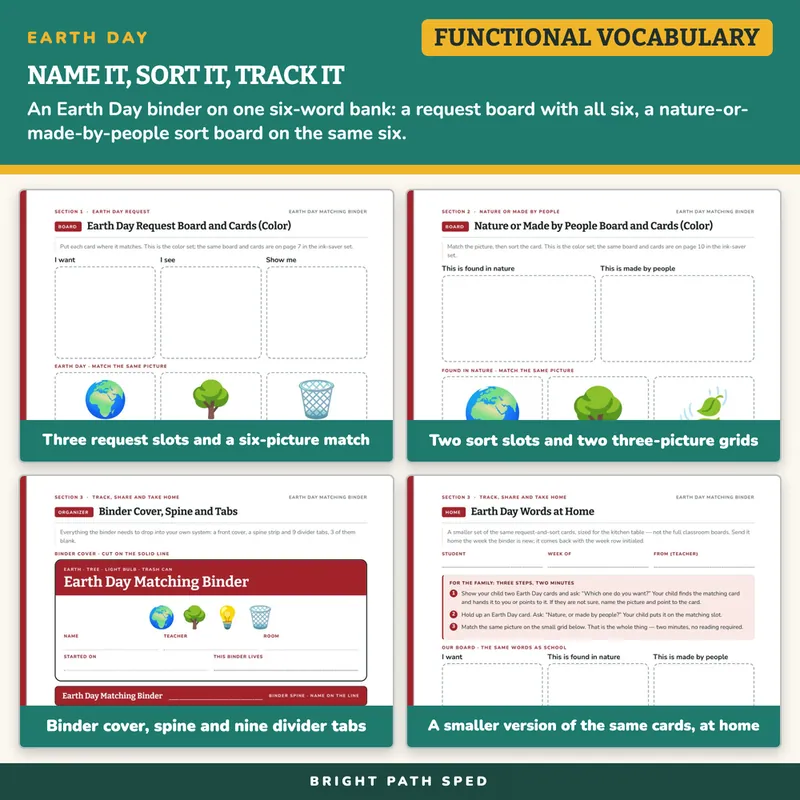
- An Earth Day Request board: three request/identify slots (I want, I see, Show me) and a six-picture match — with its own 6 cut-apart cards on the same sheet
- A Nature or Made by People board: two sort slots and two three-picture grids on the same six Earth Day words, split by what each picture shows — with its own 6 cut-apart cards on the same sheet
- Both boards twice: a full-color set for a laminated binder and a black-and-white ink-saver set for the photocopier
- 24 cut-apart picture cards in all, counting the color set and the home page once
- A weekly tracker: 8 board jobs down, Monday to Friday across, one letter per cell (no help / pointed once / said the words / not run), a "no help" count per row and a week total
- A binder organizer: a front cover, a spine strip and 9 divider tabs (3 of them blank)
- A home version: the same six-word bank, split into its two sort groups, for the kitchen table, with a seven-day "we did it" row
- A family update with a team hand-off block for the next adult who runs the binder
- A phrase bank: 24 lines in 6 groups (spoken lines for running the boards, written starters for the note afterward)
- A filled example — an invented student, one week, every count re-counted from its own row
- An answer key listing every board, the cards it takes and what correct looks like, plus the full word list (Earth Day set and home set)
- Start Here, a contents page with page thumbnails, and a "what's next" back page
An Earth Day / taking-care-of-the-earth vocabulary binder built on one six-word bank (earth, tree, trash can, leaf, light bulb, battery) run through two different boards — naming and requesting any of the six at the first board, then sorting the same six by whether the picture shows something found in nature or something a person made at the second, each with its own tracker row. Most matching binders stop at the board; this one adds the tracker, the family update and the phrase bank behind it, so a week of matching practice turns into a week of counts a case manager can bring to a meeting.
The Boards
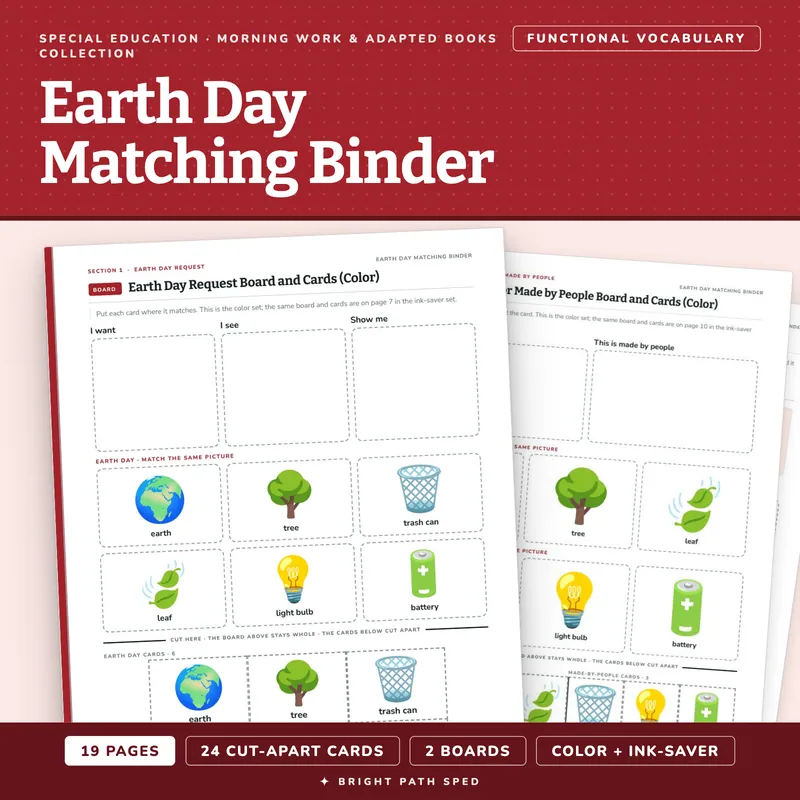
- Earth Day Request (page 6 in color, page 7 in ink-saver) — the board stays whole above a cut line; the card band below cuts apart. Three request/identify slots (I want, I see, Show me), and a six-picture match (earth, tree, trash can, leaf, light bulb, battery): the child matches the identical card onto its picture.
- Nature or Made by People (page 9 in color, page 10 in ink-saver) — two sort slots ("This is found in nature," "This is made by people") and two three-picture grids on the same six Earth Day words, so the exact six words appear on both boards (see WHY "NATURE OR MADE BY PEOPLE" IS A PICTURE SPLIT, below).
The Words
- Earth Day request cards (6): earth, tree, trash can, leaf, light bulb, battery
- Nature cards (3): earth, tree, leaf
- Made-by-people cards (3): trash can, light bulb, battery
- Home page — nature cards (3) and made-by-people cards (3): the same six words, split the same way
Every picture was chosen to be named in one word (or the same short two-word phrase, "light bulb" or "trash can") by a young child, in color AND in the black-and-white set.
WHY "NATURE OR MADE BY PEOPLE" IS A PICTURE SPLIT, NOT A RULE ABOUT EVERY OBJECT
The second board sorts by what each PICTURE shows, not by a rule about every real object everywhere: the earth, tree and leaf are all drawn as things found outdoors in nature; the trash can, the light bulb and the battery are all drawn as objects a person made, in both picture sets. A real trash can can also sit outdoors — this board is only a claim about what these six pictures show, the same kind of checkable, picture-only split this collection's other sort boards (on-the-road-or-not, flower-or-not, has-fins-or-not) already use.
Word-Bank Note
What This Is, And What It Is Not
It is a fillable PDF: type into the tracker, the organizer, the home page and the family update, or print and use a pen. The board pages print on cardstock or plain paper; the card band cuts off the bottom and the board stays whole. It works offline with no account or subscription. It is NOT an editable online slideshow or word-processor document, and it is not a test of anything.
It carries no prompt hierarchy, fading schedule or mastery rule, and it does not decide what a count means for a student or when a board is done with. The nature sort is a claim about what each picture shows, not a rule about every real object everywhere. The tracker counts which boards were done and what help was given, and nothing else.
Who This Is For
Special education teachers and paraprofessionals running functional-vocabulary or naming practice with early, pre-reading or low-verbal students, case managers who need that practice to show up as data, and the families who get the home page.
More In The Collection
This binder is part of the Morning Work & Adapted Books Collection; more matching binders are being added to the collection regularly, all on the same boards-plus-tracker shape.
Pictures (color pages): Noto Emoji by Google, Apache License 2.0. Pictures (ink-saver pages): Fluent Emoji, Copyright (c) Microsoft Corporation, MIT License.