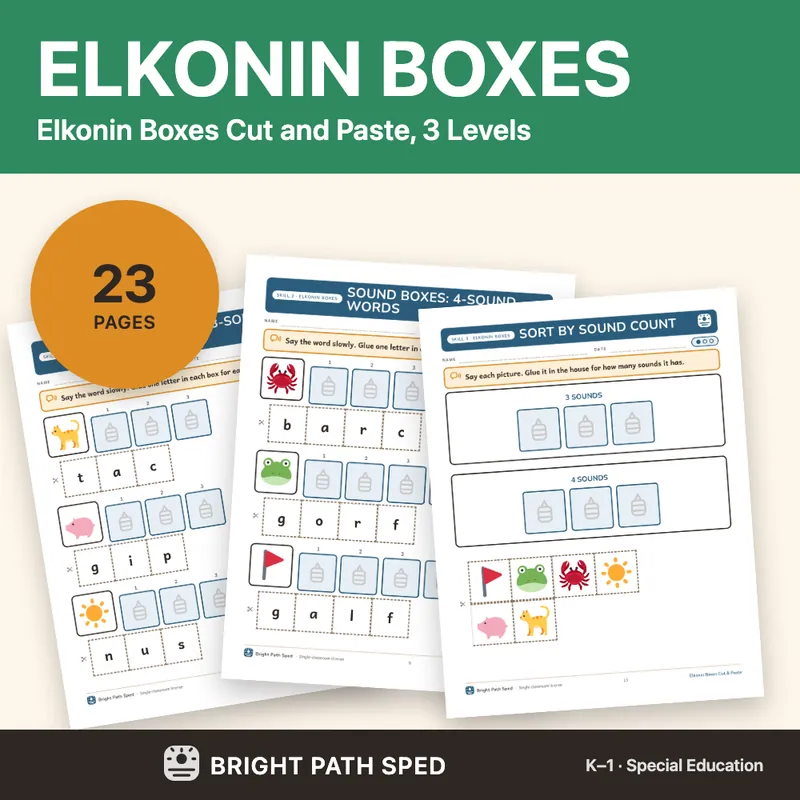
Elkonin Boxes Cut and Paste 3 Levels
- 23 pages
- Kindergarten, 1st
$4.00
DownloadOr get it with All-Access: pick any 20 resources a month for $7.
New here? Your first month of All-Access is half off with code TEACHERTOK
Already bought this, or a member?
Instant download. One teacher's license: colleagues need their own copy. Each file carries a license number.
Also on Teachers Pay Teachers: see the Bright Path Sped store
About this resource
This store already has a pencil-and-paper Elkonin box worksheet for plain 3-sound CVC words
(Sound Boxes Segmenting CVC Words Worksheets). This is the cut-and-paste version — movable letter
tiles glued into numbered boxes instead of a pencil — and it goes one step further than that
sibling: past 3-sound words into 4-sound words, both the beginning-blend kind (crab, frog, flag)
and the ending-blend kind (nest, tent). If a student has mastered plain CVC segmenting, this is
where they go next.
Three skills, three levels each. A student says the word, then glues one letter tile into each
numbered box — one tile per sound, not one tile per letter typed from memory.
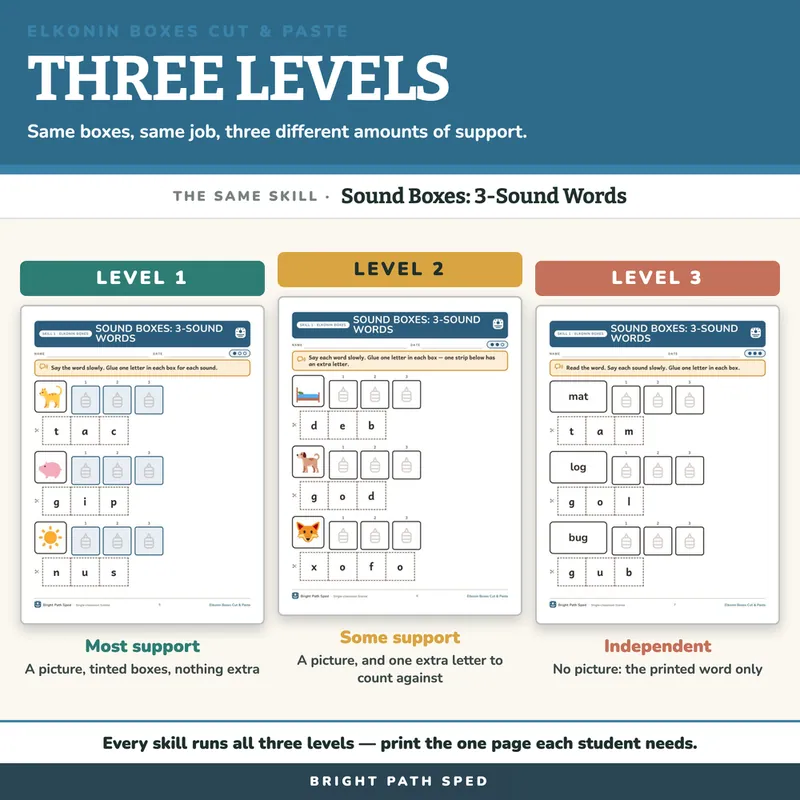
HOW THE THREE LEVELS WORK (on Skills 1 and 2)
Level 1 — a picture, tinted boxes, nothing extra. The tint shows exactly which box is which, so
the only job is listening for the sounds in order.
Level 2 — the same picture, no tint, and one word's own strip of letters carries an extra tile: a
second copy of a letter already in play, so a student who counts pieces instead of listening gets
it wrong.
Level 3 — no picture at all. The printed word is the only prompt: read it, say each sound, glue the
letters into the same boxes.
Every cut strip is printed in REVERSE spelling order, on purpose — the order the strip reads left
to right is never the order the boxes expect, so a student has to say the word and listen for each
sound rather than just copying the strip in order.
The Three Skills
1. Sound Boxes: 3-Sound Words — plain CVC words (cat, pig, sun, bed, dog, fox), three boxes
2. Sound Boxes: 4-Sound Words — beginning-blend (crab, frog, flag) and ending-blend (nest, tent)
words, four boxes
3. Sort by Sound Count — picture cards glued into one of two houses, "3 Sounds" or "4 Sounds," no
boxes this time, just counting
Every Letter Is Its Own Sound
Every word in this pack was chosen so one letter equals one sound — no digraphs, no silent
letters, no vowel teams — so a letter tile glued into a box is an honest answer, never a spelling
shortcut. That is also why Skill 2 runs on exactly seven words: this store's picture catalog has
five clean beginning-blend words and only two clean ending-blend words at this standard (the usual
others — lamp, desk — have no matching picture in the catalog at all), so every level in Skill 2
reuses this same seven-word pool rather than padding it with a word that would make the "one
letter, one sound" promise false.
What Is In The File
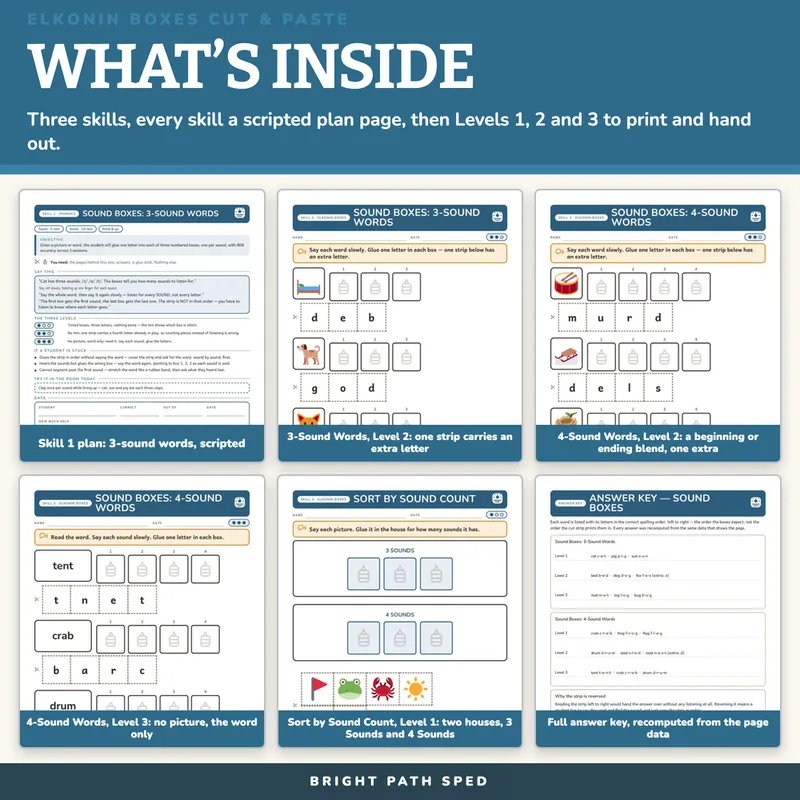
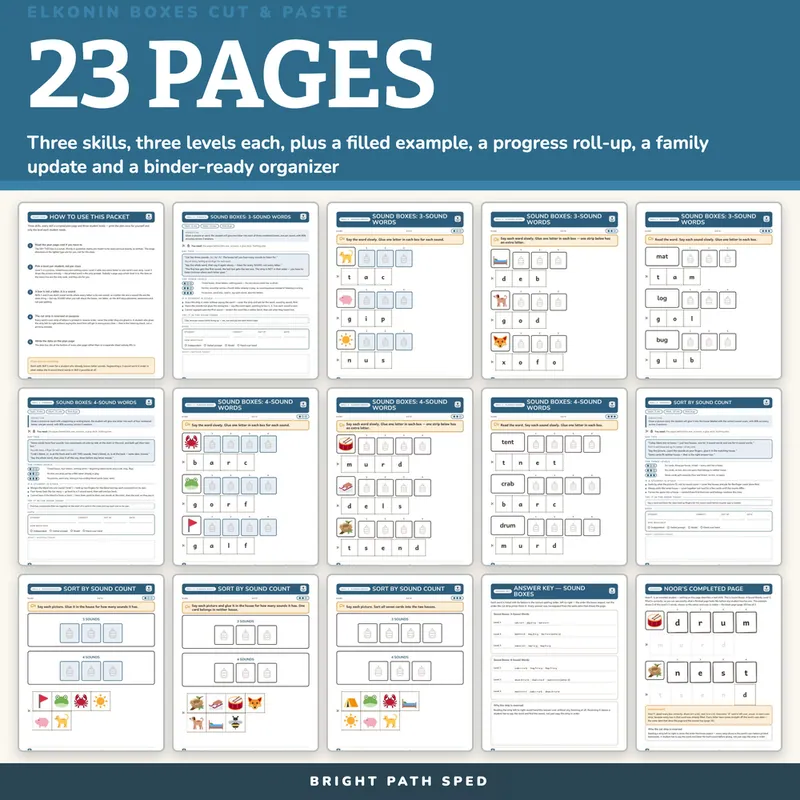
- 23 pages, one PDF
- 3 scripted lesson plan pages — a script in quotation marks a substitute could read cold, three
level notes, three "if a student is stuck" tips with the likely cause named, a try-it-today idea
and a data box on every plan
- 9 student worksheets (3 skills x 3 levels)
- 2 pages of answer keys, recomputed from the same data that draws the worksheets
- 1 filled example page — an invented student's completed worksheet, so you can see exactly what a
finished page looks like before any student touches one
- 1 progress roll-up page that turns all three skills into one sheet for an IEP meeting or a team
check-in
- 1 family-and-team update page — blanks for what you saw and what's next, plus three ways to help
at home, with no clinical or diagnostic language anywhere on it
- 1 binder cover and 1 page of 5 divider tabs plus a spine label, so this drops straight into a
binder, a hanging file or a bin of folders
- 1-page "how to use this packet" guide
- A name and date line, a big direction line and a cut rule on every worksheet
- Every cut piece sits edge to edge with its neighbor (one straight cut between pieces, never a
gap), at least five pieces on every page
- No level word and no teacher note anywhere on a student page: the dots on the name line are the
only level code, and they are there for you, not for the child
Who This Is For
Self-contained, resource and early-intervention classrooms, and any K-1 room with students who can
already isolate single sounds and are ready to segment a whole word, including the harder
consonant-blend words. It works alongside this store's Sound Boxes Segmenting CVC Words Worksheets
(the pencil-and-paper version of Skill 1, for independent writers) and Beginning Sound Sort Cut and
Paste (the same cut-and-paste shape, for a word's very first sound only).
What This Is, And What It Is Not
A print-and-cut worksheet packet with a scripted plan page in front of each skill. It is not a
fillable form, not a full curriculum, and not a claim about how quickly any student will segment a
word — every objective is written the way a classroom goal is written, with nothing clinical, no
timeline and no eligibility claim attached to it.