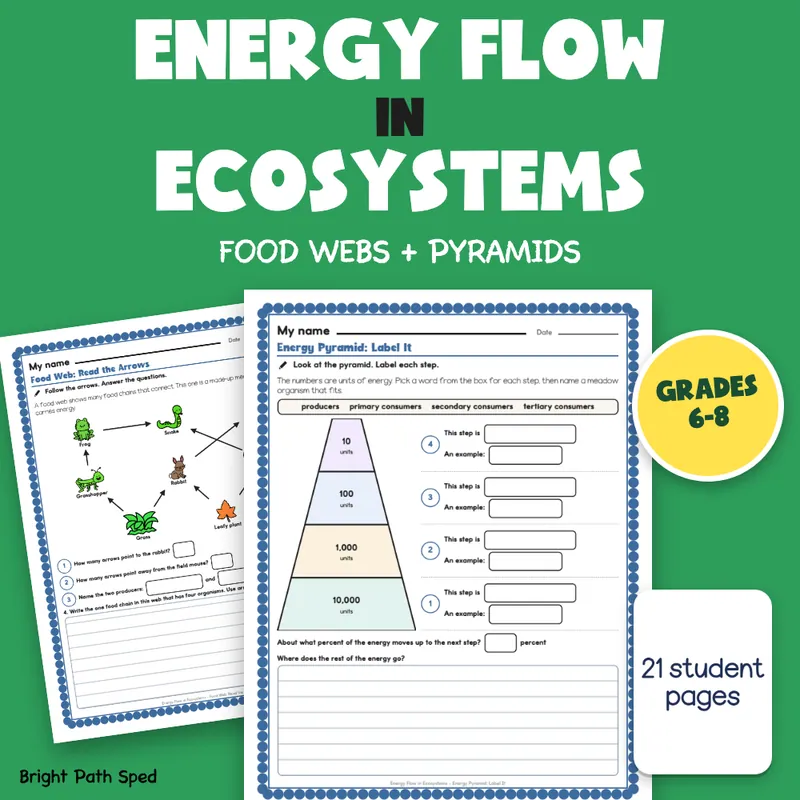
Energy Flow in Ecosystems Worksheets
- 36 pages
- 6th, 7th, 8th
$2.50 $5.00 on Teachers Pay Teachers
Half the Teachers Pay Teachers price. The same PDF, sold direct.
DownloadOr get it with All-Access: pick any 20 resources a month for $7.
New here? Your first month of All-Access is half off with code TEACHERTOK
Already bought this, or a member?
Instant download. One teacher's license: colleagues need their own copy. Each file carries a license number.
Also on Teachers Pay Teachers: see the Bright Path Sped store
About this resource
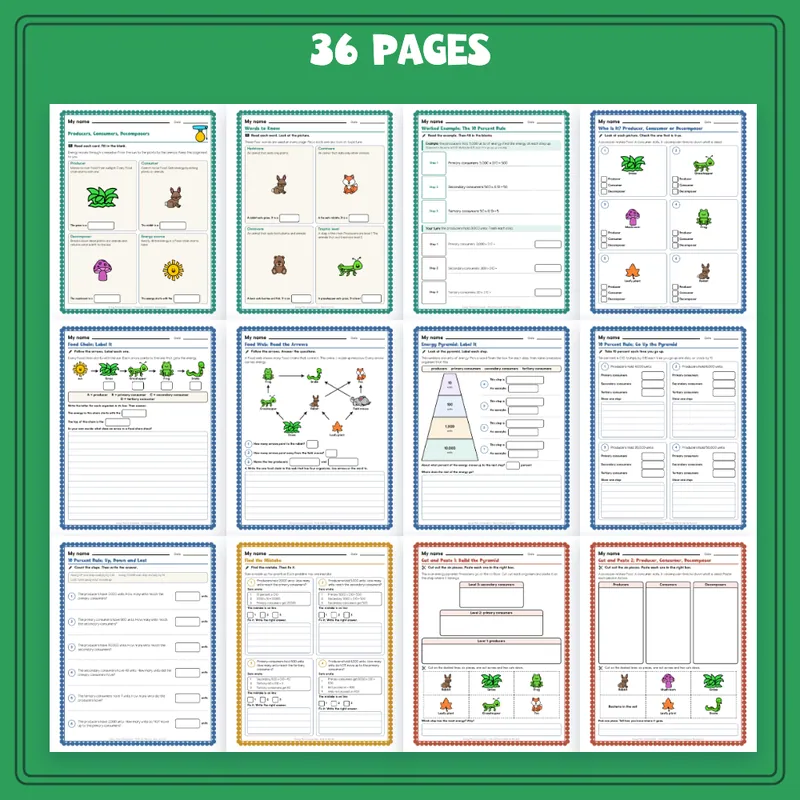
WHAT IS INCLUDED (36 pages)
- 21 student pages in 16 kinds of page, each with a name line and one short instruction
- 92 scored items on 19 sheets; every energy number was computed by program from one 10 percent rule
- 1 roles page (producer, consumer, decomposer, the sun) with a picture and a fill-in for each
- 2 reading pages: 4 more words to know (herbivore, carnivore, omnivore, trophic level) with a picture each, and an original reading with 4 questions
- 1 worked-example page: the 10 percent rule worked for one set of numbers, then a guided copy for students to finish
- 14 sort items on 2 sheets: producer, consumer or decomposer (pictures) and herbivore, carnivore or omnivore (what it eats)
- 2 food-chain pages: 1 chain to label (7 items) and 3 chains with a missing organism
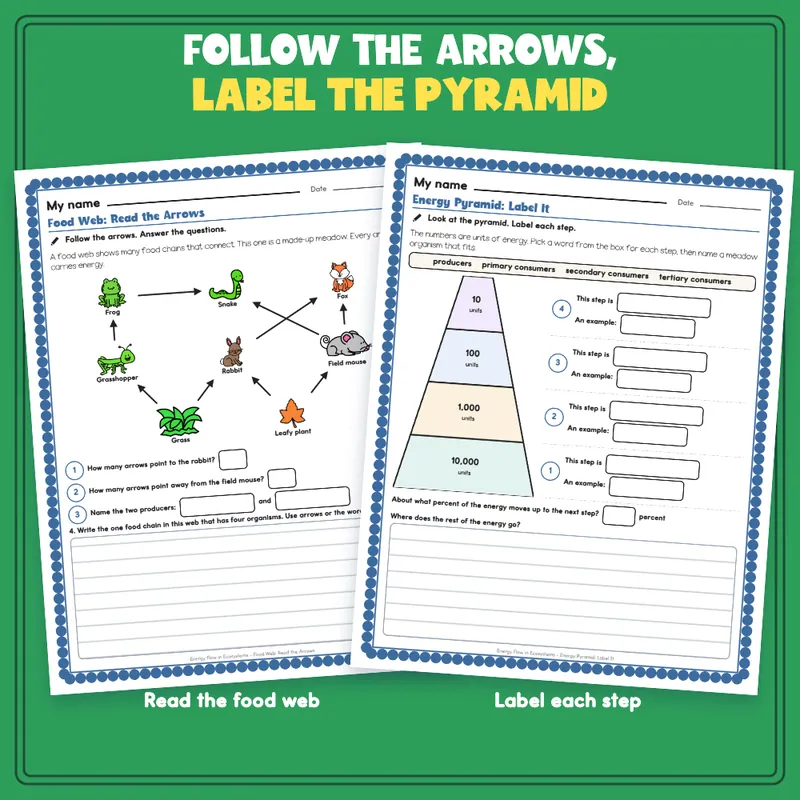
- 1 food web of 8 organisms and 9 arrows with 4 questions
- 1 energy pyramid to label with a bank of words and 5 items
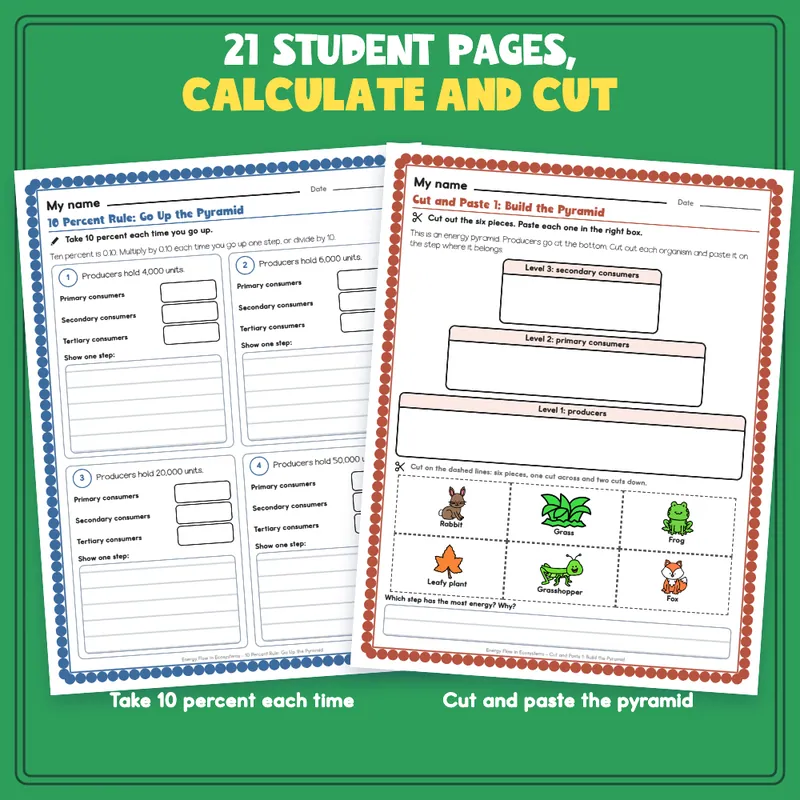
- 10 energy problems on 2 sheets: go up the pyramid, go down, and find the energy that is lost
- 6 true or false statements and 4 find-the-mistake problems (an invented student's work)
- 12 cut-and-paste pieces on 2 sorts: build the pyramid, and producer, consumer or decomposer
- 1 short answer page (3 prompts), 1 make-your-own food chain page, 1 quiz (6 items), 1 exit-ticket page (3 tickets), 1 self check (8 statements)
- 4 answer key pages; 1 tracker, 1 class grid, 1 team note, 1 family page, 1 filled example (an invented student), 1 phrase bank (17 starters in 6 groups)
- Start Here and a how-to-read-a-page page
Built For The Student Holding The Page
A "My name" line, one short instruction with a small picture cue, and a plain scalloped border. Nothing on a student page is written for an adult: the keys and records are on separate teacher pages. Chain, web and pyramid pages use licensed clip-art pictures of plants and animals with the name under each. Every cut piece is a large card with a picture and a name on it.
A Made-Up Meadow
The food web is one invented meadow: grass and a leafy plant, a grasshopper, rabbit and field mouse, a frog, snake and fox, and a mushroom to break down what is dead. Every question about the web (how many arrows point to the rabbit, which chain has four organisms) was computed from the list of arrows, so the picture and the answer always agree. The 10 percent rule is a rule of thumb, and the pages say "about 10 percent": real ecosystems vary.
Invented Examples
Every organism, number and student is made up for practice and says so. The filled example names an invented student.
Type In, Or Print
The name line, every answer box, every check box and every ruled work box are type-in fields in any PDF reader: click one, type, then save. You can also print any page. This is a fillable PDF, not a slideshow or a word-processor file.
What This Is, And What It Is Not
An energy-flow practice set with the record-keeping around it. It is not a timed test, a screener, a clinical tool, or a claim about any student's age or rate of progress. There is no IEP goal language or eligibility wording anywhere in the file, and it does not claim to match any one state's standards: there is a line on the tracker to write your own standard.
Who This Is For
Science teachers in grades 6-8 who want a unit on food chains, food webs and the energy pyramid, and special education teachers who want the same work in a form a student can finish.