Estimation Worksheets
- 29 pages
- Kindergarten, 1st, 2nd
$2.00 $4.00 on Teachers Pay Teachers
Half the Teachers Pay Teachers price. The same PDF, sold direct.
DownloadOr get it with All-Access: pick any 20 resources a month for $7.
New here? Your first month of All-Access is half off with code TEACHERTOK
Already bought this, or a member?
Instant download. One teacher's license: colleagues need their own copy. Each file carries a license number.
Also on Teachers Pay Teachers: see the Bright Path Sped store
About this resource
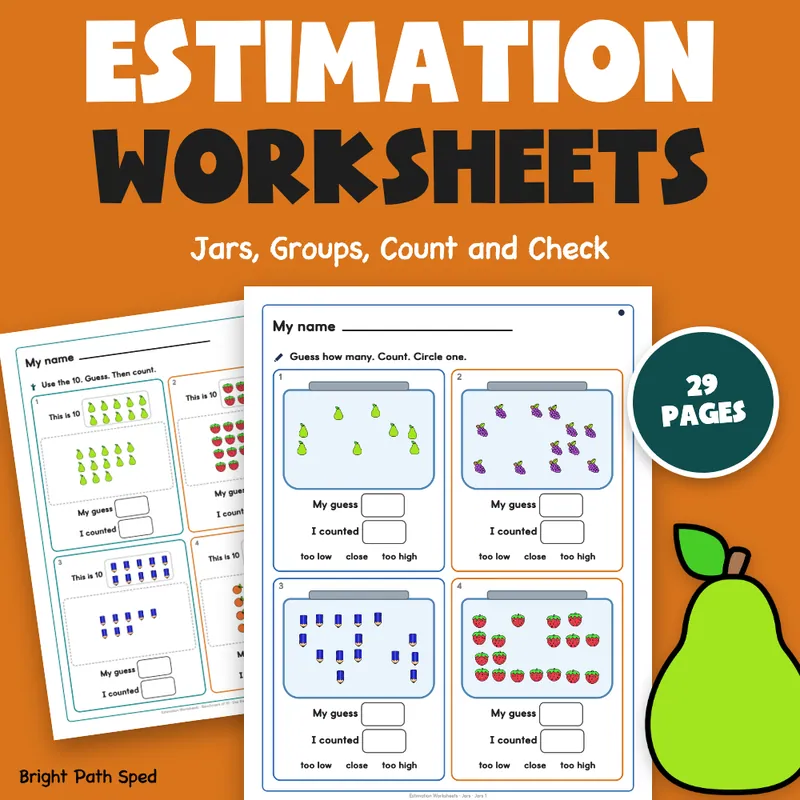
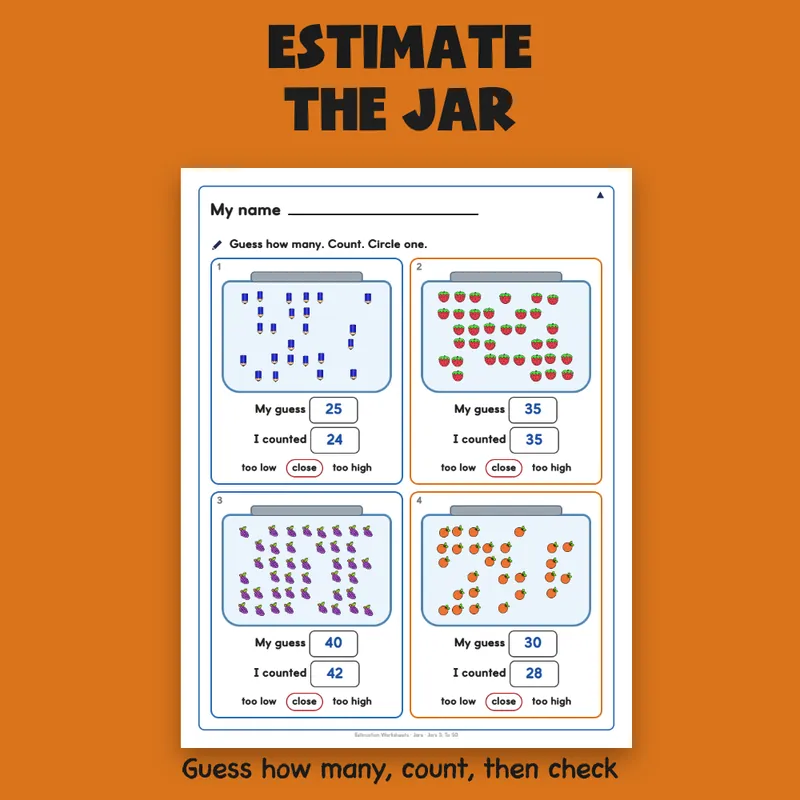
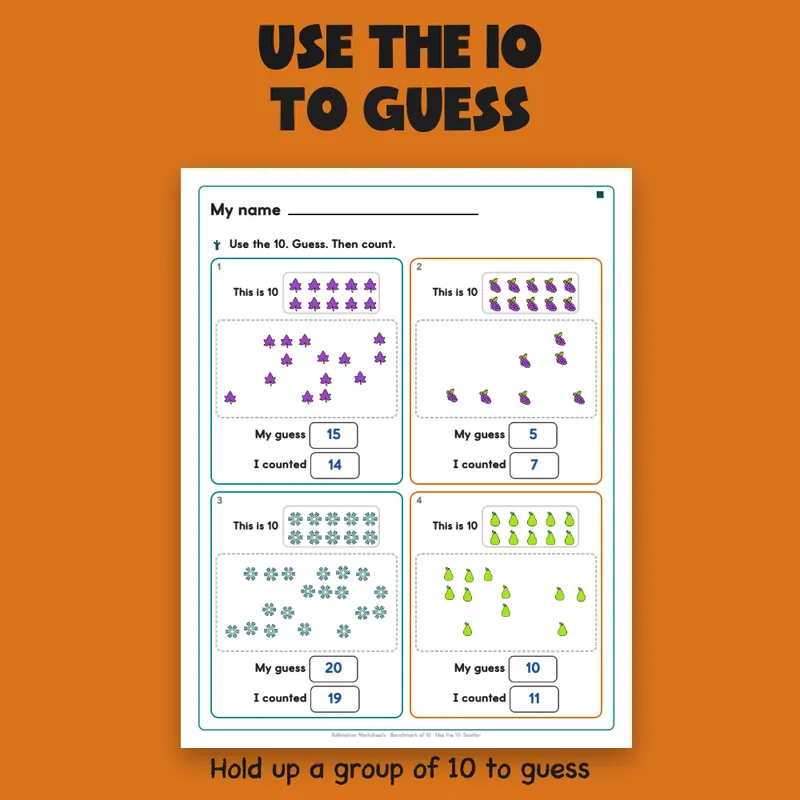
Teaching your kindergarten, first and second graders to estimate and need pages they can do on their own? This set has 18 student sheets that start with a model, then ask for a guess before every count: groups of pears, strawberries, pencils, oranges, leaves, grapes and snowflakes in jars and boxes, with a group of 10 to hold up against the big group, and counts up to 20 and up to 50. After the guess, the child counts to check and circles too low, close or too high. Big pictures, a big "My name" line, one short instruction with a small picture and big answer boxes. Print and go, or type the answers into the PDF.
SKILL: estimate how many objects are in a group, count to check (by 5s, by 10s, or by tens and ones), and say whether the guess was too low, close or too high. Close means within 3 of the count on the pages up to 20 and within 5 on the pages up to 50. No standards codes are claimed.
EVERYTHING INSIDE (29 pages)
- 18 student sheets with 64 things to do, 60 pictured groups to estimate
- 1 model page: look at a jar, use the 10, count by 5s, then check the guess three ways (too low, close, too high)
- 3 Use the 10 sheets, 12 groups: a box of 10 is shown at the same size as the pictures in the big group (the first sheet has neat rows of 5, the second is scattered, the third goes up to 50)
- 3 Jar sheets, 12 jars: guess, count, circle too low, close or too high (up to 20, then up to 50)
- 2 Tens and Ones sheets, 8 groups: pictures packed in boxes of ten with a few left over, so the child counts the tens, then the ones
- 2 Best Guess sheets, 8 groups: circle the closest of three guesses, then count to check
- 1 Draw a Group sheet, 4 boxes: draw about 10, 15, 20 or 30, then count what you drew
- 2 Reasonable or Not sheets, 8 groups: a friend's guess is printed; count, then circle reasonable or not reasonable
- 2 Check It sheets: one with 5 pictured groups to guess, count and circle, one blank chart with 6 rows for things the class counts around the room
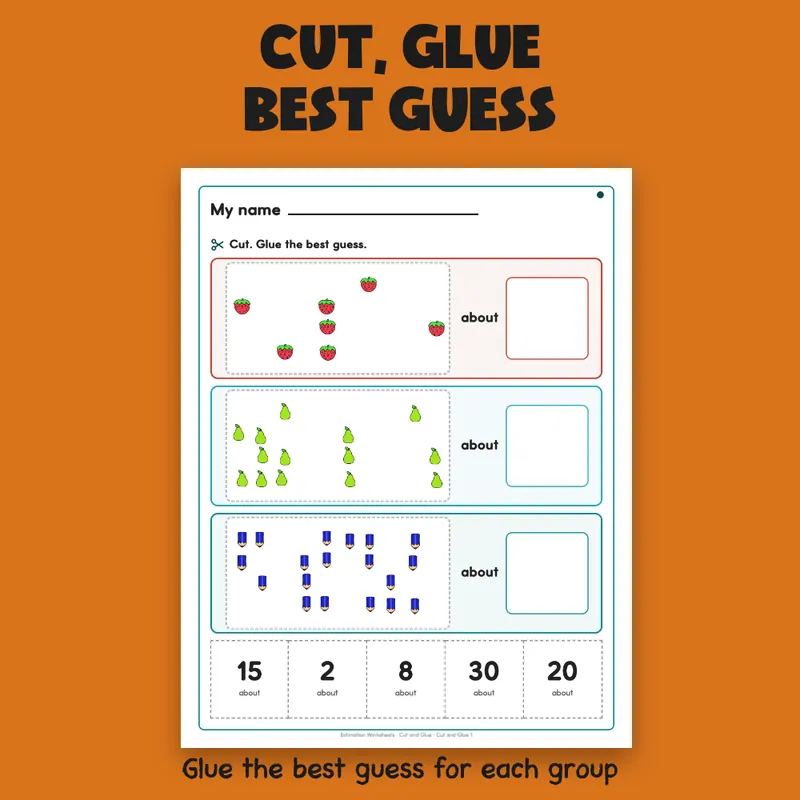
- 2 cut-and-glue sheets with 10 cut pieces: glue the best guess next to each group (5 big pieces on each sheet, edge to edge; some pieces match no group)
- Three answer-key pages with the count and the close range for every group, a tracker with a filled example (an invented student), a family page, Start Here and a What's Next page
Three Levels
A small shape in the top corner of each student page tells you the level: a circle (5 sheets) is starting, with neat rows of 5, a box of 10 to hold up and smaller groups; a square (5 sheets) is building, with scattered groups; a triangle (7 sheets) is ready for more, with the biggest groups, up to 49. The model page has no level.
How It Works
1. Read the model page together first, then print a page at the level your student needs.
2. Hand it over. One short instruction, one job: guess first, then count.
3. Check with the key and write the date and score on the tracker.
Built For The Child Holding The Page
A big "My name" line, big print, a border and room to write. Nothing on a student page is written for an adult; the keys and tracker are on separate teacher pages. The objects are everyday things drawn as pictures, in rows or scattered, with no characters to distract from the counting. The cutting pages have 5 big pieces edge to edge, so each cut is one straight line. Every group is built by the file's own code: the number of pictures, the key, the close range and each best-guess choice are computed from the same list, so the key always matches the page.
Works With
Pairs well with the 100s Chart and 120 Chart worksheets from this store for students who are building their number sense up to 50 and beyond.
What This Is, And What It Is Not
It is a fillable PDF for printing: click into a box and type, or print it and write by hand. It is not a Google Slides, Docs or PowerPoint file. It does not test, place or label students; use the pages in the order that fits your class.
Who This Is For
Kindergarten, first and second grade teachers, interventionists, special education teachers and families who want estimation practice with jars and groups of objects.