Finding Common Denominators Worksheets
- 29 pages
- 4th, 5th, 6th
$1.75 $3.50 on Teachers Pay Teachers
Half the Teachers Pay Teachers price. The same PDF, sold direct.
DownloadOr get it with All-Access: pick any 20 resources a month for $7.
New here? Your first month of All-Access is half off with code TEACHERTOK
Already bought this, or a member?
Instant download. One teacher's license: colleagues need their own copy. Each file carries a license number.
Also on Teachers Pay Teachers: see the Bright Path Sped store
About this resource
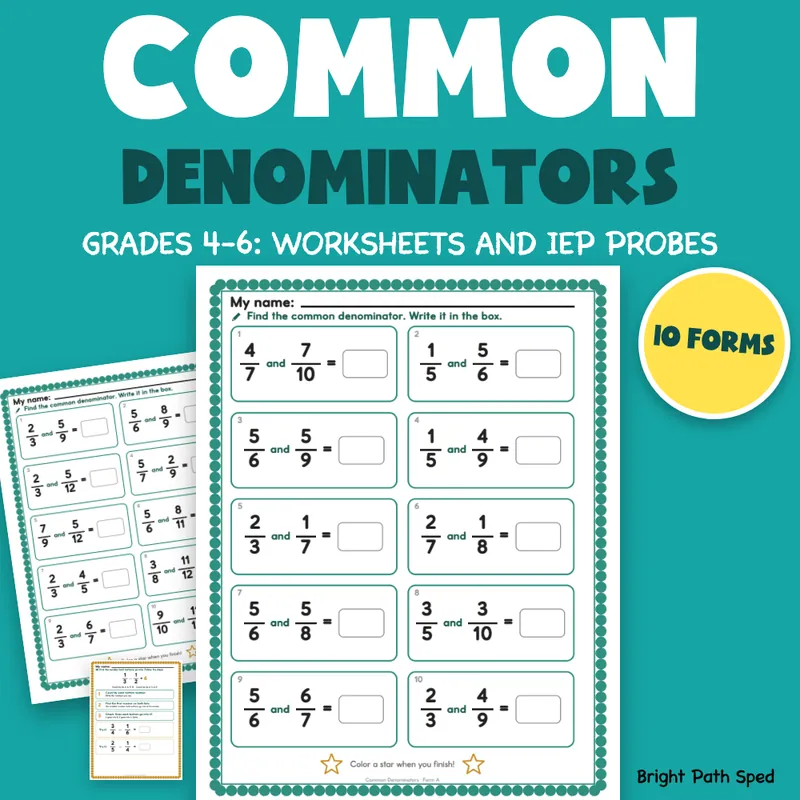
Finding a common denominator is the step that adding and comparing fractions depend on. This file gives you the practice, the weekly probe and the graph to measure it, with every answer done for you.
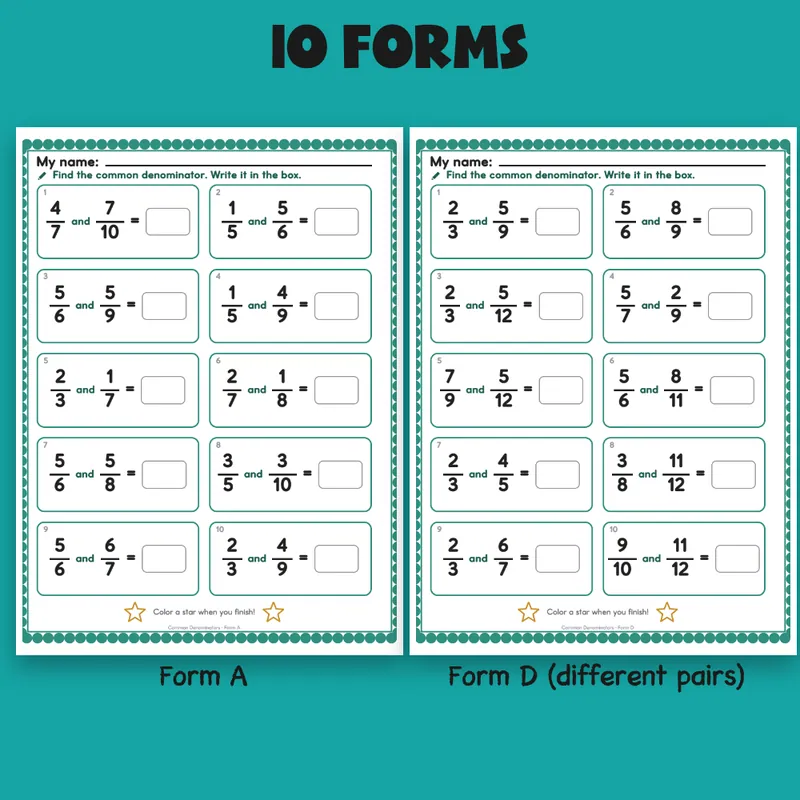
Every item is a pair of fractions, such as 1/3 and 1/2. The student writes the common denominator, the smallest number both bottoms go into: 6. Ten untimed forms, A through J, each have ten pairs. No two pairs repeat across the forms, so the score means the same thing on Form A and on Form J.
WHAT IS INCLUDED - 29 pages: a start-here page, a binder cover and divider tabs, a goal page, a how-to-find-one page for students, three practice worksheets at three levels, ten probe forms of ten pairs each (100 pairs in all), a four-page answer key, teacher notes, a graph and data log, a caseload summary, a filled-in example with an invented student, a family update and team handoff page, and a thank-you page. 522 type-in fields.
Start Here And The Goal (Pages 3-5)
- A seven-step routine on one page: baseline on three forms, the goal, a weekly probe in rotation, the log and graph, the decision, the report
- A goal page with a blank goal line and the six-part frame as type-in fields. The goal is written from the IEP; nothing on the page is written for you
- A baseline table, three benchmark rows, and the scoring directions
How To Find One (Page 6)
- A student page: count by each bottom number, find the first number on both lists, check that each bottom goes into it
- 1/3 and 1/2 worked out (6), and two pairs to try (12 and 20) with the boxes left empty
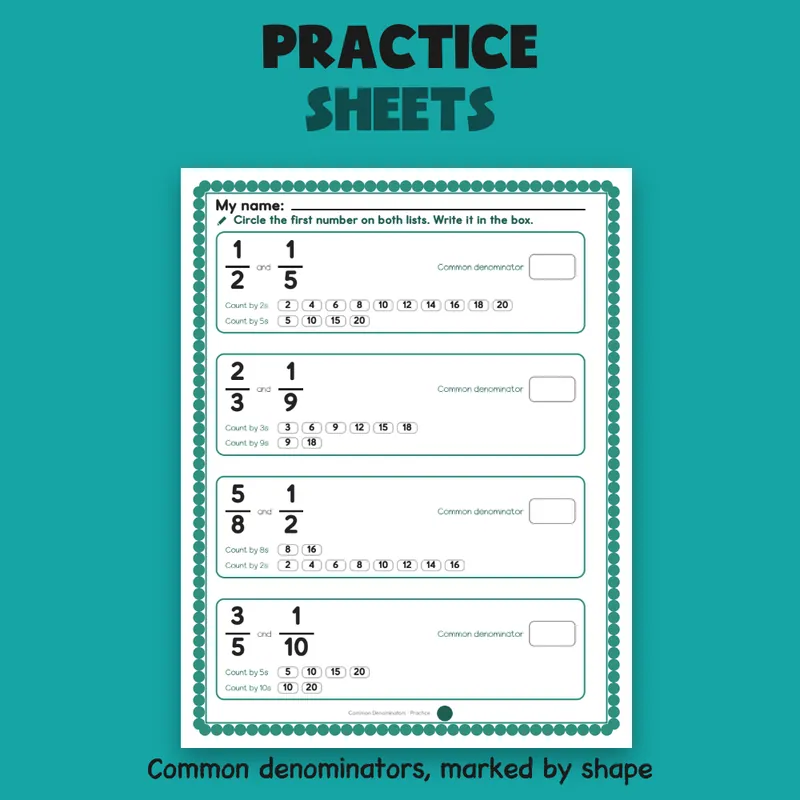
Practice Worksheets, Marked By Shape (Pages 7-9)
- A circle sheet prints the multiples of each bottom; the student circles the first match and writes it in the box (4 pairs)
- A square sheet has the student write the common denominator and both fractions with it, with a show-your-work area (6 pairs)
- A triangle sheet has three bottoms at once, such as 2/3, 3/8 and 5/12 (6 sets)
- The level is a small shape, never a color or a number. The shape tells you which sheet to hand out; it is not a grade
Ten Probe Forms, A Through J (Pages 10-19)
- Ten pairs per form, each with a box for the common denominator
- Each form has two pairs where one bottom divides the other, four with a common denominator up to 30, and four with one from 31 to 72
- A My name line, one short instruction with a pencil picture, and a star to color when finished
- No answers, goal text or scoring strip on a student sheet
A Four-Page Answer Key (Pages 20-23)
- Every pair on all ten forms with its common denominator, a Right? column and a Correct box under each form
- Form J and the three practice sheets on the last key page, with the new fractions worked out for the square sheet
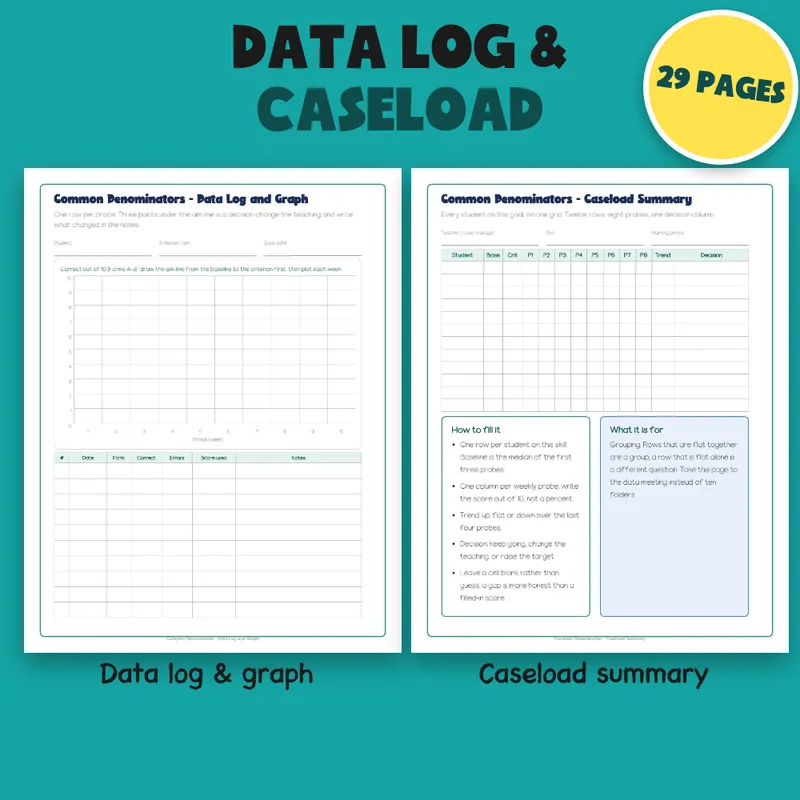
Teacher Notes, Graph And Caseload (Pages 24-26)
- Reading the errors: the bigger bottom taken without a check, the bottoms multiplied (right, but not the least), and a multiplication fact that slipped
- Prompts to say aloud, and the words to use when you teach it
- A y-axis already scaled 0 to 10, ten weekly columns, a ten-row log, and a caseload grid of twelve students
A Worked Example (Page 27)
- Jordan, an invented student. Baseline on Forms A, B and C, the median of 4, 5 and 4; ten weekly probes; three points under the aim line forcing a teaching change; the criterion met on the last three probes
- The progress-report sentence the log produces, with every number on the log above it
A Family Update And Team Handoff (Page 28)
- A family update with blanks for this week's score, a team handoff checklist, and a meeting summary sentence with blanks for the scores
What This Is, And What It Is Not
It is a fillable PDF. The goal page, data log, caseload page, family update page and the answer boxes on the probe forms are type-in fields: open the file in a PDF reader, click a line or box, type, and Save As once per student. The probe forms and practice sheets print clean: the student writes on paper.
It is not a norm-referenced assessment and it carries no benchmark score or "typical" rate. The goal line is blank on purpose: your team writes it from the IEP. The ten forms and the practice sheets are untimed, so the condition stays the same all year. Your district's own rules for goals and scoring go on the blank lines provided. It is not a Google Slides, Docs or PowerPoint file.
Who This Is For
Fourth, fifth and sixth grade special education teachers and case managers writing fraction goals, intervention teachers, general education teachers who want practice sheets with answer keys, and the paraprofessionals who give the weekly probe.