Genetics and Heredity Worksheets
- 35 pages
- 6th, 7th, 8th
$2.50 $5.00 on Teachers Pay Teachers
Half the Teachers Pay Teachers price. The same PDF, sold direct.
DownloadOr get it with All-Access: pick any 20 resources a month for $7.
New here? Your first month of All-Access is half off with code TEACHERTOK
Already bought this, or a member?
Instant download. One teacher's license: colleagues need their own copy. Each file carries a license number.
Also on Teachers Pay Teachers: see the Bright Path Sped store
About this resource
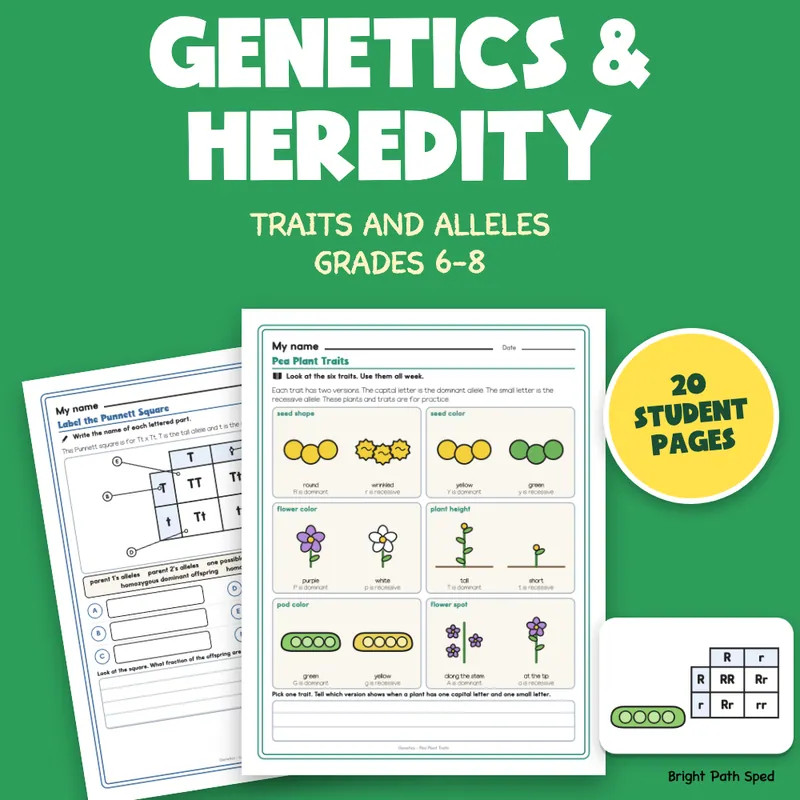
Teaching genetics and heredity and want pages students can read, write on and cut? This is a complete unit for grades 6-8 on how traits pass from parent plants to offspring, using made-up pea plants: what a trait and a gene are, what alleles are, which allele is dominant and which is recessive, the difference between a genotype and a phenotype, and how to fill in and read a Punnett square. It starts with two short original readings and ends with quizzes, cut-and-sort pages, answer keys and a place to record progress.
EVERYTHING INSIDE (35 sheets)
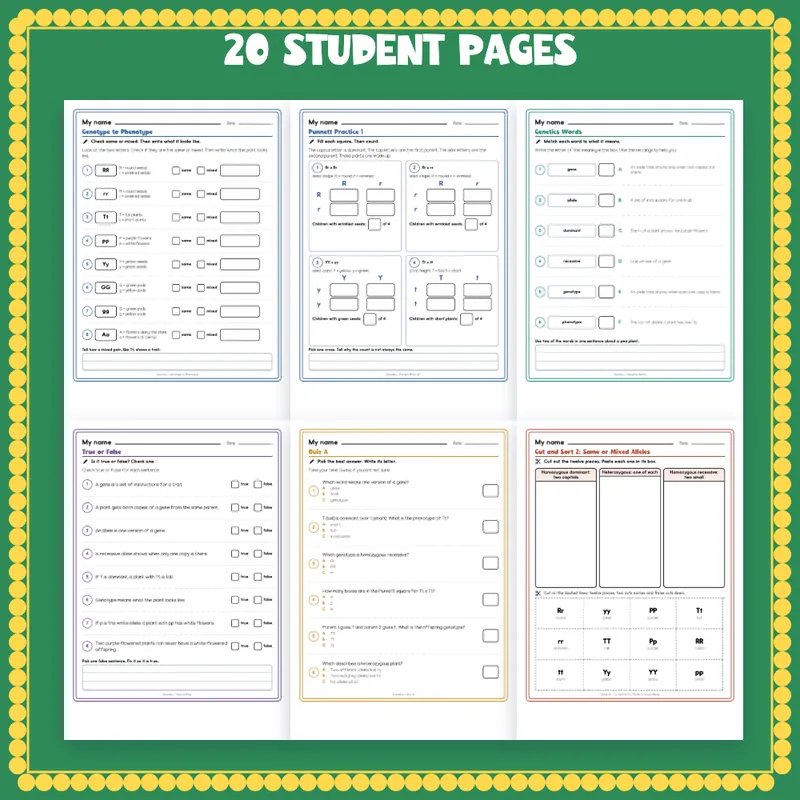
- 20 student sheets in 15 kinds of sheet, each with a name line and one short instruction
- 97 scored items on 14 sheets, every Punnett answer in the keys worked out from the parents' alleles
- 2 readings with 4 multiple-choice questions each and a main-idea box
- 1 vocabulary match: 6 words (gene, allele, dominant, recessive, genotype, phenotype); 1 clue-card sheet: 8 cards (those six plus homozygous and heterozygous), each with an example
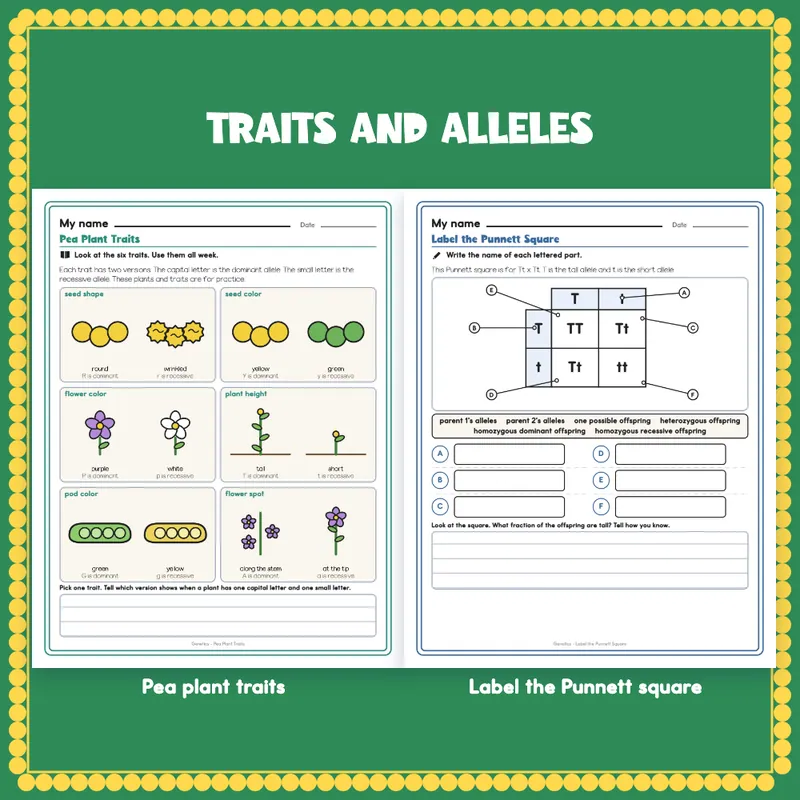
- 1 pea plant traits chart: 6 traits (seed shape, seed color, flower color, plant height, pod color, flower spot), each drawn in its dominant and its recessive version
- 1 label-the-Punnett-square sheet: 6 lettered parts with a word bank
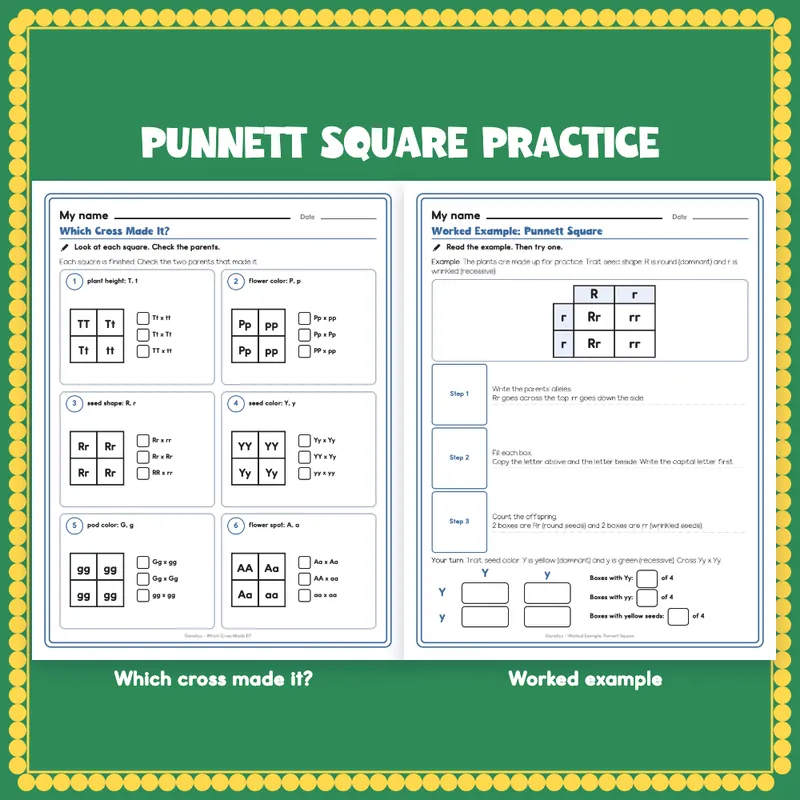
- 1 worked example (Rr x rr, step by step) with a try-it square (Yy x Yy)
- 1 genotype-to-phenotype sheet: 8 genotypes, check same or mixed and write what the plant looks like
- 2 Punnett practice sheets: 4 squares each to fill and count; 1 which-cross-made-it sheet: 6 finished squares, check the two parents
- 1 true-or-false sheet (8 sentences); 1 short-answer sheet (3 questions); 1 Find the Mistake sheet (4 sentences from an invented student)
- 2 quizzes (12 items); 1 exit-ticket sheet (3 tickets); 1 self check (8 statements)
- 24 cut-and-sort pieces on 2 sheets: sort 12 traits into dominant or recessive, and 12 genotypes into homozygous dominant, heterozygous or homozygous recessive (each 12 pieces in a 4 by 3 grid, edge to edge)
- 4 answer key sheets; 1 tracker, 1 class grid, 1 team note, 1 family page
- 1 filled example (an invented student), 1 phrase bank (17 starters in 6 groups)
- Start Here and a how-to-read-a-page sheet
Built For The Student Holding The Page
A "My name" line, one short instruction with a small picture cue, and a double-rule border. Nothing on a student page is written for an adult: the keys and records are on separate teacher sheets. Every picture (seeds, pods, flowers, stems and Punnett squares) is drawn plainly, with no clip art, so the pages print clean in black and white.
How A Student Decides
A capital letter is a dominant allele and shows when one copy is there. A small letter is a recessive allele and shows only when two copies are there. The two letters a plant has are its genotype; the trait it shows is its phenotype. The Punnett pages put one parent across the top and one down the side, so students see the chances for the offspring, not a promise about any one plant.
Invented Examples
The plants, traits and students are made up and say so. The short-answer sheet has no single right sentence: the key says what to look for.
Type In, Or Print
The name line, every answer box, every check box and every ruled work box are type-in fields in any PDF reader: click one, type, then save. You can also print any page. This is a fillable PDF; it is not a Google Slides, Docs or PowerPoint file.
What This Is, And What It Is Not
A genetics and heredity practice set with the record-keeping around it, for simple one-gene traits. It is not a lab, a timed test, a screener, or a claim about any student's age or rate of progress. There is no health information anywhere in it.
If You Want More
For tracing a trait through a family, see our Pedigree Worksheets, and for how alleles are passed on in cells, see our meiosis resources, both from Bright Path Sped. More science from this store: Forms of Energy Worksheets and Energy Transformations Worksheets.