Harlem Renaissance Worksheets
- 59 pages
- 7th, 8th, 9th, 10th, 11th, 12th
$2.50 $5.00 on Teachers Pay Teachers
Half the Teachers Pay Teachers price. The same PDF, sold direct.
DownloadOr get it with All-Access: pick any 20 resources a month for $7.
New here? Your first month of All-Access is half off with code TEACHERTOK
Already bought this, or a member?
Instant download. One teacher's license: colleagues need their own copy. Each file carries a license number.
Also on Teachers Pay Teachers: see the Bright Path Sped store
About this resource
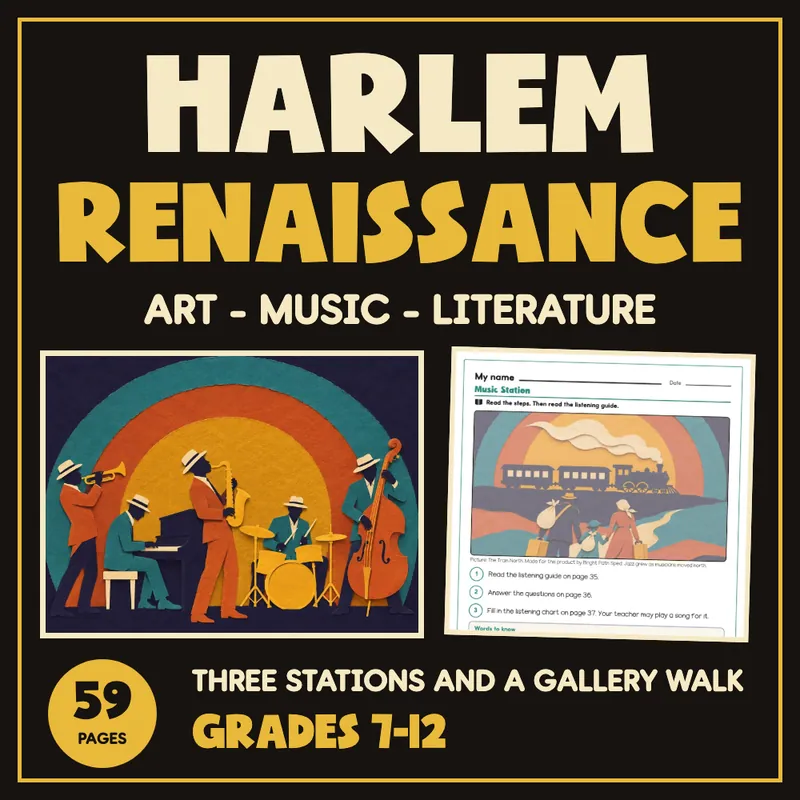
Teaching the Harlem Renaissance and need pages students can actually work on? This is a complete set for grades 7-12 with three stations: Art, Music and Literature. At each station students look, listen or read, answer observe, infer and connect questions in ruled boxes and fill in an organizer, then record what they found on a gallery walk sheet. The set also has readings and practice pages. Students read the story two ways, a short read of 152 words and a full read in three parts (the Great Migration, jazz and music, writers and artists), then analyze two source pages written for this file, order the events on a timeline, fill in a cause and effect organizer and a figures chart of seven writers, musicians and artists, draw an eight-panel comic strip, answer short questions, write a claim-evidence-reasoning paragraph, take a twelve-item quiz, do three cut-and-paste sorts and finish with exit tickets. Answer keys give the letters and a sample for every open answer.
EVERYTHING INSIDE (59 pages)
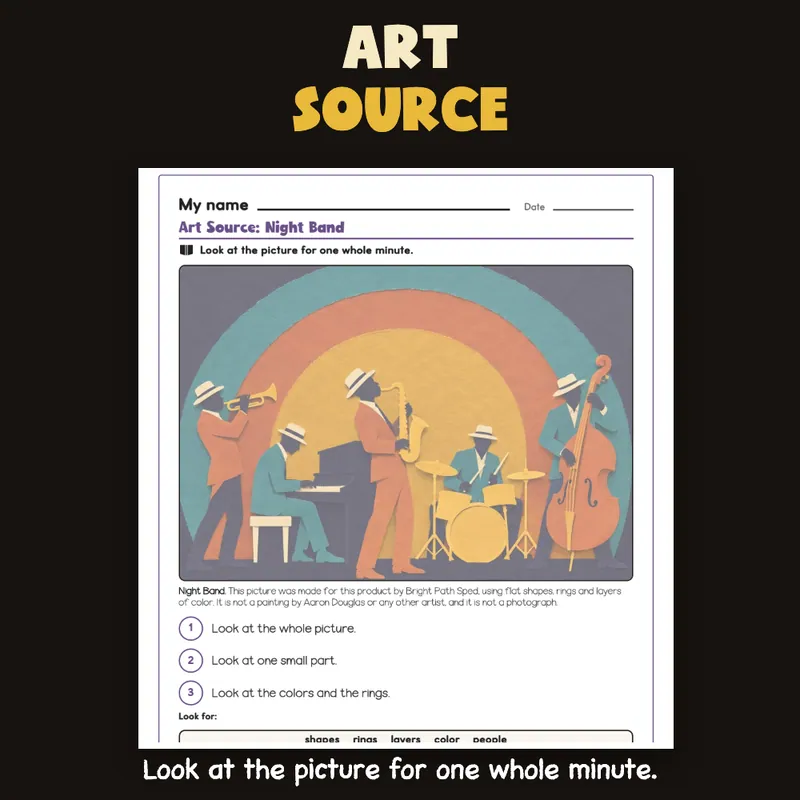
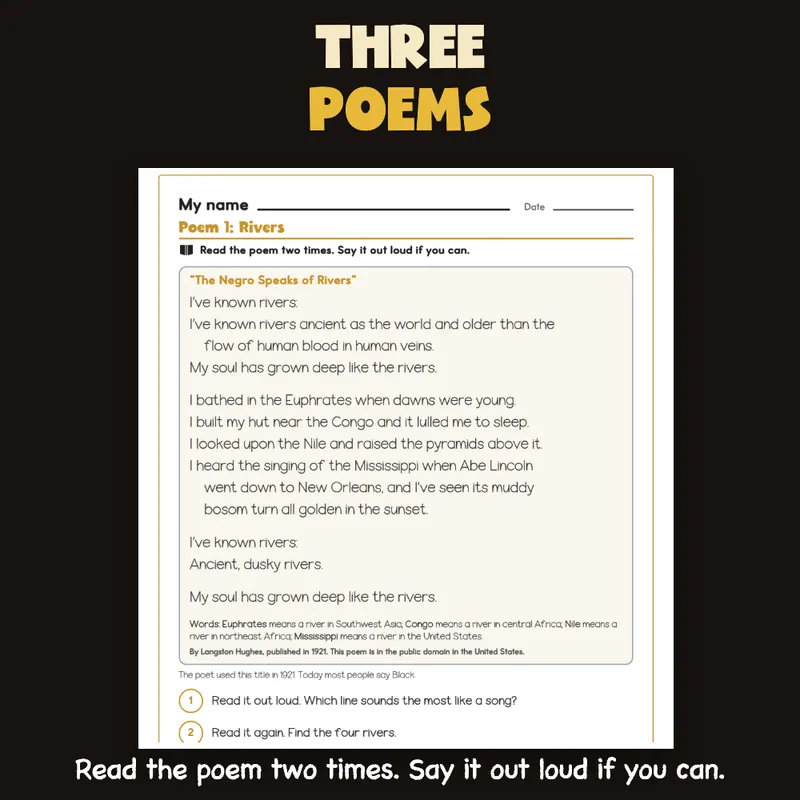
- 3 stations (each with a station card, a source, questions and an organizer): ART (an original silhouette picture made for this product, 6 questions, a chart and a blank frame to make your own silhouette picture, plus a compare page: students compare that picture with one real work your teacher shows, chosen from Aaron Douglas, Aspects of Negro Life mural series, 1934; Archibald Motley, Blues, 1929; Augusta Savage, Gamin, about 1929; the works are in museum collections, no images are included, and your teacher finds one), MUSIC (a text listening guide on the band, call and response, improvising, the blues, Louis Armstrong and Duke Ellington; 6 questions; a listening chart you fill in from a recording your teacher plays or from the guide; two suggested recordings are named for you to play, Louis Armstrong, West End Blues, 1928, and Duke Ellington, Mood Indigo, 1930; no audio is included) and LITERATURE (3 public-domain poems with full text: The Negro Speaks of Rivers by Langston Hughes, 1921; If We Must Die by Claude McKay, 1919; The Tropics in New York by Claude McKay, 1920; 6 questions; a poem chart)
- 21 station questions in all: 6 at each station (2 observe, 2 infer and 2 connect) and 3 on the compare page
- 1 gallery walk record sheet, 1 station rotation page (3 groups, 3 rounds) and 1 stations guide of sample answers plus a teacher notes sheet
- 39 student pages in 16 kinds of page, each with a name line and one short instruction
- 62 scored items spread over 13 scored worksheets, every answer taken from the same lists that print on the page
- Reading 1, a short read of 152 words with a main idea box and 3 checks; Reading 2, the full story in 3 parts (The Great Migration, Jazz and Music, Writers and Artists) of 142 to 146 words each, with a main idea box, a why-it-mattered box and 2 checks each (9 checks in all)
- 2 source analysis pages (written for this file, not historical documents) with 6 questions in ruled boxes: Source A is an invented letter from a family that moved north, and Source B paraphrases in modern words the message of an essay Langston Hughes published in 1926. Neither is a real quote, and each page says so
- 1 Before and After Check (5 questions, an answer box for each time) and 1 Before You Read page with 4 true-or-false items
- 1 Words to Know page: match 8 words (renaissance, migration, jazz, segregation, poet, improvise, culture, anthropologist) to their meanings
- 1 timeline page: write the date for 6 events from 1910 to 1929
- 1 cause and effect organizer with 4 causes, 1 figures chart for 7 people (Langston Hughes, Louis Armstrong, Zora Neale Hurston, Duke Ellington, Claude McKay, Aaron Douglas and Countee Cullen: field and what they made or did), 1 comic strip spread across two sheets with 8 panels (a drawing box at least 2.5 inches tall and one speech line in each)
- 6 short-answer questions across two pages, 4 ruled lines each
- 2 claim-evidence-reasoning pages: an organizer and an 18-line paragraph page
- 12-item quiz across two pages; 4 exit tickets
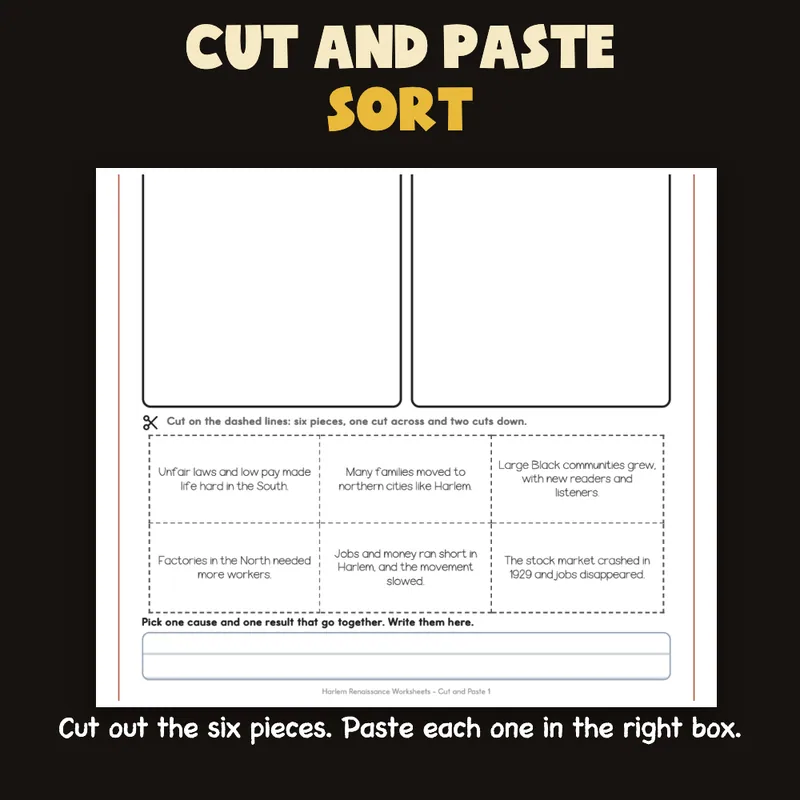
- 18 cut-and-paste pieces on 3 sort mats (cause or result, who would say it with three full-width boxes, put in order), 6 pieces each in a 3 by 2 grid
- 5 answer keys (4 plus the stations guide) with a sample for every open answer; 1 tracker, 1 class grid, 1 team note, 1 family page
- 1 filled example (an invented student), 1 phrase bank (17 starters in 6 groups)
- A binder cover with type-in teacher and class fields, and a page of divider tabs (Readings, Sources, Sorts, Keys, Records) with a spine label to cut out
- Start Here and a how-to-read-a-page page
Built For The Student Holding The Page
A "My name" line, one short instruction with a small plain icon cue, a thin solid border and big ruled boxes. Nothing on a student page is written for an adult: the keys and records are on separate teacher pages. The cut pages have six pieces in a strip-and-grid layout, edge to edge, so there are only a few straight cuts. The four station pictures were made for this product by Bright Path Sped; there are no photographs. The station card and source pages have no writing space, so you can reuse one copy at each station. The file prints clean in black and white, and the pictures are printed lighter to save ink.
A Short Account, Not A Full Textbook
Each reading is a plain-words summary written for this file. It covers Harlem as a neighborhood in New York City, the Great Migration that began around 1916, segregation, jazz and its roots in Black communities in the South, Louis Armstrong and Duke Ellington, the Cotton Club, Langston Hughes and his first book of poems in 1926, Zora Neale Hurston, Claude McKay, Countee Cullen, the painter Aaron Douglas, the magazine The Crisis, and the Great Depression that began in 1929. The pages use no long quotations: the two source pages are written for this file in modern words and say so. Check the readings against your own textbook; they are not tied to any standard. The only student in the file is an invented example, and it says so.
Type In, Or Print
The name line, every answer box, every check box and every ruled work box are type-in fields in any PDF reader: click one, type, then save. This is a fillable PDF; it is not a Google Slides or PowerPoint file.
What This Is, And What It Is Not
A set of Harlem Renaissance readings and practice pages with the record-keeping around it. It has no audio and no images of real artworks: for the music station you play a recording your school may use, or students fill in the chart from the listening guide; for the compare page you find an image of one real work. The art-station picture is an original picture made for this product; it is not a painting by Aaron Douglas or any other artist and it is not a photograph. It is not a timed test, a screener, a clinical tool, or a claim about any student's age or rate of progress. There is no IEP goal language or eligibility wording anywhere in the file, and no claim of alignment to any standard. It is not a complete history of the period.
If You Want More
Shays Rebellion Worksheets | Reading, Timeline, Comic Strip Grades 6-8; Jamestown Worksheets | Sort, Match, Timeline 6th 7th 8th Grade; Southern Colonies Worksheets | Reading, Map, Economy Sort, Quiz Grades 6-8.