Inherited Traits Worksheets
- 45 pages
- 6th, 7th, 8th
$2.50 $5.00 on Teachers Pay Teachers
Half the Teachers Pay Teachers price. The same PDF, sold direct.
DownloadOr get it with All-Access: pick any 20 resources a month for $7.
New here? Your first month of All-Access is half off with code TEACHERTOK
Already bought this, or a member?
Instant download. One teacher's license: colleagues need their own copy. Each file carries a license number.
Also on Teachers Pay Teachers: see the Bright Path Sped store
About this resource
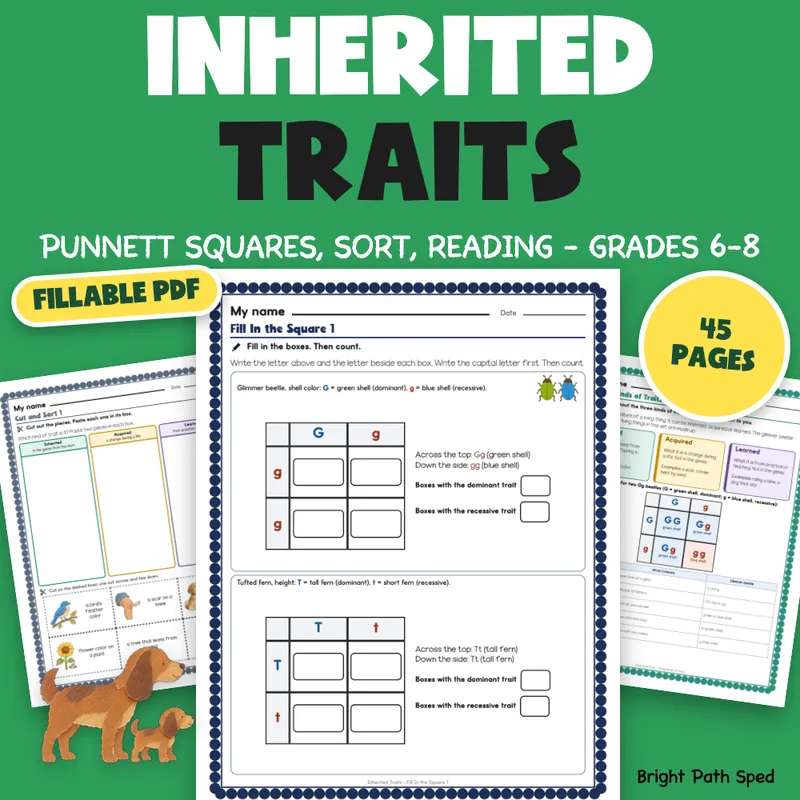
Teaching inherited traits and need pages students can actually work on? This is a complete unit for grades 6-8. A reference page sets inherited, acquired and learned traits side by side and shows a filled Punnett square for two Gg glimmer beetles with a word table (allele, genotype, phenotype, dominant, recessive). Students match six words, read five short passages (traits from parents, acquired and learned, alleles, Punnett squares, genes and the environment) and answer five questions on each, then name each example as inherited, acquired or learned. A worked example walks through a filled square, and a Your Turn gives a second one. Genotype and Phenotype has students read a pair of letters and say the trait it shows and whether the alleles are homozygous or heterozygous. Three Fill In the Square pages give six Punnett squares with type-in boxes, then ask students to count the dominant and recessive traits, and Draw the Offspring has students fill in a square and then draw each offspring in a blank box. A data table of four batches, two bar graphs to draw, two Fix It pages, four claim, evidence, reasoning panels, a quiz, short answer and three cut-and-sort mats finish the student pages. Six answer keys, a tracker, a class grid, a team note and a family page are included. The organisms in the Punnett squares and data pages are made up, so no real species is described.
EVERYTHING INSIDE (45 pages)
- 26 student pages in 14 kinds of sheet, each with a name line and one short instruction
- 187 scored items on 25 sheets, with every answer computed from the letters and numbers on the page
- 1 reference page: inherited, acquired and learned traits, a filled Punnett square and a word table
- 1 inheritance words page: 6 words to match
- 5 reading pages (traits from parents, acquired and learned, alleles, Punnett squares, genes and the environment), 5 questions each, 25 in all
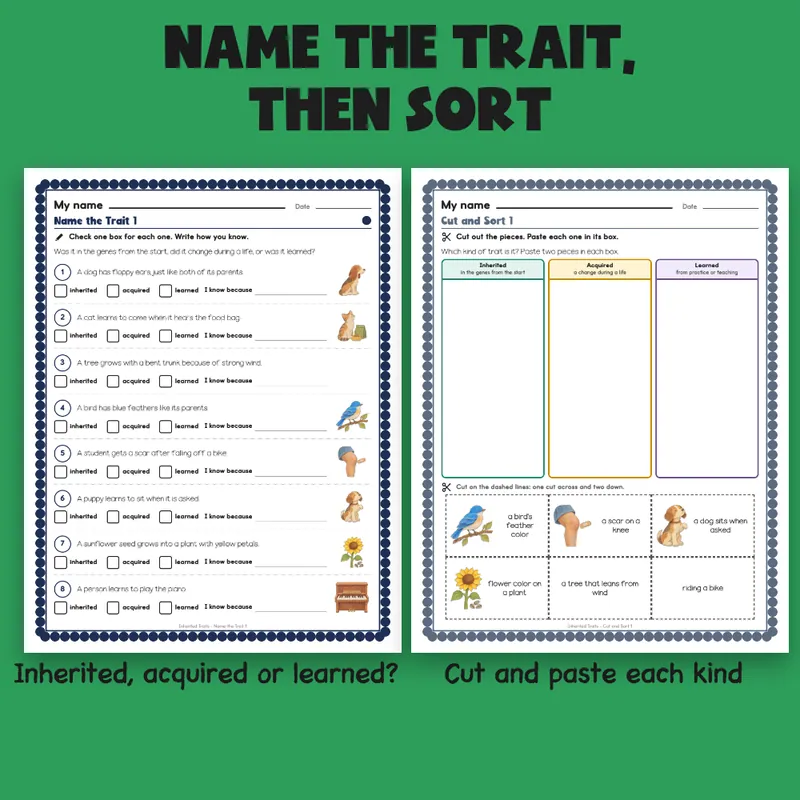
- 16 Name the Trait items across two sheets (8 everyday examples, 8 clues): inherited, acquired or learned
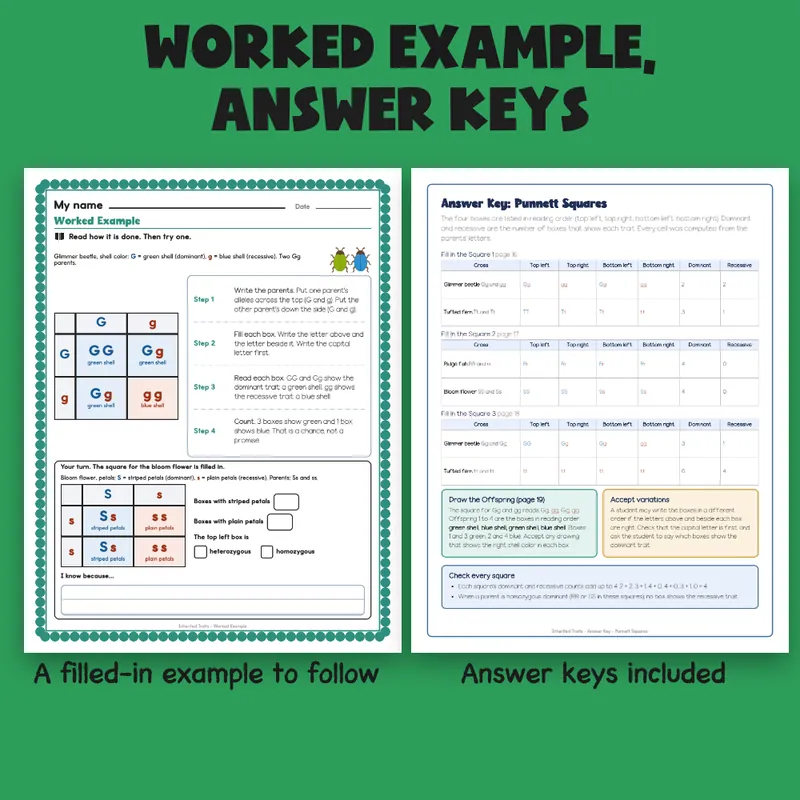
- 1 worked example with a Your Turn (3 items)
- 1 Genotype and Phenotype page: 6 pairs of letters, 12 items
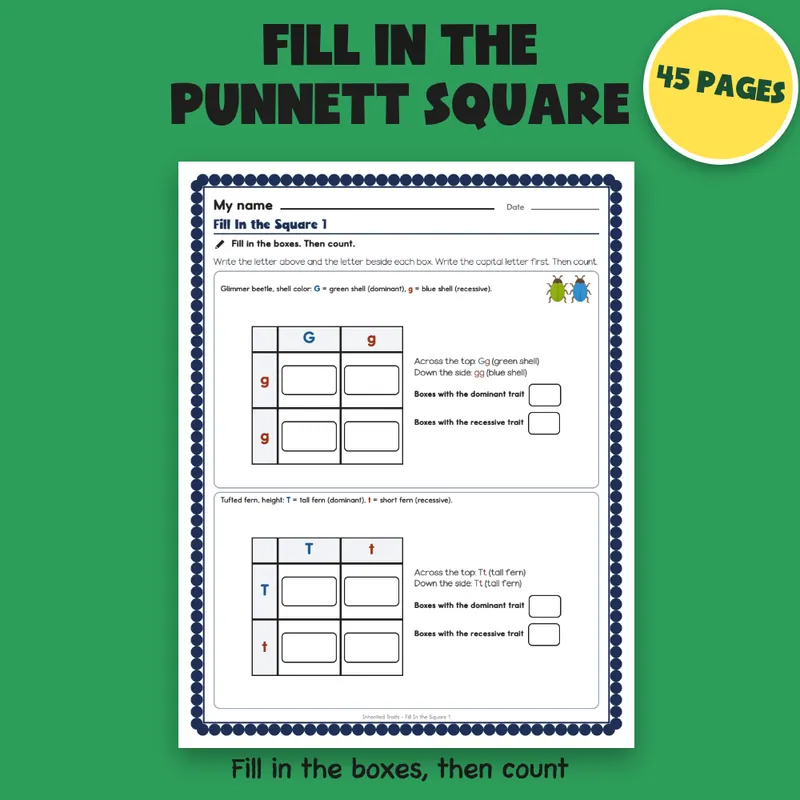
- 3 Fill In the Square pages: 6 Punnett squares, 36 items (the four boxes of each square, then two counts)
- 1 Draw the Offspring page: a square to fill in and 4 blank boxes to draw in, 8 items
- 1 data table page (4 batches, 10 items) and 1 bar graph page (2 graphs to draw, 8 items)
- 10 Fix It statements across two sheets (6 false, 4 true)
- 4 claim, evidence, reasoning panels across two sheets, 12 items
- 10 quiz items and 5 short-answer questions with sample answers
- 26 cut-and-sort pieces on 3 mats: a three-way mat of 6 pieces (inherited, acquired, learned), then two mats of 10 pieces (genotype or phenotype; inherited or not inherited)
- 6 answer keys; 1 tracker, 1 class grid, 1 team note, 1 family page
- 1 filled example (an invented student), 1 phrase bank (17 starters in 6 groups), 1 binder cover and 6 divider tabs with a spine label to cut out
- Start Here and a Teacher Notes page
Built For The Student Holding The Page
A "My name" line, one short instruction with a small picture cue, and a plain scalloped border. Nothing on a student page is written for an adult: the keys and records are on separate teacher pages. Dominant is blue and recessive is red-orange, and every box also carries the words and letters, so a black and white copy reads too. The Punnett squares and graph grids are drawn in the file from boxes, letters and graph lines, and the examples are illustrated with pictures of animals, plants and a made-up beetle.
Invented Examples
The organisms in the squares and data pages and every number are made up for practice (the glimmer beetle, tufted fern, ridge fish and bloom flower), and the student in the filled example is made up and says so. The traits are simplified on purpose: one gene with two alleles. There is no lab procedure, health information, equation or standards code anywhere in the file.
Type In, Or Print
The name line, every answer box, every Punnett square box, every check box and every ruled work box are type-in fields in any PDF reader: click one, type, then save. The cut-and-sort pages are for scissors and glue, and the graph and offspring pages are for drawing in pencil on a printed page. This is a fillable PDF; it is not a Google Slides or PowerPoint file.
What This Is, And What It Is Not
A unit on inherited, acquired and learned traits, how alleles are passed from two parents, and how a Punnett square shows chances, with the record-keeping around it. It does not include a lab procedure, probability rules beyond the four boxes of a square, or detail on any real species or human trait. It is not a timed test, a screener, a clinical tool, or a claim about any student's age or rate of progress. There is no IEP goal language or eligibility wording anywhere in the file.
If You Want More
Homeostasis Worksheets | Feedback Loops, Sort and Diagrams Grades 6-8; Abiotic and Biotic Factors Worksheets | Sort, Diagram, Short Answer Grades 6-8; Asexual and Sexual Reproduction Worksheets | Compare and Sort Grades 6-8.