Ionic and Covalent Bonds Worksheets
- 46 pages
- 8th, 9th, 10th
$2.50 $5.00 on Teachers Pay Teachers
Half the Teachers Pay Teachers price. The same PDF, sold direct.
DownloadOr get it with All-Access: pick any 20 resources a month for $7.
New here? Your first month of All-Access is half off with code TEACHERTOK
Already bought this, or a member?
Instant download. One teacher's license: colleagues need their own copy. Each file carries a license number.
Also on Teachers Pay Teachers: see the Bright Path Sped store
About this resource
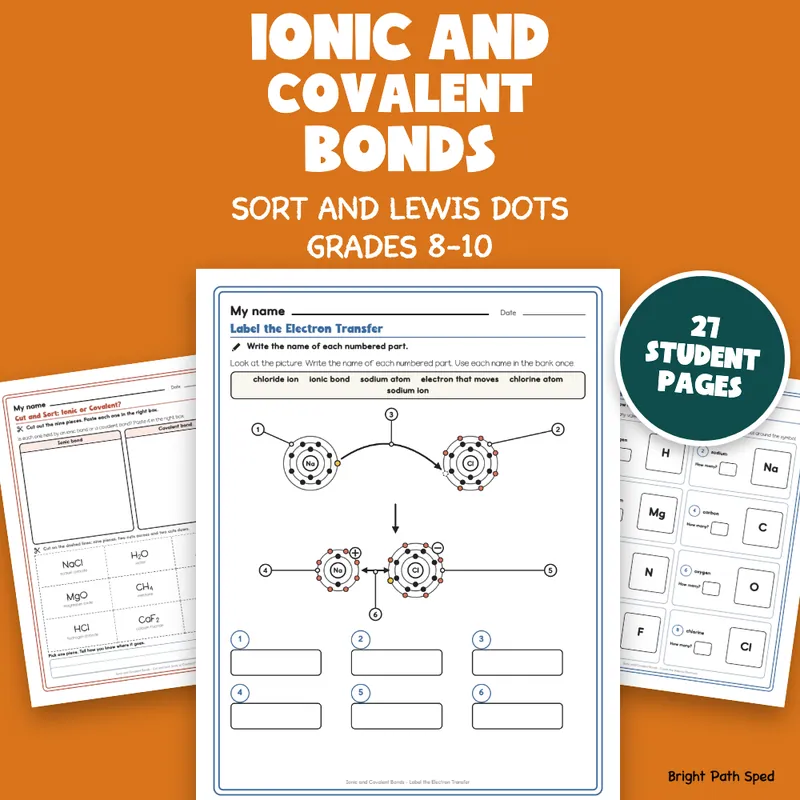
Teach ionic and covalent bonds with a working unit instead of one worksheet: a labeled electron-transfer diagram (sodium and chlorine) and a labeled electron-sharing diagram (hydrogen and chlorine in Lewis dots), a draw-it page for magnesium and oxygen, a sort of ten compounds by bond type, a compare table, six small Lewis structures to count, two short readings, five structure cards, cut-and-sort pages, quizzes and answer keys for every scored page. Students decide whether a bond is ionic or covalent from the elements in it, count valence electrons, name ions, balance charges to write formulas such as NaCl, MgO and CaF2, and explain the difference between transferring and sharing electrons in their own sentences. It is a fillable PDF: type into it or print it.
WHAT IS INCLUDED - 46 pages, 548 type-in fields
Start And Teach
- Start Here and How To Read a Page - which page for which job, and what every kind of box on a student page is for
- 2 readings (Ionic Bonds; Covalent Bonds), 3 questions each
- 5 structure cards on 2 sheets (valence electrons, the ionic bond, the covalent bond, ions, metals and nonmetals), with a "Bonds at a glance" card
- 6 vocabulary words to match, and 1 worked example (Is NaCl ionic or covalent?) with a turn for the student
Build The Skills
- Metal or nonmetal: 12 elements to check
- Count the valence electrons: 8 elements, with a dot square for the student to draw in
- Lose or gain, and name the ion: 8 atoms, 16 answers
- Balance the charges: 6 ion pairs, with how many of each ion and the formula (18 answers)
Transfer, Sharing And Pairs
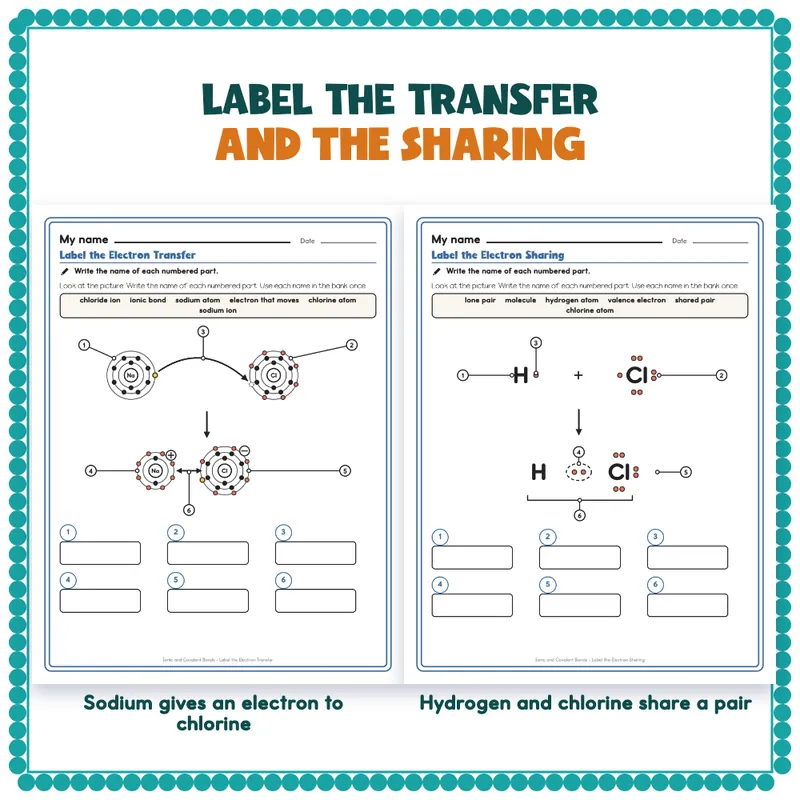
- 2 diagrams to label, 6 numbered parts each, with a word bank: electron transfer (sodium and chlorine become ions) and electron sharing (hydrogen and chlorine in Lewis dots). Drawn by us; no people, no animals, no clip art
- 1 draw-it page: draw the outer electrons and the arrows for magnesium and oxygen, then write the two ion charges and the formula
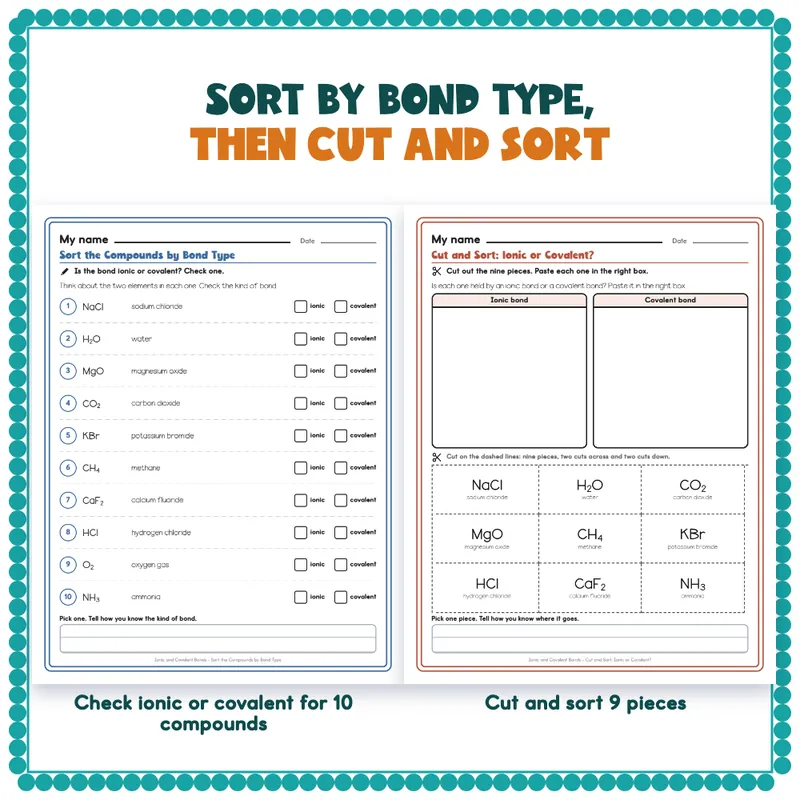
- Sort the compounds: 10 compounds (NaCl, MgO, KBr, CaF2, H2O, CO2, CH4, HCl, O2, NH3) checked as ionic or covalent
- Compare the two bonds: a 5-row table with a word bank (10 boxes), and 8 sentences to check as ionic, covalent or both
- Count the pairs: 6 small Lewis structures (HCl, H2O, CO2, CH4, O2, NH3), shared pairs and lone pairs for each (12 answers)
Check And Write
- 2 true or false sheets (12 sentences, with the fix for each false one) and 1 find-the-mistake sheet (4 sentences)
- 2 short-answer sheets (6 questions, 4 ruled lines each)
- 2 quizzes of 6 multiple-choice items and 1 exit-ticket sheet (3 tickets)
- 2 cut-and-sort pages, 18 pieces in all, 9 to a page, in a 3 by 3 grid: ionic or covalent compounds, and positive or negative ions
Score And Report
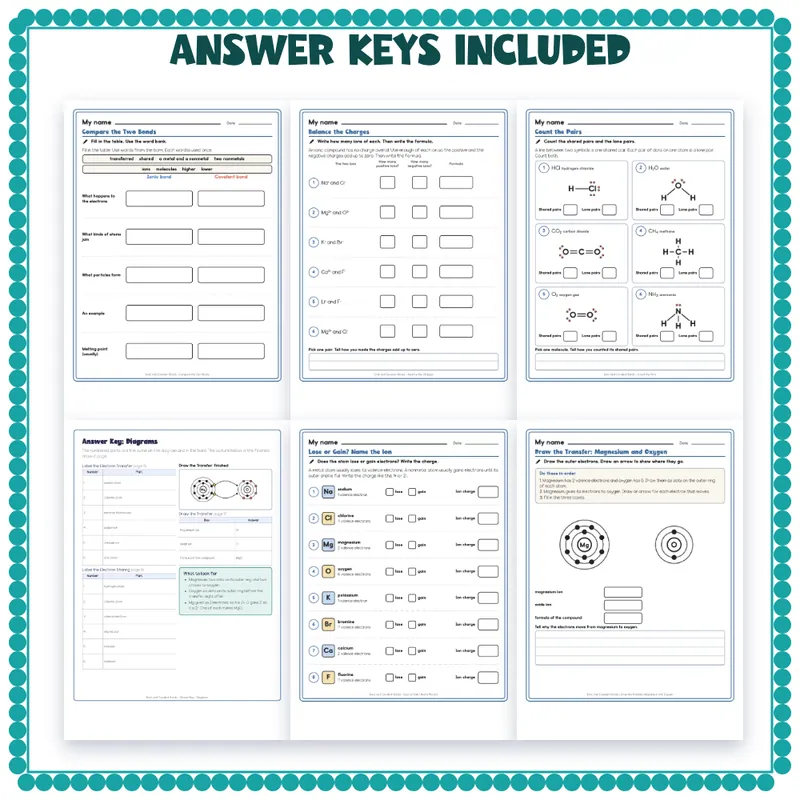
- 8 answer key sheets for every scored page, with what to look for on the writing pages
- 1 tracker, 1 class progress grid, 1 team note, 1 family page, 1 filled-in example (an invented student), 1 phrase bank of 17 starters
In all: 27 student pages in 19 kinds of sheet and 167 scored items on 21 sheets.
What This Is, And What It Is Not
It is a fillable PDF. Open it in a PDF reader, click a line, a box or a check box, type, and Save As. It works offline with no account or subscription, and every page also prints clean in black and white. It is NOT a Google Slides, Google Docs or PowerPoint file, and it does not grade itself.
It is a classroom worksheet unit, not a lab. There is no lab procedure and no experiment. The science is the standard grades 8-10 textbook account: valence electrons, a full outer shell, ionic bonds as transfer between a metal and a nonmetal, covalent bonds as sharing between two nonmetals. The students named in the filled example and on the mistake page are invented and say so. There is a line on the tracker for your own district's or state's standard.
Who This Is For
Science and chemistry teachers in grades 8-10 who want a bonding unit with diagrams, sorts and short writing, special education and resource teachers who need paper with room to write and cut-and-sort pages with big pieces, and substitutes who need a unit that explains itself.