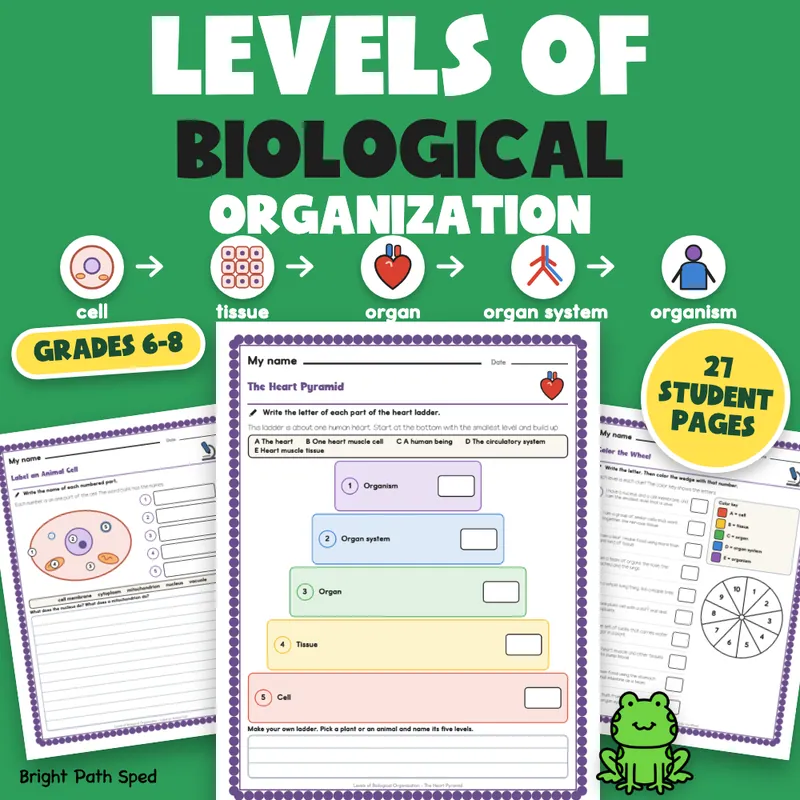
Levels of Biological Organization Worksheets
- 45 pages
- 6th, 7th, 8th
$2.50 $5.00 on Teachers Pay Teachers
Half the Teachers Pay Teachers price. The same PDF, sold direct.
DownloadOr get it with All-Access: pick any 20 resources a month for $7.
New here? Your first month of All-Access is half off with code TEACHERTOK
Already bought this, or a member?
Instant download. One teacher's license: colleagues need their own copy. Each file carries a license number.
Also on Teachers Pay Teachers: see the Bright Path Sped store
About this resource
Teaching the levels of biological organization to grades 6-8 and need pages students can actually work on? This is a complete set: seven short readings that climb from what the levels are to the cell, tissues, organs, organ systems, organisms and the levels above the organism, each with a main idea box, an example box and two checks to answer with a letter. Students then name the level of ten examples, fill two stepped pyramids (one with clues, one for a human heart), label an animal cell and a plant cell, match tissues and organ systems, complete four cell-to-organism ladders, and work a color-by-code wheel of ten clues. They also answer six short questions, plan and write a claim-evidence-reasoning paragraph about whether the heart is a tissue or an organ, take a twelve-item quiz and do three cut-and-paste sorts. Answer keys give the letters, the finished color wheel and a sample for every open answer.
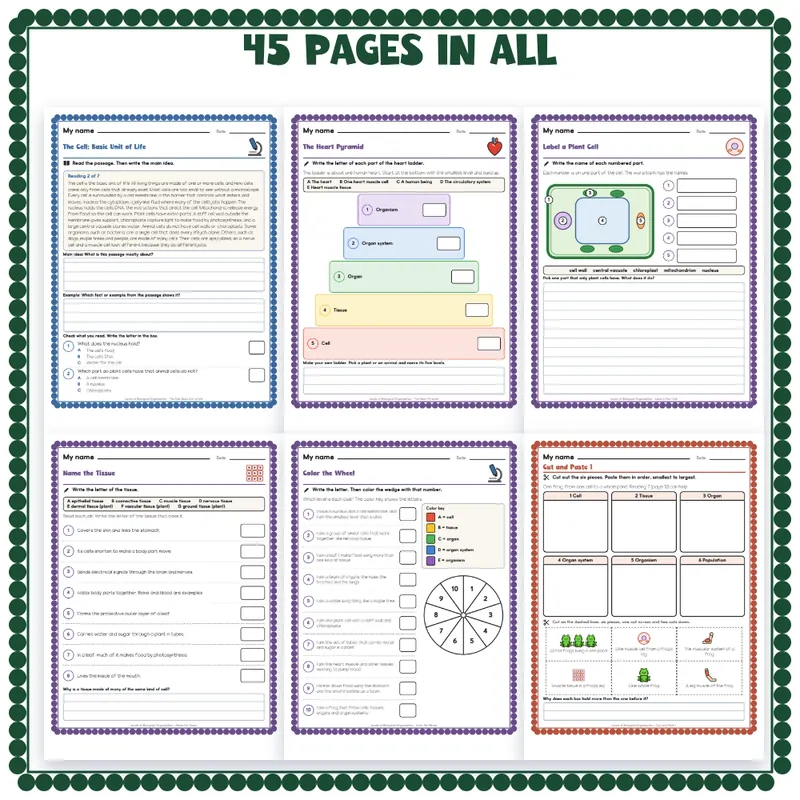
EVERYTHING INSIDE (45 pages)
- 27 student pages in 14 kinds of page, each with a name line and one short instruction
- 120 scored items spread over 23 scored sheets, every answer taken from the same data that prints on the page
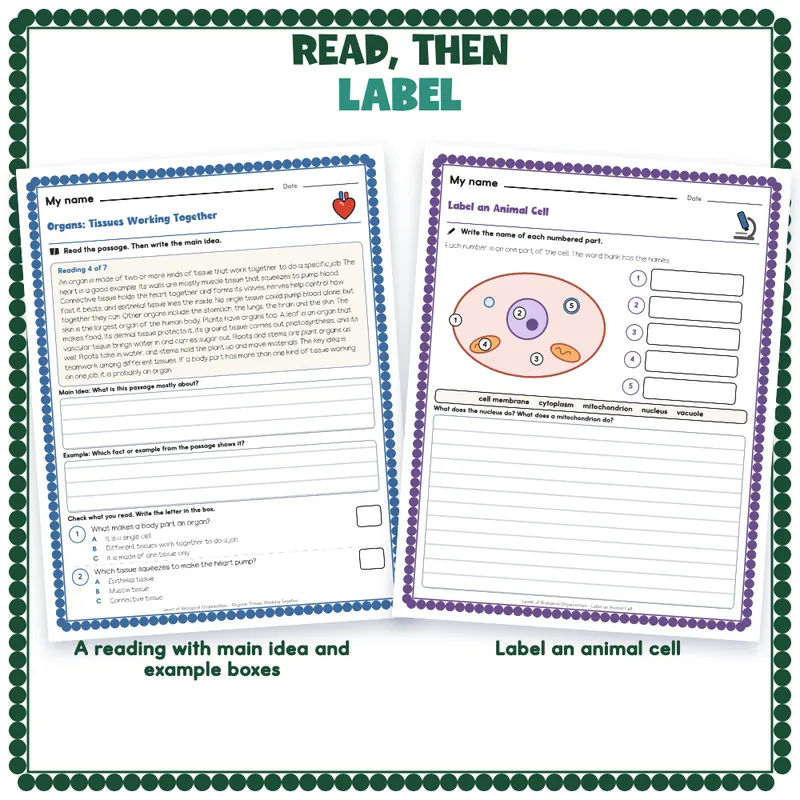
- 7 readings of 163 to 178 words, each with a main idea box and an example box (at least 3 ruled lines each) and 2 checks (14 checks in all)
- 1 Before You Read page with the five levels in a row and 4 true-or-false items
- 1 Words to Know page: match 8 words (cell, tissue, organ, organ system, organism, nucleus, unicellular, population) to their meanings
- 1 Which Level? page: name the level of 10 examples
- 2 pyramid pages: Fill the Pyramid (5 steps with clues) and The Heart Pyramid (5 steps from a lettered bank)
- 2 cell pages: label an animal cell and a plant cell, 5 numbered parts each, drawn for this file
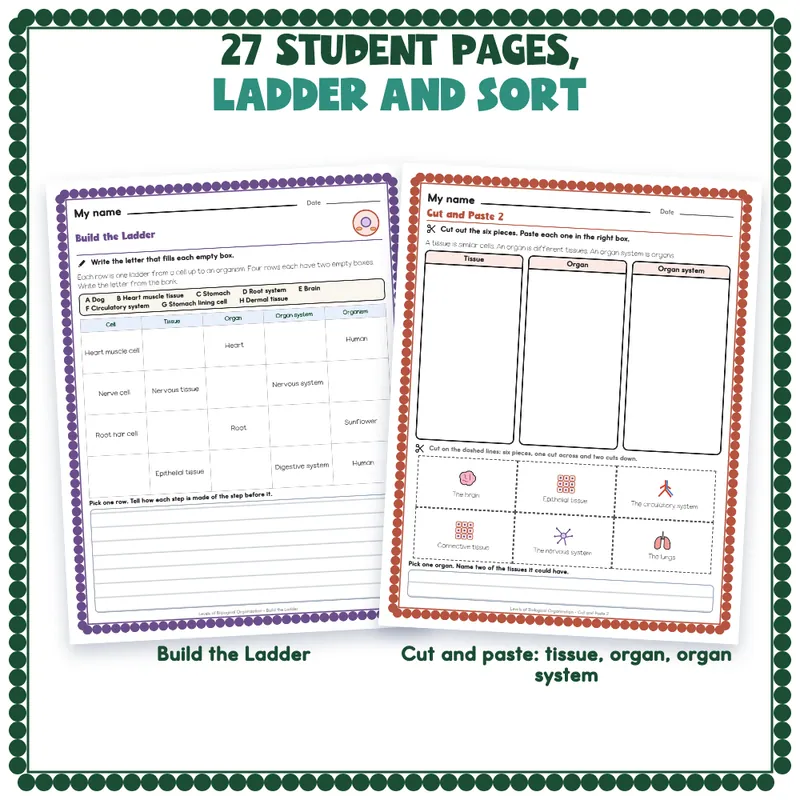
- 1 Name the Tissue page (8 jobs, 7 tissue types), 1 Organ Systems page (8 organs, 6 systems) and 1 Build the Ladder page (4 chains, 8 empty boxes)
- 1 Color the Wheel page: 10 clues, a color key and a ten-wedge wheel
- 6 short-answer questions across two pages, at least 4 ruled lines each
- 2 claim-evidence-reasoning pages: an organizer and an 18-line paragraph page
- 12-item quiz across two pages
- 18 cut-and-paste pieces on 3 sort mats (in order from cell to population, tissue or organ or organ system, plant cells only or both), 6 pieces each in a 3 by 2 grid
- 5 answer keys with a sample for every open answer; 1 tracker, 1 class grid, 1 team note, 1 family page
- 1 filled example (an invented student), 1 phrase bank (17 starters in 6 groups)
- 1 binder cover and a set of divider tabs and a spine label
- Start Here and a how-to-read-a-page page
Built For The Student Holding The Page
A "My name" line, one short instruction with a small picture cue, a plain scalloped border and big ruled boxes. Nothing on a student page is written for an adult: the keys and records are on separate teacher pages. The cut pages have six pieces in a strip-and-grid layout, edge to edge, so there are only a few straight cuts. Clip art is kept to a frog and a kidney; the cell, tissue, heart, lungs, brain, microscope and cover pictures, the cell diagrams, ladder row, pyramids and wheel are drawn for this file. The cut tiles on two of the three sort mats carry a small picture. The file prints clean in black and white; color the wheel with crayons on paper.
A Short Account, Not A Full Textbook
Each reading is a plain-words summary of one idea, written for this file. It does not quote any source and it is not tied to a particular standard. Check the details against your own textbook. The only student in the file is an invented example, and it says so.
Type In, Or Print
The name line, every answer box, every check box and every ruled work box are type-in fields in any PDF reader: click one, type, then save. The color wheel is colored by hand on the printed page. This is a fillable PDF; it is not a Google Slides or PowerPoint file.
What This Is, And What It Is Not
A set of life science readings and practice pages with the record-keeping around it. It is not a timed test, a screener, a clinical tool, or a claim about any student's age or rate of progress. There is no IEP goal language or eligibility wording anywhere in the file, and no claim of alignment to any standard.
If You Want More
Plant and Animal Cells Worksheets | Diagram, Sort, Compare, Write 6th-8th Grade; Digestive System Worksheets | Label, Sequence, Sort, Write 6th-8th Grade.