Liquid Volume Worksheets
- 33 pages
- 3rd, 4th
$1.75 $3.50 on Teachers Pay Teachers
Half the Teachers Pay Teachers price. The same PDF, sold direct.
DownloadOr get it with All-Access: pick any 20 resources a month for $7.
New here? Your first month of All-Access is half off with code TEACHERTOK
Already bought this, or a member?
Instant download. One teacher's license: colleagues need their own copy. Each file carries a license number.
Also on Teachers Pay Teachers: see the Bright Path Sped store
About this resource
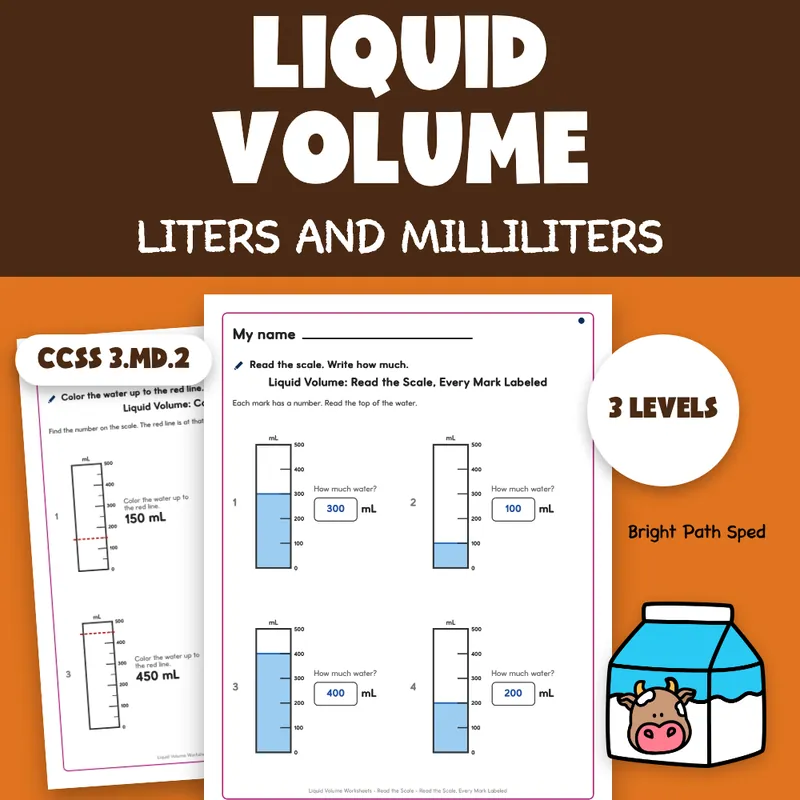
Looking for liquid volume worksheets that your third and fourth graders can finish without a lot of explaining? This set has 20 student sheets built on one idea: find the top of the water, find the number just below it, and count up by the small marks. Students decide whether an amount is measured in liters or milliliters, pick the best estimate, read scales in mL and in L, compare and order volumes, and solve word problems with adding, subtracting and equal groups. Every page has a big "My name" line, one short instruction, and big boxes to write in. Print and go: students write with a pencil, and the answer boxes can also be typed into on screen.
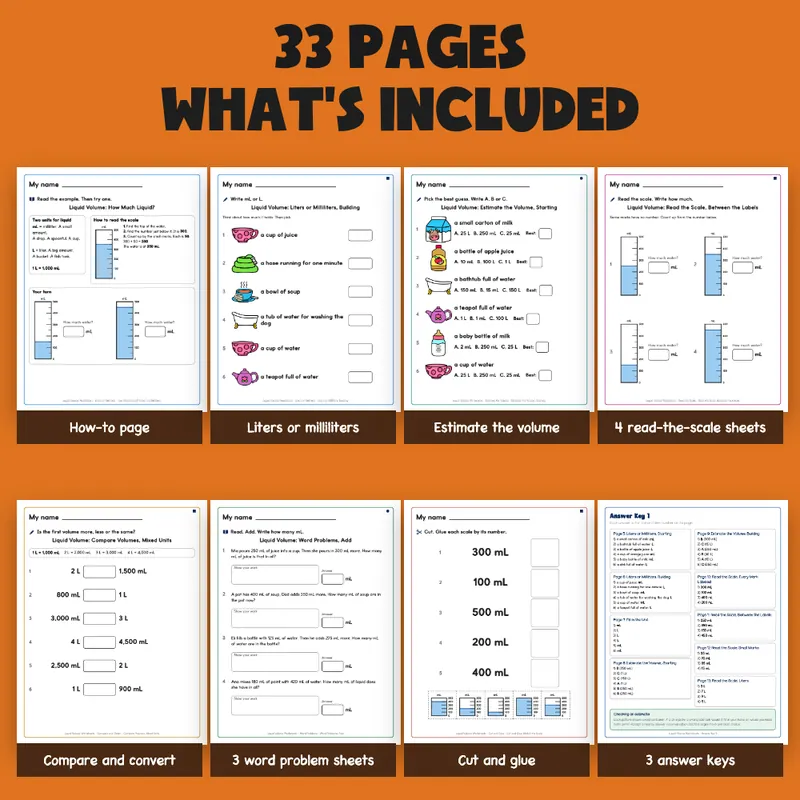
EVERYTHING INSIDE (33 pages)
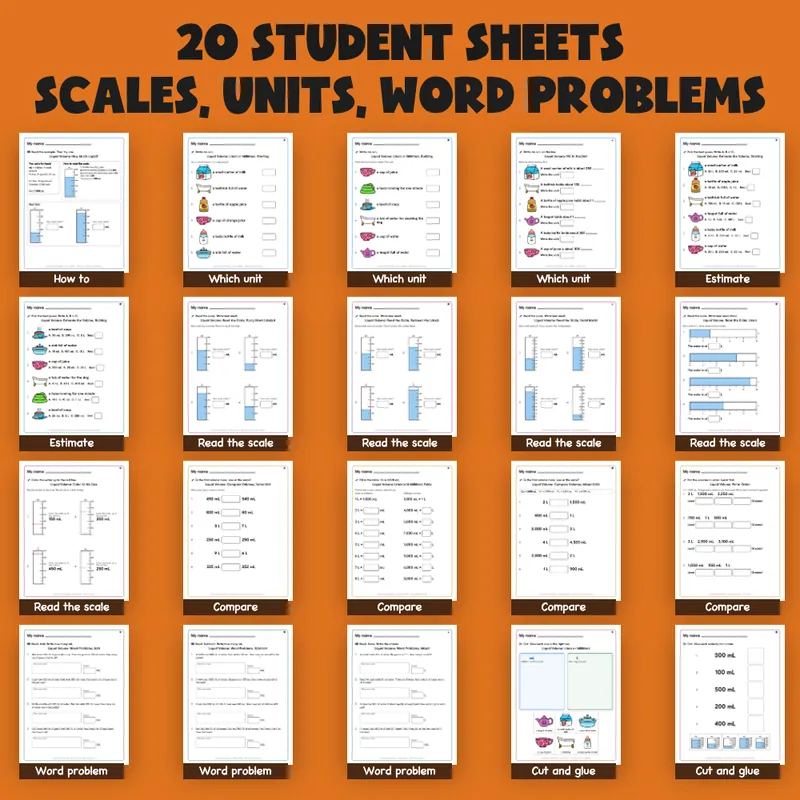
- 20 student sheets (18 scored sheets with 99 items, plus a how-to page and a color-to-the-line page)
- 1 how-to page: what mL and L mean, how to read a scale in three steps, and one to try
- 3 liters-or-milliliters sheets (6 items each, every item with a picture): write mL or L for a phrase, then fill in the unit in a sentence
- 2 estimate sheets (6 items each, every item with a picture): pick the best guess from three choices
- 4 read-the-scale sheets (4 scales each): every mark labeled, marks between the labels, small marks (each worth 5 mL), and a liters scale lying down
- 1 color-to-the-line sheet (4 scales): color the water up to the red line
- 4 compare and convert sheets: same unit (6 items), a liters and milliliters table (14 blanks), mixed units (6 items) and put three volumes in order (4 sets)
- 3 word-problem sheets (4 problems each): add, subtract, and a mixed page with an equal-groups problem; each has a work box
- 2 cut-and-glue sheets: sort 6 picture cards (a picture and its words) into liters and milliliters, and match 5 scales to their readings
- 2 wall posters (1 Liter = 1,000 Milliliters, Which Unit?)
- 3 answer-key pages, a tracker with a roll-up graph (18 scored sheets), a filled example (an invented student), a family page, a Start Here page, a terms page, a What's Next page and a credits page
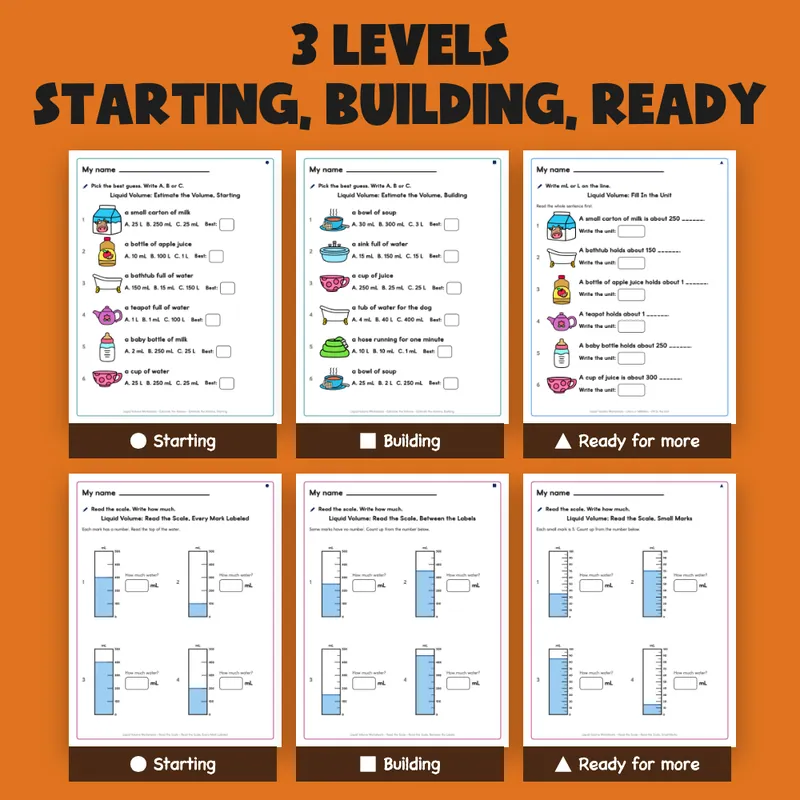
Three Levels
A small shape in the top corner of 19 student sheets tells you the level: a circle (8 sheets) is starting, a square (7 sheets) is building, and a triangle (4 sheets) is ready for more, such as small marks on the scale, mixed units, ordering or a mixed word-problem page. The how-to page carries no level shape.
How It Works
1. Pick a section: which unit, estimate, read the scale, compare and order, word problems, or cut and glue.
2. Print a page and hand it over. One short instruction, one job. Students write in the boxes.
3. Check with the key, write the date and score on the tracker, and color the roll-up column.
4. Hang a poster for students who need the units in front of them.
Built For The Child Holding The Page
A big "My name" line, big print, boxes big enough for a child's handwriting, and room to work. Each container on the unit, estimate and sort pages has a picture beside it (36 pictures in all), and the scales are plain bars with tick marks, easy to read and easy to photocopy. Nothing on a student page is written for an adult; the keys, tracker and notes are on separate teacher pages. All names and numbers on the practice sheets are made up. Every water level on a scale was checked against its answer by code, every comparison and ordering was worked out in milliliters, and every answer in the key comes from the same numbers as its page.
What This Is, And What It Is Not
It is a fillable PDF for printing: the name line and the answer boxes can be typed into, or you can print and write by hand. It covers liquid volume in metric units only (milliliters and liters). It does not include mass or customary units such as gallons and quarts. It is not a file you can resize or re-edit, and it is not a Google Slides, Docs or PowerPoint file. It does not test, place or label students; use the pages in the order your class learns measurement.
Who This Is For
Aligned to CCSS 3.MD.2: measure and estimate liquid volumes and masses of objects using standard units of grams, kilograms, and liters. This set covers the liquid volume (liters and milliliters) part only.
Third and fourth grade teachers, interventionists, special education teachers and families who want liquid volume practice with liters and milliliters.