Logical Fallacies Worksheets
- 37 pages
- 7th, 8th, 9th, 10th, 11th, 12th
$2.50 $5.00 on Teachers Pay Teachers
Half the Teachers Pay Teachers price. The same PDF, sold direct.
DownloadOr get it with All-Access: pick any 20 resources a month for $7.
New here? Your first month of All-Access is half off with code TEACHERTOK
Already bought this, or a member?
Instant download. One teacher's license: colleagues need their own copy. Each file carries a license number.
Also on Teachers Pay Teachers: see the Bright Path Sped store
About this resource
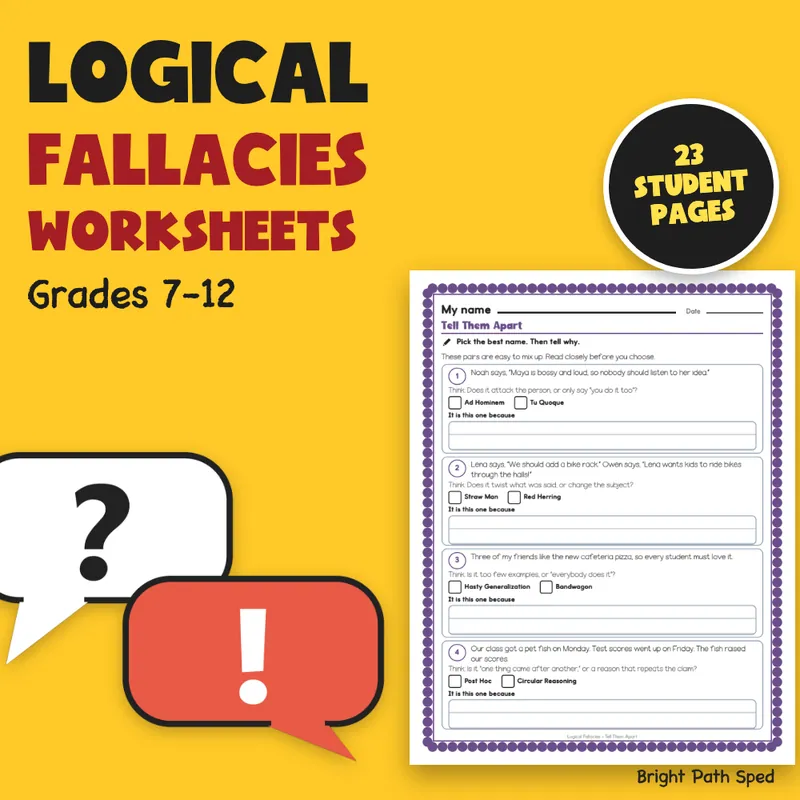
Teaching logical fallacies and need worksheets students can actually write on? This set covers twelve common fallacies in plain language: ad hominem, straw man, false dilemma, slippery slope, bandwagon, appeal to authority, hasty generalization, circular reasoning, red herring, post hoc, appeal to emotion and tu quoque. Each one gets a definition, clue words, an invented example and a line on why it fails. Students then name the fallacy, tell look-alikes apart, spot fallacies in invented ads, headlines and posts, rewrite weak arguments with a real reason, take a quiz and cut and sort. Answer keys name the best answer for every item. Printable, no prep.
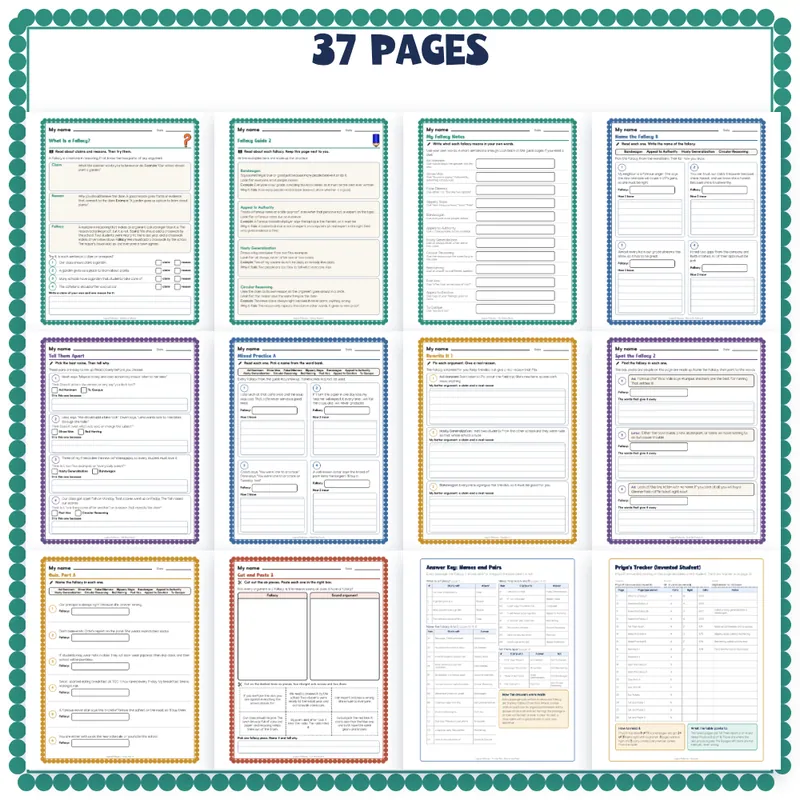
EVERYTHING INSIDE (37 pages)
- 23 student pages in 13 types of page, each with a name line and one short instruction
- 73 scored items on 17 scored pages, every one keyed to the fallacy it was written to show
- A claims and reasons page, with 4 claim-or-reason items
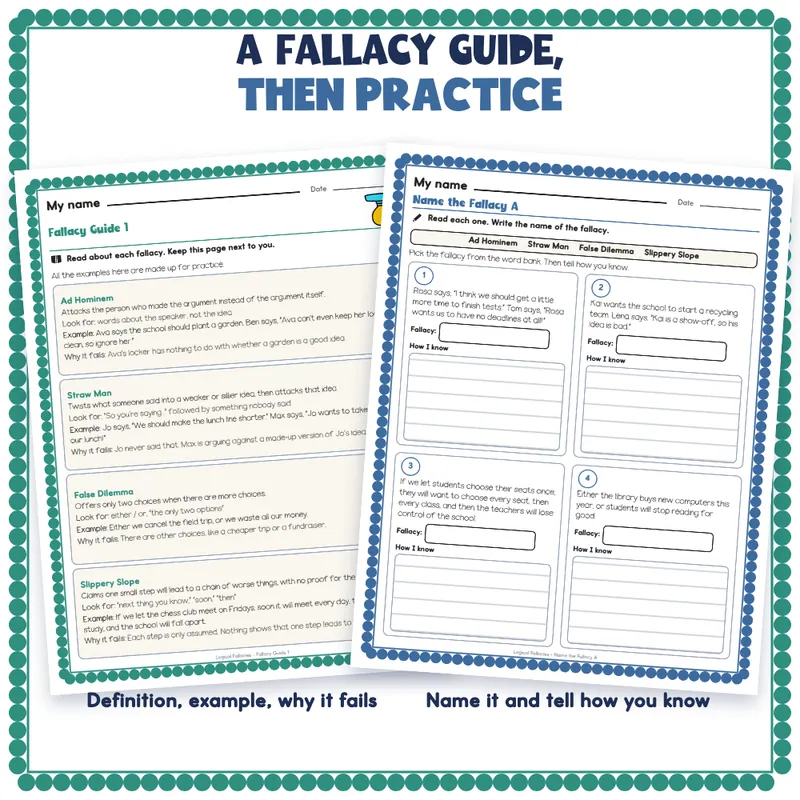
- 3 fallacy guide pages: 12 fallacies, each with a definition, clue words, an invented example and why it fails
- 1 notes organizer with a box for each of the 12 fallacies
- 12 name-the-fallacy passages across three pages, each with a short word bank and a "how I know" box
- 4 tell-them-apart pairs (ad hominem or tu quoque, straw man or red herring, and more)
- 8 mixed-practice passages with a word bank of all twelve names
- 6 rewrite-it arguments with 5 ruled lines each: keep the idea, add a real reason
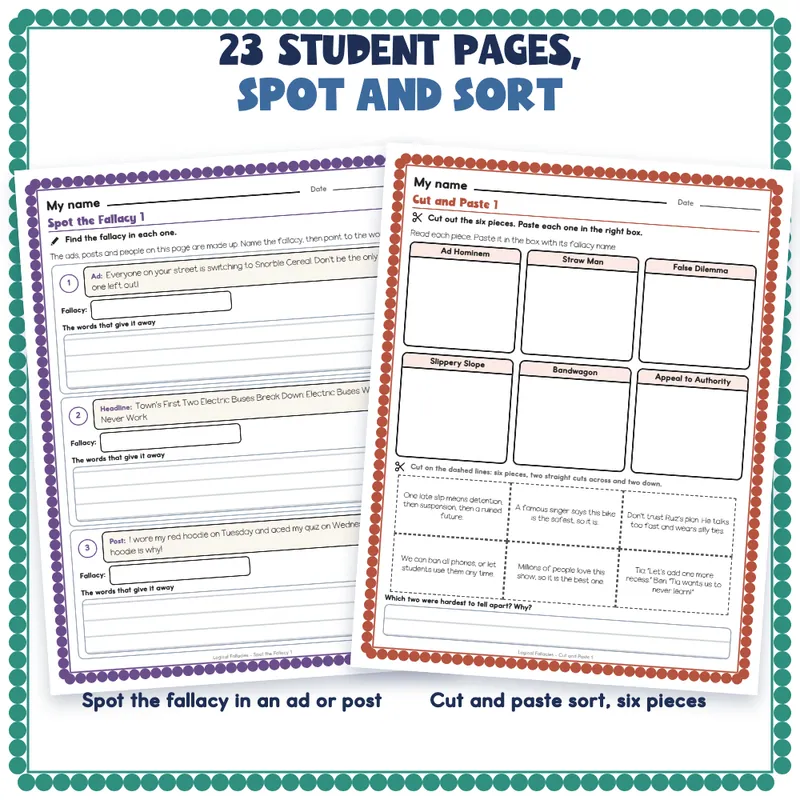
- 6 invented ads, headlines, posts and letters to spot, with room to point to the words that give each one away
- 12-item quiz, one passage for each fallacy; 3 exit tickets; 1 write-your-own page; 1 self check
- 18 cut-and-paste pieces on 3 sort mats (6 into 6 fallacy boxes, 6 into 6 more, and 6 sorted into fallacy or sound argument)
- 3 answer keys; 1 tracker, 1 class grid, 1 team note, 1 family page
- 1 filled example (an invented student), 1 phrase bank (17 starters in 6 groups)
- Start Here and a how-to-read-a-page page
Built For The Student Holding The Page
A "My name" line, one short instruction with a small picture cue, and a plain scalloped border. Nothing on a student page is written for an adult: the keys and records are on separate teacher pages. Work boxes are ruled and give real room to explain. Clip art is kept to a lightbulb, a question mark and a pencil. The file prints clean in black and white.
Invented Examples
Every passage, ad, headline, brand, post and person is made up for practice, and the pages say so. The filled example names an invented student. No real quotation, statistic or news story is used.
Type In, Or Print
The name line, every answer box, every check box and every ruled work box are type-in fields in any PDF reader: click one, type, then save. This is a fillable PDF; it is not a Google Slides or PowerPoint file.
What This Is, And What It Is Not
A logical fallacies practice set with the record-keeping around it. It is not a timed test, a screener, a clinical tool, or a claim about any student's age or rate of progress. There is no IEP goal language or eligibility wording anywhere in the file.
If You Want More
Argumentative Writing | Claim Evidence Reasoning Organizers, Rubric Grades 6-8; 5 Paragraph Essay Graphic Organizer | Outline, Thesis, Transitions 6th-9th Grade; Figurative Language Worksheets | Simile, Metaphor, Idiom 6th 7th 8th Grade.