Multiplication Anchor Chart
- 34 pages
- 3rd, 4th
$2.00 $4.00 on Teachers Pay Teachers
Half the Teachers Pay Teachers price. The same PDF, sold direct.
DownloadOr get it with All-Access: pick any 20 resources a month for $7.
New here? Your first month of All-Access is half off with code TEACHERTOK
Already bought this, or a member?
Instant download. One teacher's license: colleagues need their own copy. Each file carries a license number.
Also on Teachers Pay Teachers: see the Bright Path Sped store
About this resource
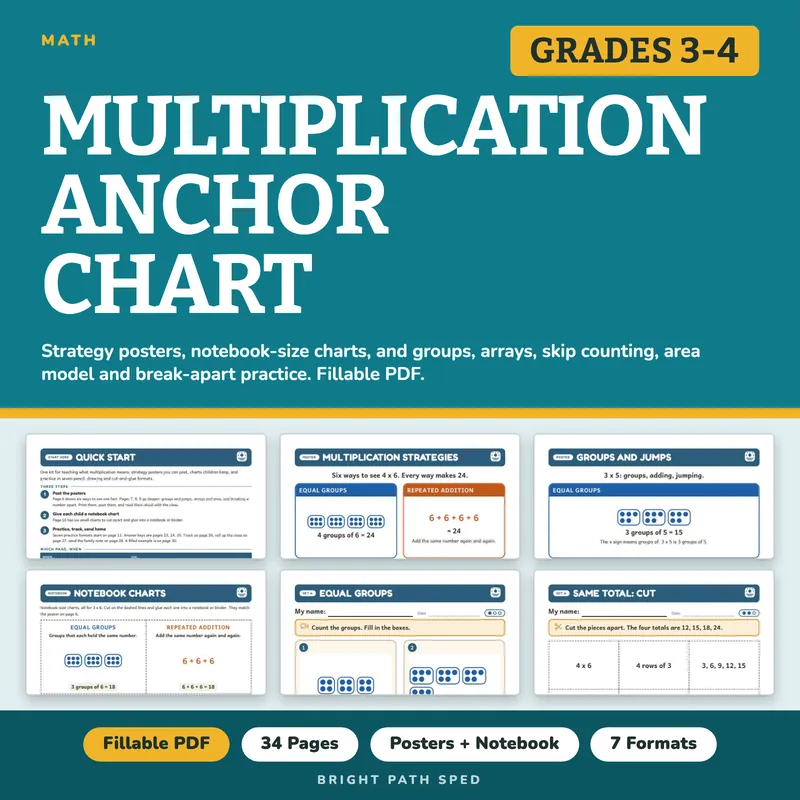
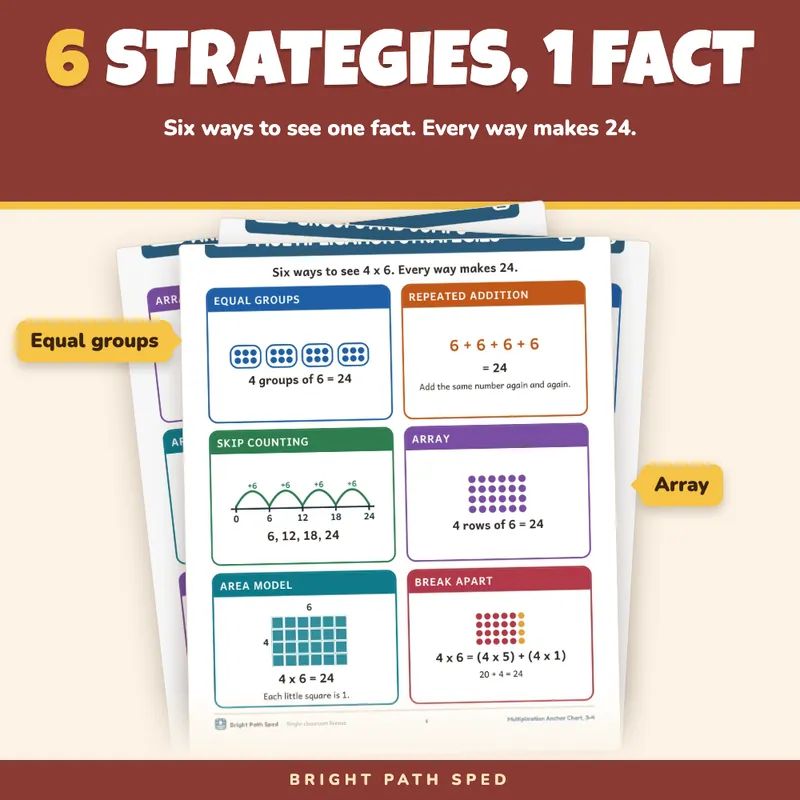
Children remember multiplication when they can see it. This kit gives you the multiplication anchor chart to post, six small charts for each child's notebook, and practice at three levels. The same fact (4 x 6 = 24) is shown six ways on one poster: equal groups, repeated addition, skip counting, an array, an area model, and break apart. Each strategy keeps its own color and name on every page, and every dot is big enough to count.
EVERYTHING INSIDE (34 pages)
- 4 poster pages: six strategies side by side on one fact (page 6), groups and jumps with 3 x 5 (page 7), arrays and the area model with 4 x 7 (page 8), and break it apart with 6 x 7 plus tens and ones with 3 x 24 (page 9)
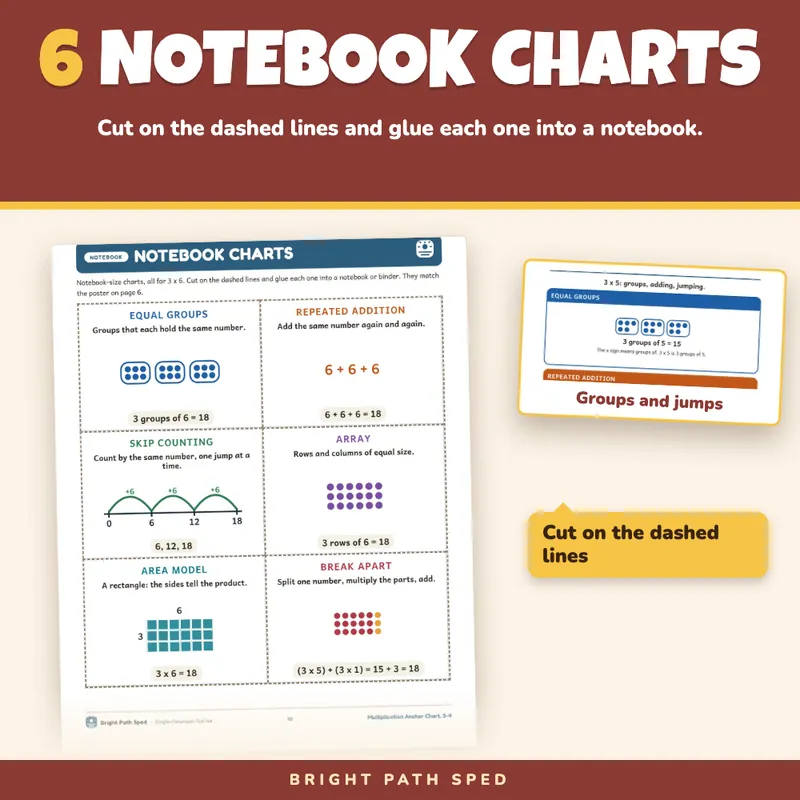
- 1 notebook page (page 10): 6 small charts to cut apart and glue into a notebook (Equal Groups, Repeated Addition, Skip Counting, Array, Area Model, Break Apart)
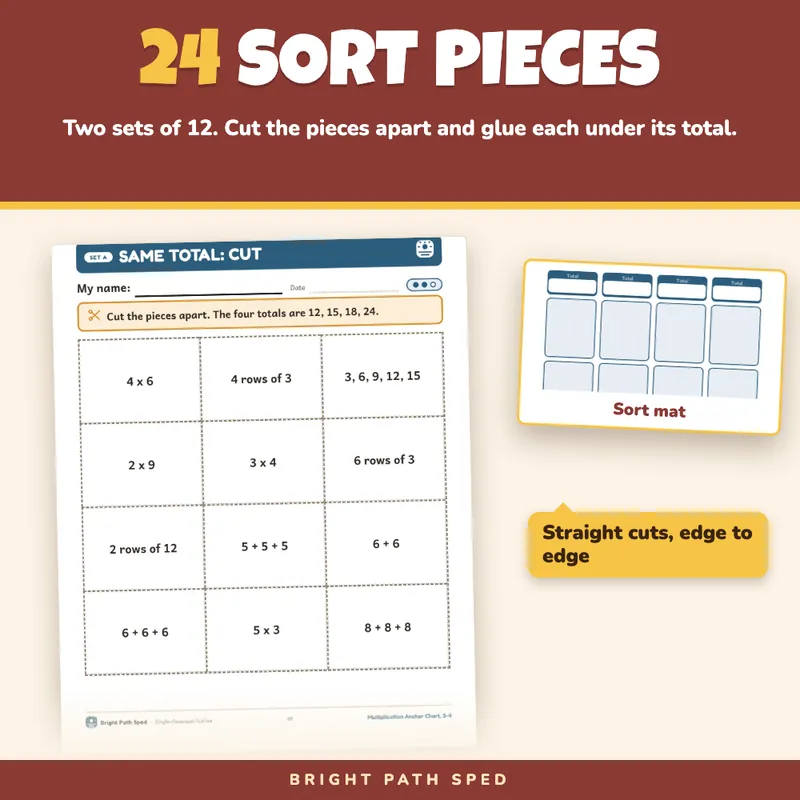
- 12 student practice pages in 7 formats: Equal Groups (2 sets), Arrays (2 sets), Skip Counting, Same Total (a sort mat and 2 cut-and-glue sets of 12 pieces), Break It Apart (2 sets), Tens and Ones, and Draw It
- 38 invented practice items, plus 24 sort pieces
- 3 answer keys, generated from the same data as the student pages
- 1 tracker, 1 class progress grid, 1 family note, 1 whole-class mini-lesson page
- 1 filled example (an invented student), 1 phrase bank (13 starters), 1 binder cover, 6 divider tabs and a spine label to cut out
- Start Here, a how-to-read-a-page page and a contents page with every page number
The Seven Practice Formats
1. Equal Groups (1 dot) — four pictured sets of rings per page; count the groups, then fill in "__ groups of __ = __" and "__ x __ = __".
2. Arrays (1 dot) — four dot arrays per page; count the rows, then fill in the boxes.
3. Skip Counting (1 dot) — six count-by rows (by 2, 5, 3, 4, 6 and 8) with three empty boxes in each.
4. Same Total (2 dots) — cut 12 pieces (multiplication sentences, repeated addition, rows of, and skip counts) and glue the three that make each total on the mat.
5. Break It Apart (2 dots) — four problems per page, each broken into a 5 and a leftover part; multiply each part, then add.
6. Tens and Ones (3 dots) — four two-digit by one-digit problems broken into tens and ones, with the area model drawn for the child.
7. Draw It (3 dots) — draw groups or an array in a big box, then fill in the sentence.
Built For The Child Holding The Page
A big "My name" line, one short instruction, large rounded letters, big boxes to write in, real room to draw, and dots in the corner (not words) to show the level. Every cut page has 6 or 12 pieces in a block, edge to edge, so each cut is one straight line.
Everything Is Invented
All problems and pictures are made up for practice. No real child is named. The filled example names an invented student and says so on the page.
Type In, Or Print
The name and date lines, tracker, class grid, family note and mini-lesson page are type-in fields in any PDF reader. The student pages are pencil work. This is a fillable PDF; it is not a Google Slides or PowerPoint file.
Who This Is For
Teachers of grades 3-4: general education, resource room and self-contained classrooms, and anyone who wants a multiplication anchor chart plus practice in one file. The mini-lesson page is for teaching the whole class from the poster; the family note sends the skill home.
What This Is, And What It Is Not
Strategy posters, notebook charts and practice, with the record-keeping around it. It is not a times-table chart, a screener or a scored test, and it makes no claim about any student's level or rate of progress. There is no standard-algorithm cheat sheet and no IEP goal language in the file.