Nonsense Word Fluency Practice
- 29 pages
- Kindergarten, 1st, 2nd
$2.00 $4.00 on Teachers Pay Teachers
Half the Teachers Pay Teachers price. The same PDF, sold direct.
DownloadOr get it with All-Access: pick any 20 resources a month for $7.
New here? Your first month of All-Access is half off with code TEACHERTOK
Already bought this, or a member?
Instant download. One teacher's license: colleagues need their own copy. Each file carries a license number.
Also on Teachers Pay Teachers: see the Bright Path Sped store
About this resource
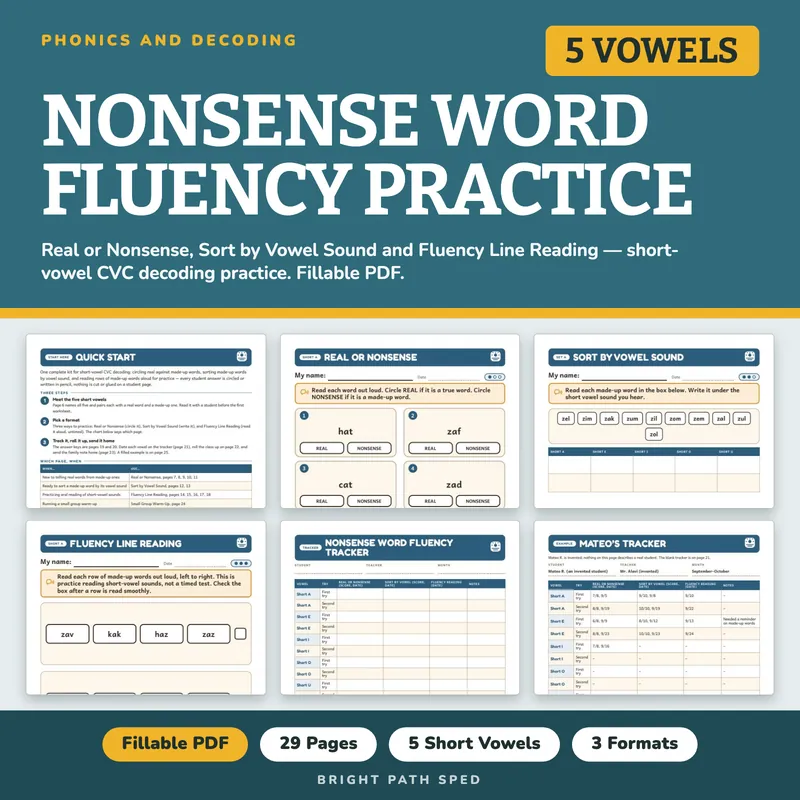
Decoding a made-up word is the real test of short-vowel CVC phonics — a real word can be guessed from
memory, but a made-up one has to be sounded out. This is a complete kit for all five short vowels: three
different ways to practice telling real from made-up and reading made-up words aloud, plus a tracker, a
class grid, a family note and a small group warm-up, so nothing has to be written from scratch.
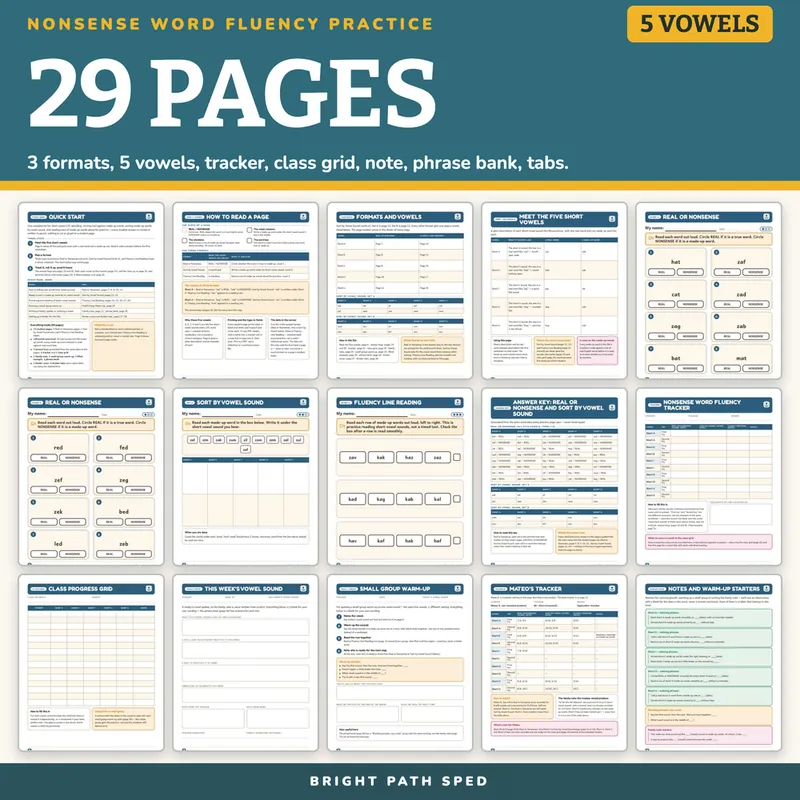
EVERYTHING INSIDE (29 pages)
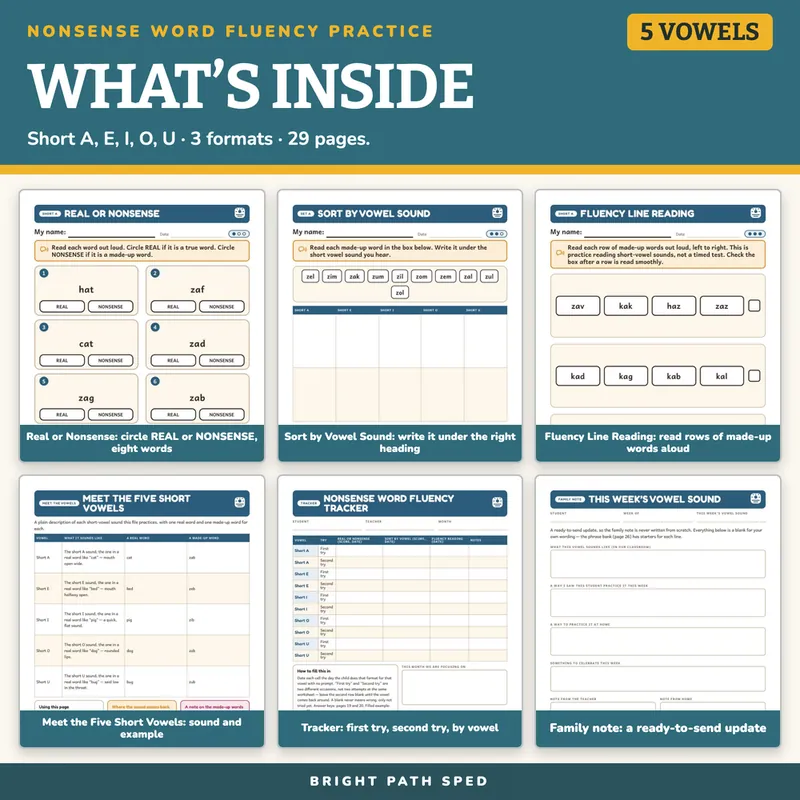
- 12 student pages in 3 formats: 5 Real or Nonsense pages (one a vowel, 8 words each), 2 Sort by Vowel
Sound sets (10 words each), 5 Fluency Line Reading pages (one a vowel, 12 words each in 3 rows)
- 120 words practiced in all: 20 real CVC words and 100 made-up words, every made-up word checked in code
against real-word lists so it never doubles as a true word
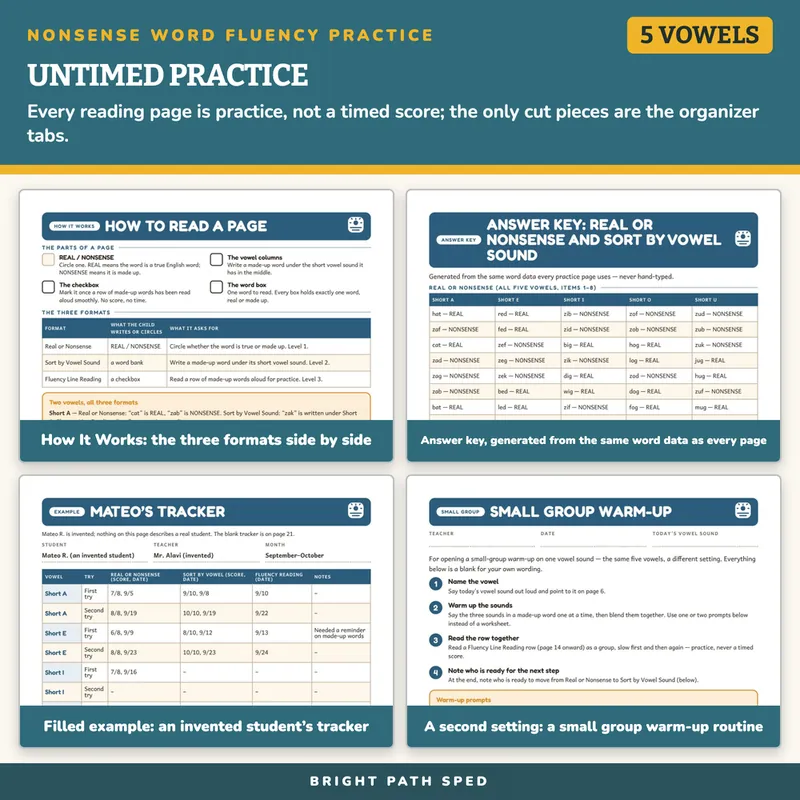
- 2 answer keys, generated from the same word data as the student pages (one covers Real or Nonsense and
Sort by Vowel Sound; one is a reading reference for Fluency Line Reading, since an aloud-reading page has
no score to key)
- 1 tracker (first try / second try, by vowel) and 1 whole-class progress grid
- 1 family note (a ready-to-send update) and 1 small group warm-up (a different setting — a short group
routine, not individual seatwork)
- 1 filled example (an invented student), 1 phrase bank (14 observable-language starters), 1 binder cover,
and 5 divider tabs with a spine label to cut out
- Start Here, a how-to-read-a-page page, a contents page that gives every page number, and a Meet the Five
Short Vowels reference page
The Three Formats, Easiest To Hardest
1. Real or Nonsense (starting) — eight words on a page, four real CVC words and four made-up ones,
shuffled; circle REAL or NONSENSE for each. One page a vowel.
2. Sort by Vowel Sound (building) — ten made-up words in a word bank; write each one under the short vowel
sound it has in the middle. Two full sets (A, B), two words a vowel in each.
3. Fluency Line Reading (ready for more) — three rows of four made-up words, read aloud left to right for
practice. Untimed: there is no words-per-minute score and no cutoff anywhere in this file.
Built For The Child Holding The Page
A big "My name" line, one short instruction, large rounded letters, real room to write or circle, and dots
(not words) to show which level a page is. Nothing on a student page is written for an adult.
Every Made-Up Word Is Checked
Every "nonsense" word is a pronounceable, invented pseudoword — never a real English word, a name, or
slang. Each one is checked in code against a real-word list (common sight words plus real CVC words from
the same word family) before it is used on any page. Fluency Line Reading is read-aloud practice: no
words-per-minute score, no cutoff, and no claim about a real student's rate.
Type In, Or Print
The name and date lines, the tracker, the class grid, the family note and the small group warm-up are
type-in fields in any PDF reader. The words a student circles or writes are pencil work. This is a
fillable PDF; it is not a Google Slides or PowerPoint file.
Who This Is For
Kindergarten, first and second grade classrooms, self-contained and resource rooms, and any teacher or
interventionist running short-vowel CVC decoding practice. The small group warm-up sends the same five
vowels to a short group routine; the family note sends them home.
What This Is, And What It Is Not
A short-vowel CVC decoding worksheet set with the record-keeping around it. It is not a standardized or
norm-referenced test, a screener, a clinical or diagnostic tool, or a claim about any student's age or
rate of progress. There is no IEP goal language or eligibility wording anywhere in the file.