Number Bonds to 20 Worksheets
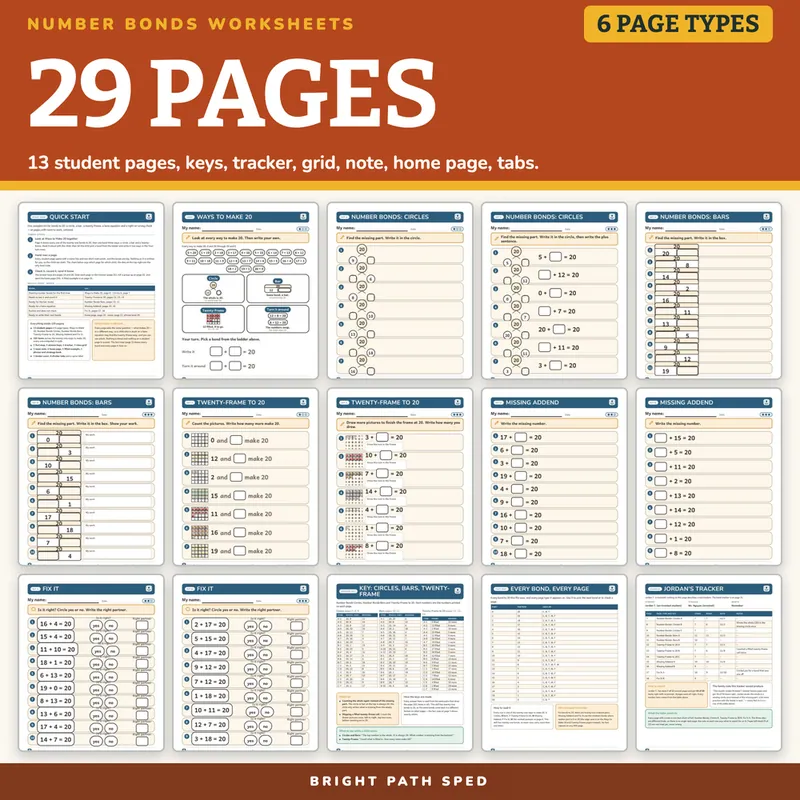
- 29 pages
- 1st
$4.00
DownloadOr get it with All-Access: pick any 20 resources a month for $7.
New here? Your first month of All-Access is half off with code TEACHERTOK
Already bought this, or a member?
Instant download. One teacher's license: colleagues need their own copy. Each file carries a license number.
Also on Teachers Pay Teachers: see the Bright Path Sped store
About this resource
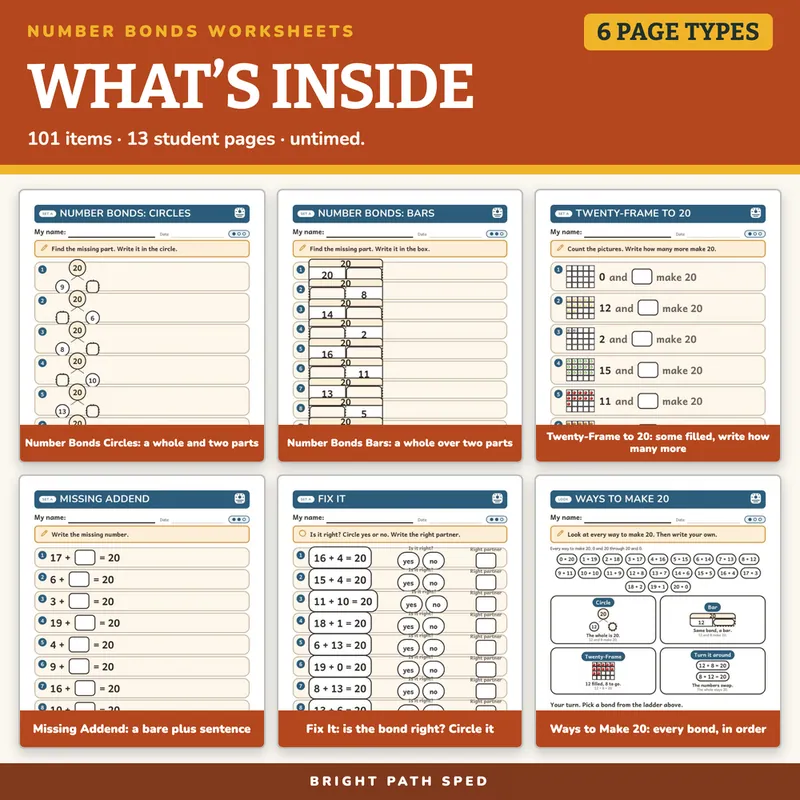
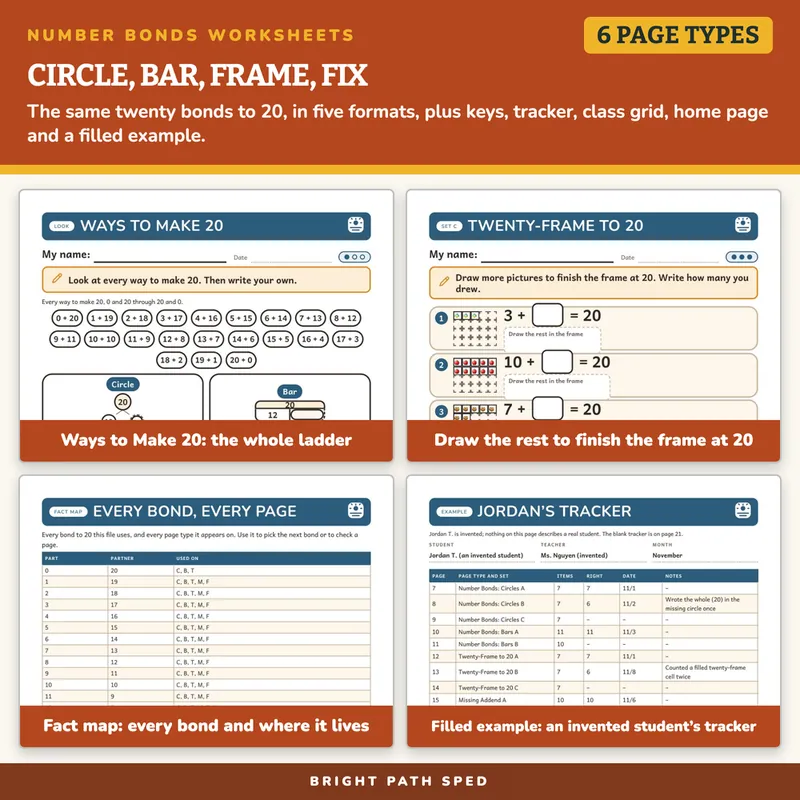
One complete kit for bonds to 20 — every bond whose whole is 20, shown five ways: as a circle, as a bar, as a twenty-frame (with pictures to count), as a bare equation, and as a right-or-wrong check. The same 21 bonds come back on every page type in a different format so a child who is stuck on a bare equation may find the twenty-frame easy, and you can see which representation works best. Nothing is timed and nothing on a student page is scored.
✓ This is a worksheet practice file. Children write directly on the pages to show what makes 20.
✓ This is a fillable PDF — click any answer box, type, and save. Every field is interactive in any PDF reader (not Google Slides, not PowerPoint, not Word).
✓ These pages have room to work. Every answer box is at least 0.5 inches tall; the biggest is the twenty-frame, where there is space to draw more pictures.
✓ Everything was drawn by us — the pictures (apple, star, fish, ball, cookie), the frames, every circle and bar. No emoji, no stock.
✗ This is NOT a test. Nothing here has a timer or a score printed on the page; that is a separate kind of resource.
✗ This is NOT a timed probe. If your team wants a timed check for an IEP goal, use the Number Bonds to 20 Progress Monitoring Probes instead (if available).
✗ This is NOT an assessment checklist. Nothing on a student page names a level. The dots at the top right (1, 2, or 3) are the only level code, so children do not compare pages.
This file is for a 1st-grade teacher, special educator, interventionist, or specialist who has a small group or a table of children who are learning bonds to 20 and need to see it more than one way. Every page has a simple instruction and a name line at the top. Student pages have no teacher talk, no scoring, and no language that assumes prior knowledge. A 1st grader can start the minute you hand over a page.