Patterning AB AAB ABB ABC Task Box
- 35 pages
- Not Grade Specific
$1.50 $3.00 on Teachers Pay Teachers
Half the Teachers Pay Teachers price. The same PDF, sold direct.
DownloadOr get it with All-Access: pick any 20 resources a month for $7.
New here? Your first month of All-Access is half off with code TEACHERTOK
Already bought this, or a member?
Instant download. One teacher's license: colleagues need their own copy. Each file carries a license number.
Also on Teachers Pay Teachers: see the Bright Path Sped store
About this resource
PATTERNING PRACTICE FOR INDEPENDENT WORK — 35 pages
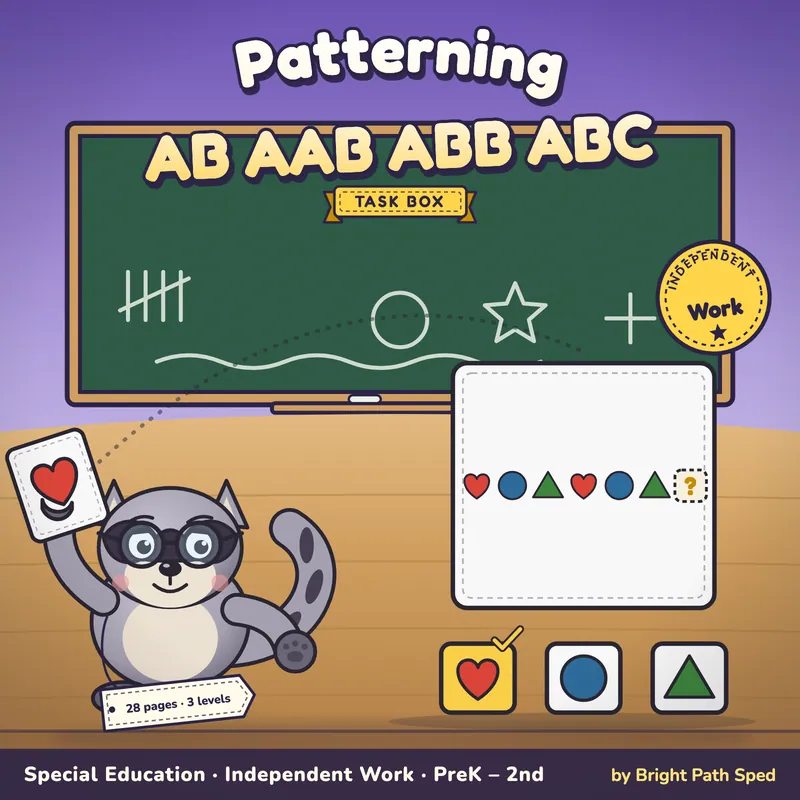
- 36 patterning cards in 3 levels, 12 cards a level: AB, AAB, ABB and ABC, three cards of each type at every level
- Level 1: complete the end of the pattern. Level 2: find the missing shape in the middle. Level 3: extend the pattern by two
- Every card is a wide strip card (about 7.5 x 3.3in, big easy-to-read shapes) with its blank and a row of three choices to mark
- Every card twice: tinted tiles for a laminated classroom box and black-on-white tiles for the photocopier, so 72 card faces in all
- 2 pattern strips pages (color and ink-saver): one worked strip each of AB, AAB, ABB and ABC, nine tiles long, with the repeating part marked
- An answer key listing all 36 strips by level, with the answer for every blank
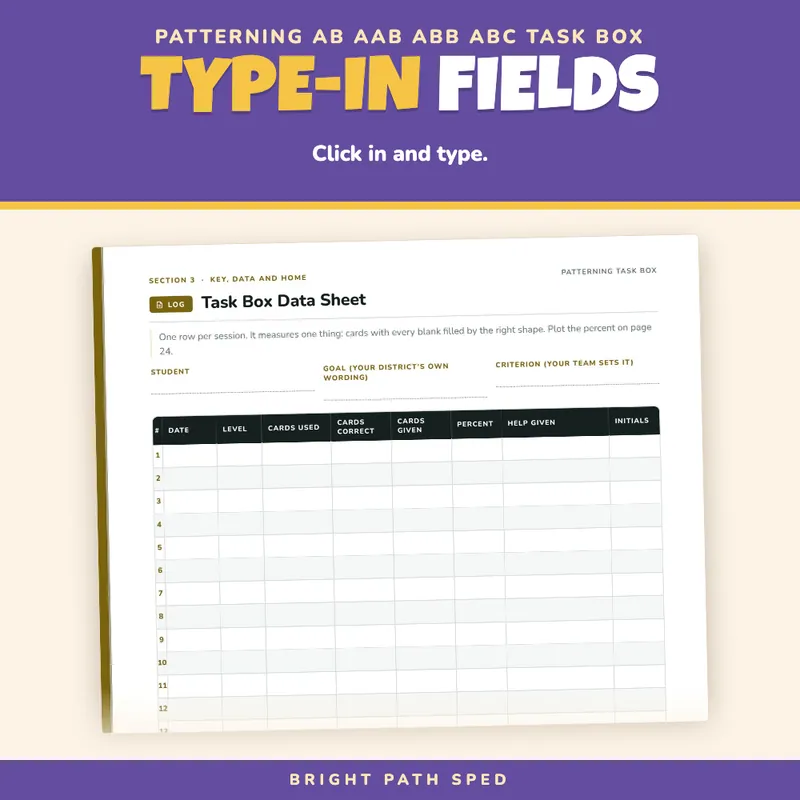
- A task box data sheet (14 rows: date, level, cards used, cards correct, cards given, percent, help given, initials)
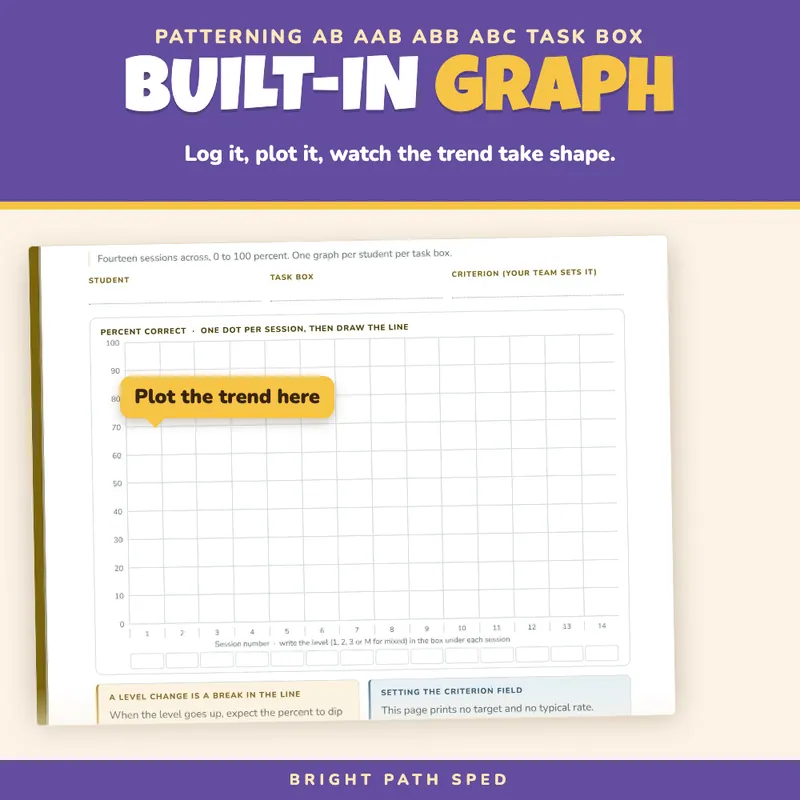
- A percent graph, 14 sessions across, with a level box under each session
- A filled example: an invented student, 8 sessions, every percent re-counted from its own row
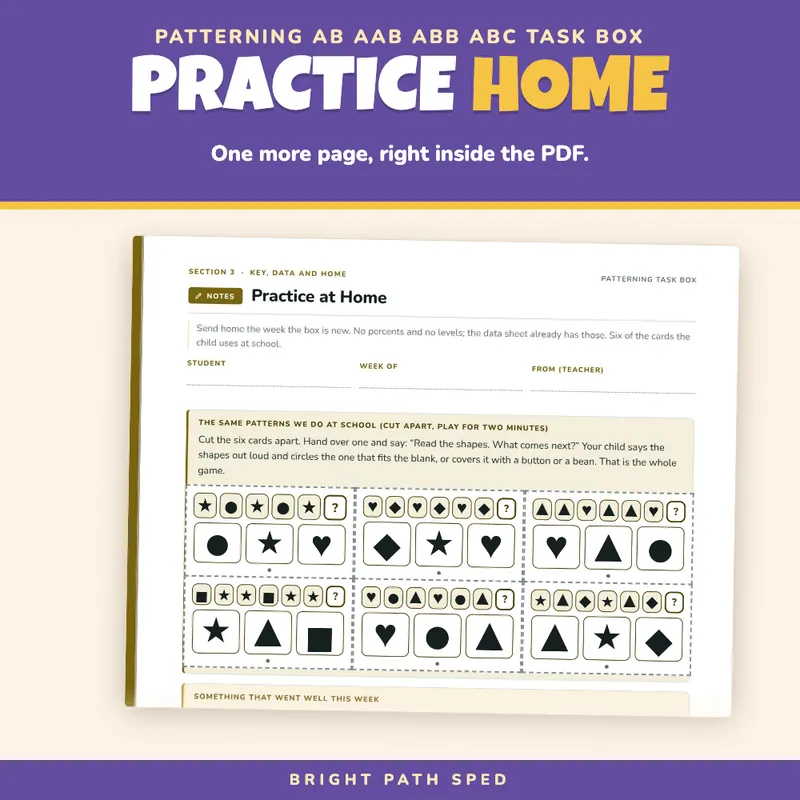
- A family practice page with six of the same cards
- A phrase bank: 25 lines in 6 groups (spoken lines for running the box, written starters for the note afterward)
- Start Here, a contents page with page thumbnails, and a "what's next" back page
Patterning is the skill of reading a repeating strip and saying what comes next. This task box gives a child 36 chances to do it, from "what is the last shape?" up to "what are the next two?", and gives the adult a data sheet and graph so the practice turns into a line on a page that can go to a meeting.
Six Shapes, Told Apart By Shape, Not By Color Alone
Star, heart, circle, square, triangle and diamond. Every pattern on every card is made of those six, so the black-and-white set works exactly like the color set. There is no picture library: every shape is plain printed text.
The Four Pattern Types
- AB: two shapes taking turns
- AAB: the first shape twice, then the second
- ABB: the first shape once, then the second twice
- ABC: three different shapes in a row
Every strip is long enough to show its repeating part twice (at Levels 1 and 3 both times come before the first blank), and each card has one right answer.
Three Levels
- Level 1, complete the end: the blank is the last tile. One row of three choices.
- Level 2, complete the middle: the blank has at least two tiles on each side, so the child has to look left and right of the gap.
- Level 3, extend by two: the strip ends in two blanks, marked 1 and 2, with a row of three choices for each. A card counts as correct when both marks are right.
On a two-shape card the wrong choices are the strip's other shape and a shape that is not on the strip at all. On an ABC card all three choices are on the strip. Nothing on a card says its level except a dot code in the corner (one, two or three dots), so a mixed-up box sorts itself back together.
Easy To Prep
Print on cardstock, laminate if you like, and cut. Each page holds three big strip cards, edge to edge, so the sheet comes apart in a couple of straight cuts. Marking is a circle, a clothespin or a chip; laminated cards take a dry-erase marker and wipe clean.
What This Is, And What It Is Not
It is a fillable PDF: type into the data sheet, the graph header, the family page and the example-style notes, or print and use a pen. It works offline with no account or subscription. It is NOT an editable online slideshow or word-processor document, and it is not a test of anything.
It carries no prompt hierarchy, fading schedule or mastery rule, and it does not decide what a percent means for a student or when to move up a level. The goal line and the criterion field are blanks for your district's own wording and your team's own number. It measures one thing: cards with every blank filled by the right shape.
Who This Is For
Special education teachers and paraprofessionals running independent work stations or task box rotations, case managers who need that practice to show up as data, and the families who get the practice page sent home.
More In The Collection
This is one set in the Task Box Collection, which is also sold together in the Task Box Collection Bundle. More sort, counting and pattern boxes are added regularly, all on the same cards-plus-data shape.