Piecewise Functions Worksheets
- 49 pages
- 9th, 10th, 11th
$2.50 $5.00 on Teachers Pay Teachers
Half the Teachers Pay Teachers price. The same PDF, sold direct.
DownloadOr get it with All-Access: pick any 20 resources a month for $7.
New here? Your first month of All-Access is half off with code TEACHERTOK
Already bought this, or a member?
Instant download. One teacher's license: colleagues need their own copy. Each file carries a license number.
Also on Teachers Pay Teachers: see the Bright Path Sped store
About this resource
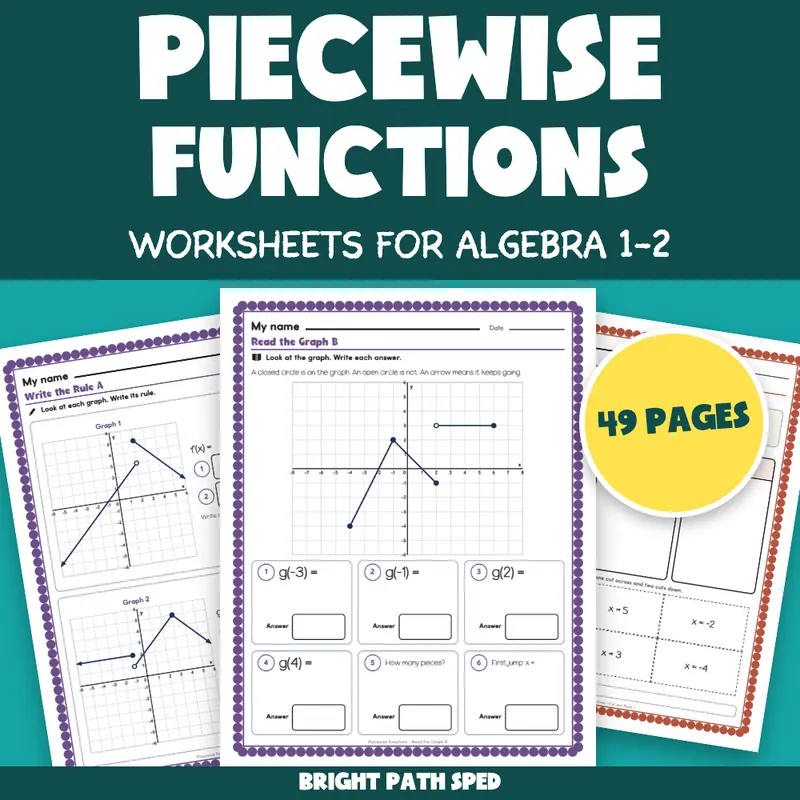
Teaching piecewise functions and need more than one set of notes and one activity? This is a complete unit for Algebra 1-2: the parts of a piecewise function, evaluating f(x) from the right piece, graphing each piece with open and closed circles, reading values off a graph, writing the rule from a graph, domain and range, and word problems about made-up fees. Students fill in guided notes, study worked examples with a guided copy to fill in, then practice with real room to show their work. Find-the-mistake pages, quizzes, exit tickets and three cut-and-paste sorts finish the unit. Answer keys show every answer.
EVERYTHING INSIDE (49 pages)
- 32 student pages in 14 kinds of page, each with a name line and one short instruction
- 155 scored items on 28 sheets, every answer computed by program from the same function that prints the rule and draws the graph
- Guided notes with blanks and a word bank: the parts of a piecewise function, and open and closed circles
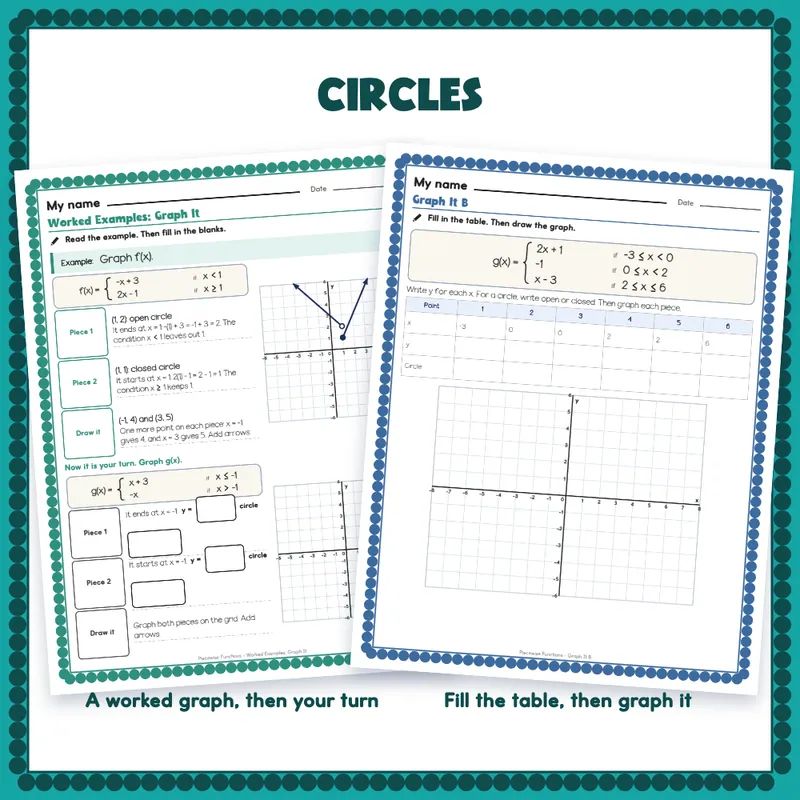
- Worked examples with 7 guided items to fill in: evaluating f(x), graphing with open and closed circles, and domain and range
- 18 evaluate problems: pick the piece whose condition is true, then work it out (linear pieces, a constant piece and a squared piece)
- 18 read-the-graph items: values read off a graph, how many pieces, where the first jump is
- 24 graph-it items: a table of 21 points (the ends of each piece with open or closed, two whole-number points on any piece that goes on forever, and points inside a squared piece) and 3 graphs to draw on blank grids
- 10 write-the-rule items: the rule and the condition for each piece of a graph
- 16 domain and range items on 8 graphs, including a graph with a hole and graphs with more than one part
- 18 word-problem items in 3 stories (parking, shipping, bike rental): evaluate, write the rule from sentences, solve for the input, and find the most it can cost
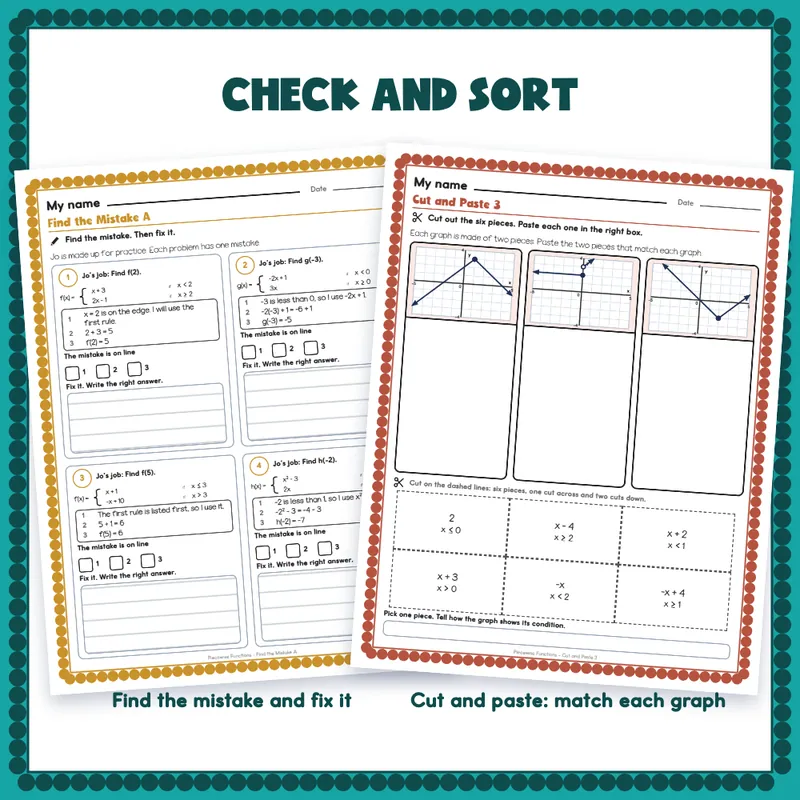
- 8 Find the Mistake problems (an invented student's work, one mistake each)
- 1 Make Your Own page; 12 quiz items on 2 quizzes; 6 exit-ticket items; 1 self check (8 statements)
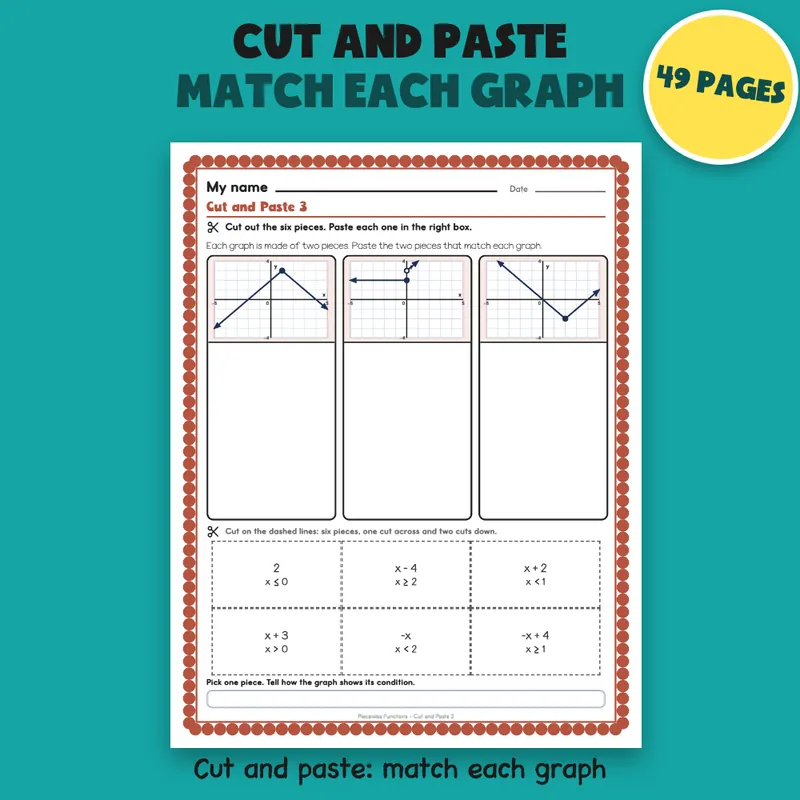
- 18 cut-and-paste pieces on 3 sorts (6 pieces into 3 boxes each: which rule an x-value uses, which output a piece gives, which graph two rules make)
- 6 answer key pages; 1 tracker, 1 class grid, 1 team note, 1 family page
- 1 filled example (an invented student), 1 phrase bank (17 starters in 6 groups)
- Start Here and a how-to-read-a-page page
Built For The Student Holding The Page
A "My name" line, one short instruction with a small picture cue, and a plain scalloped border. Nothing on a student page is written for an adult: the keys and records are on separate teacher pages. Every problem has a ruled work box and an answer box. Every graph is a coordinate grid drawn by the program from the function itself, with closed circles, open circles and arrows where a piece goes on forever. Clip art is kept to a lightbulb, a question mark and a pencil. The file prints clean in black and white.
Invented Examples
Every function, every story shop and every student is made up for practice and says so. Money in the word problems is written in dollars. The filled example names an invented student.
Type In, Or Print
The name line, every answer box, every table cell to fill in, every check box and every ruled work box are type-in fields in any PDF reader: click one, type, then save. You can also print any page. The blank graph grids are for drawing by hand. This is a fillable PDF; it is not a Google Slides or PowerPoint file.
What This Is, And What It Is Not
A piecewise functions practice set with the record-keeping around it. It is not a timed test, a screener, a clinical tool, or a claim about any student's age or rate of progress. There is no IEP goal language or eligibility wording anywhere in the file, and it does not claim to match any one state's standards or any test: there is a line on the tracker for your own.
If You Want More
Slope and Y Intercept Worksheets | Progress Monitoring Probes Grades 8-9 IEP; Linear vs Nonlinear Functions Progress Monitoring Probes | Grades 8-9 IEP Math; Exponential Functions Progress Monitoring Probes | Grades 8-10 IEP Math.