Place Value Tens and Ones Cut and Paste
- 26 pages
- PreK, Kindergarten, 1st, 2nd
$4.00
DownloadOr get it with All-Access: pick any 20 resources a month for $7.
New here? Your first month of All-Access is half off with code TEACHERTOK
Already bought this, or a member?
Instant download. One teacher's license: colleagues need their own copy. Each file carries a license number.
Also on Teachers Pay Teachers: see the Bright Path Sped store
About this resource
Five place-value skills. Every one of them printed three times, at three levels of support, with a
scripted lesson plan in front of each one so a teacher, a para, or a substitute can pick the page up
cold and run it.
Fifteen cut-and-paste worksheets in one PDF, plus the five plan pages. The cut strip sits on the same
page as the work, so nothing gets separated on the way to the desk.
A Ten Is Always One Solid Rod
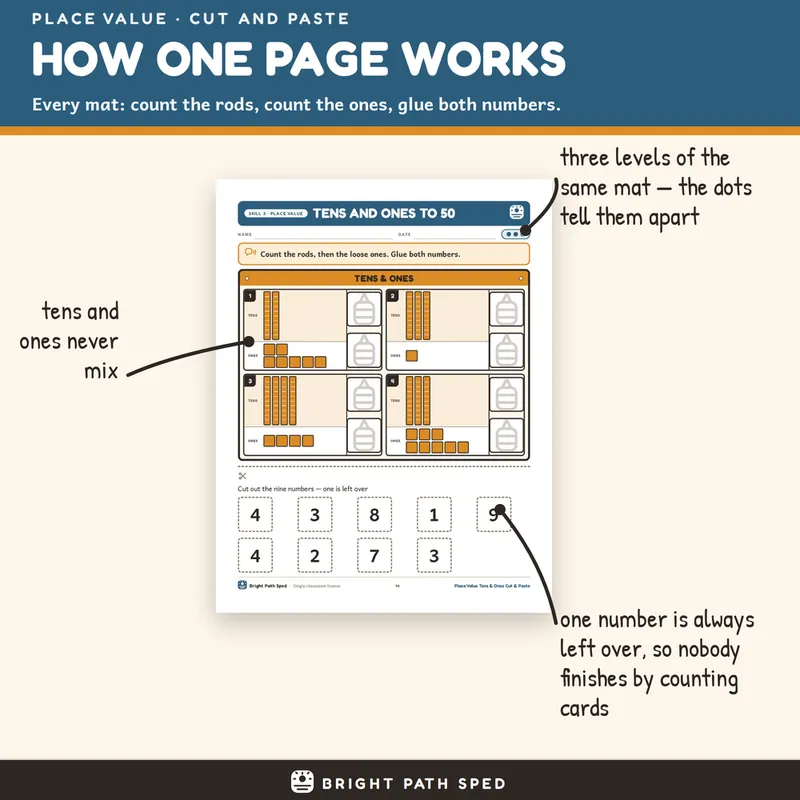
Every number twenty and up is drawn with this pack's own base-ten blocks: one ten is one solid bar,
never ten separate squares side by side. A student counts RODS for the tens digit and small loose
squares for the ones digit — the same base-ten-blocks convention a classroom set of physical
manipulatives already uses, so the page and the concrete materials teach the same picture.
How The Three Levels Work
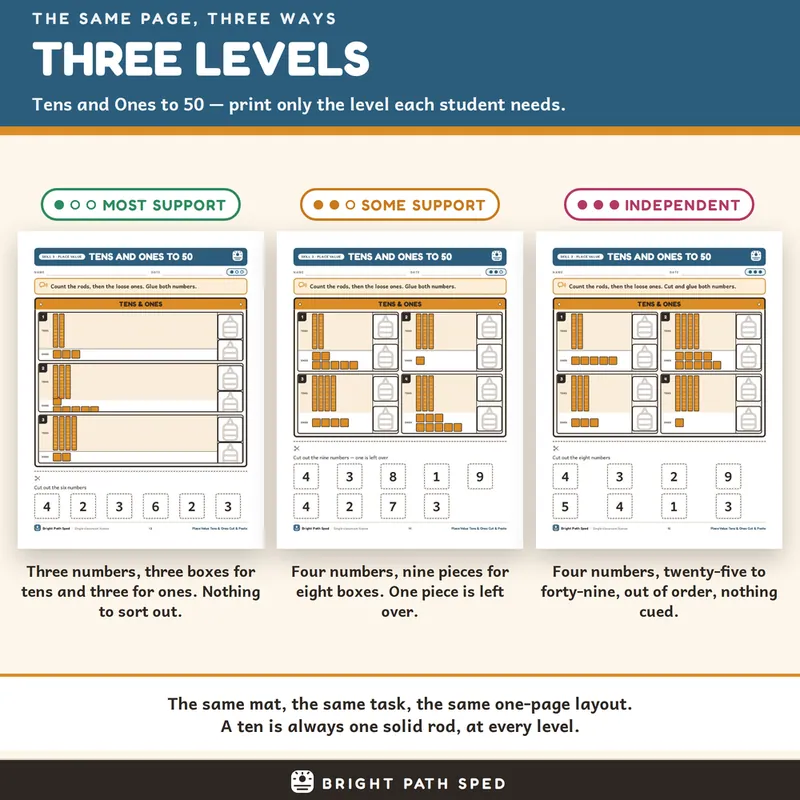
Level 1 — three of everything: three ten-frames, three teen numbers, three pairs to compare. Every box shows
the frame or the rods drawn in full, and the pieces match the blanks one for one — there is no wrong piece to
pick up.
Level 2 — four of everything, nine pieces for eight boxes on most skills. Nothing is tinted, and one number
on the strip belongs to nothing and has to be set aside.
Level 3 — four, five or six, scattered, no cues at all. This is the progress-monitoring page for the
skill.
The level is shown on the child's sheet as a color tone and a row of dots and nothing else, so the
three levels look the same on the desk.
The Five Skills, In The Order Students Actually Learn Them
1. Build a Ten — a ten-frame with some already filled; how many more make a whole ten
2. Tens and Ones to 19 — a teen number as one full frame plus a second, partly filled one; glue both
the tens count and the ones count
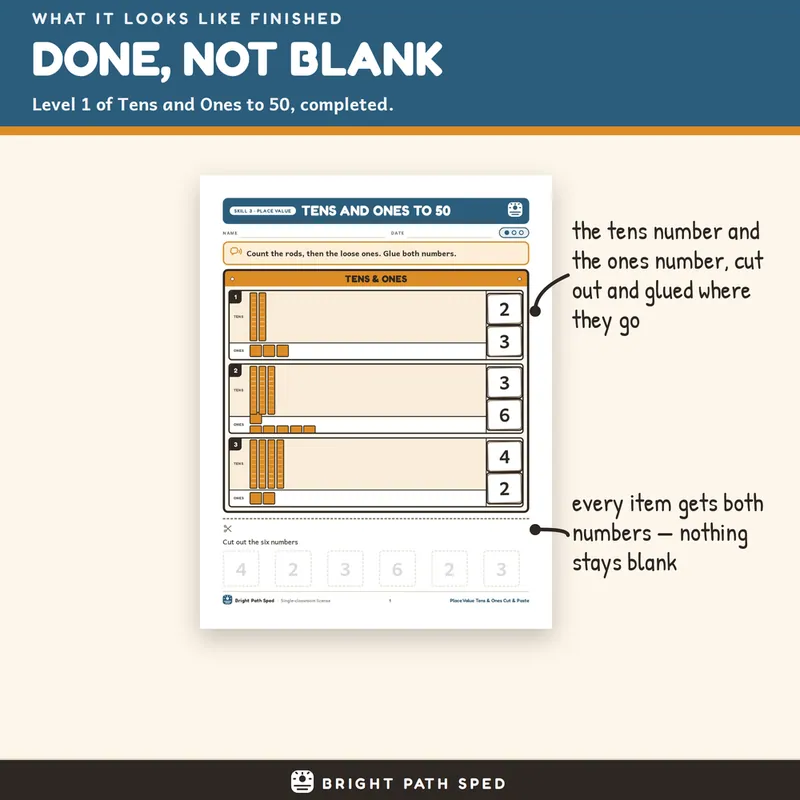
3. Tens and Ones to 50 — a few rods plus loose ones, twenty-three up to forty-nine; glue both numbers
4. Tens and Ones to 99 — more rods, up to nine rods on a page, plus loose ones; glue both numbers
5. Compare Two-Digit Numbers — two block sets with no numeral printed for either one; glue <, >, or =
Skill 5 never prints the number being compared. The comparison has to come from counting the rods
(and the ones, when the rod counts tie) — never from reading two digits side by side.
What Is In The File
- 26 pages, one PDF
- 15 worksheets (5 skills x 3 levels)
- 58 place-value items across those 15 worksheets, worth 91 individual glued answers and 96 cut
pieces total (91 correct answers plus one spare piece on every Level 2 page)
- 5 scripted plan pages, one in front of every skill, each with a SAY THIS script in quotation marks
a person can read out loud verbatim
- 1-page teacher guide to the three levels, with what to do when a student is stuck
- 2 pages of answer keys, computed from the same data that draws the pages, with the spare Level 2
piece named on every line
- Name and date line and a scissors rule line on every worksheet
- Clear, child-friendly print throughout, every numeral a student reads set at cut-card size, and no page
that depends on color to be understood: the mat, the rods and the ones are drawn in heavy black line, so a
grayscale copy works exactly as well as a color one and there is no separate B&W file
- The level is shown on the child's sheet as a color tone and a row of dots and nothing else: no student page
says "Level 1" in words a child reads, so the three levels look the same on the desk
What A Page Looks Like
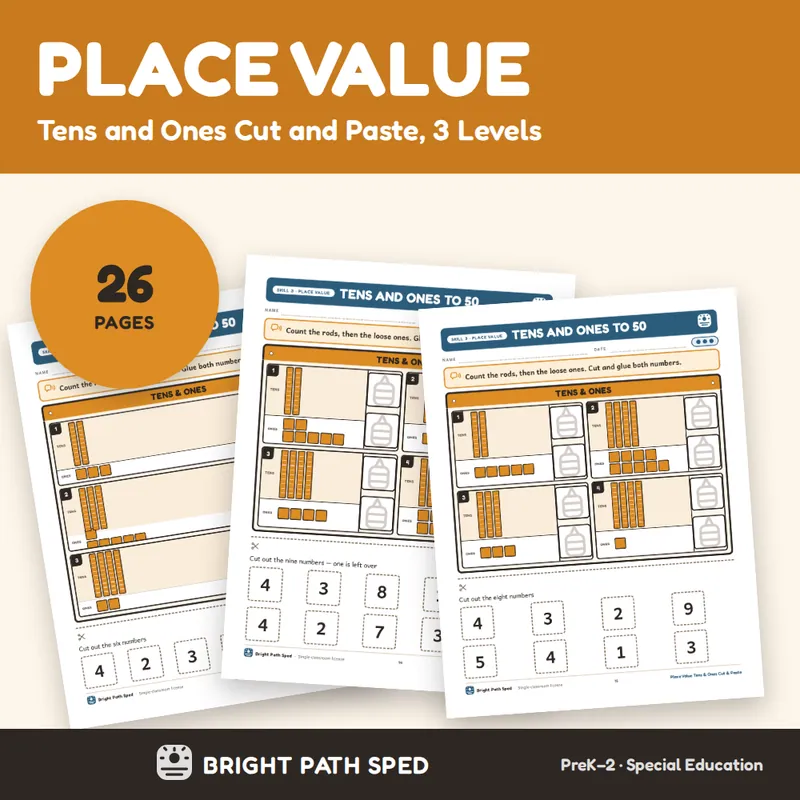
Each item on the tens-and-ones pages is its own place-value mat: a TENS strip over a ONES strip, the rods
and loose ones drawn tall inside them, and the answer box right under the pile it belongs to. The cut
pieces print under the mat at a size a six-year-old can cut and hold, and every numeral is set at that same
size. The compare page keeps both block sets side by side with no numeral printed for either one.
Who This Is For
Self-contained, resource and life-skills classrooms, early intervention, and any elementary room with
a wide skill range in it. Pair it with Addition to 20 Cut and Paste for the operation these numbers
build straight into, or with Number Bonds to 10 Cut and Paste for the part-whole half of this same
math block.
What This Is, And What It Is Not
This is a print-and-go worksheet set with a scripted plan page in front of every skill. It is not a
progress-monitoring probe (see the Place Value: Tens and Ones probes for that) and it makes no claim
about how quickly a student should master any skill — write your own timeline against your own
students' data.