Progress Monitoring Forms Special Education
- 69 pages
- PreK, Kindergarten, 1st, 2nd
$2.50 $5.00 on Teachers Pay Teachers
Half the Teachers Pay Teachers price. The same PDF, sold direct.
DownloadOr get it with All-Access: pick any 20 resources a month for $7.
New here? Your first month of All-Access is half off with code TEACHERTOK
Already bought this, or a member?
Instant download. One teacher's license: colleagues need their own copy. Each file carries a license number.
Also on Teachers Pay Teachers: see the Bright Path Sped store
About this resource
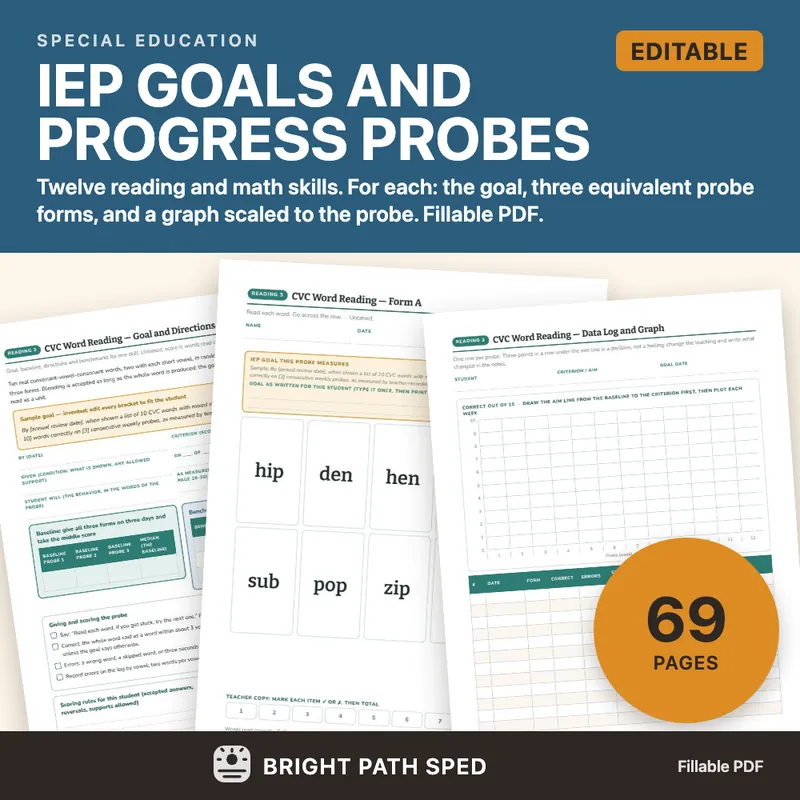
The goal and the thing that measures it, in one file. For twelve early reading and math skills: a goal page with a sample goal written in the probe's own words, three equivalent probe forms the student works on, and a data log with a graph scaled to that probe. Every probe is untimed and ten items long, so a score of 8 means the same thing on every form of every skill, and a student is never scored on speed. Baseline on Monday, goal written by Tuesday, first data point on Friday.
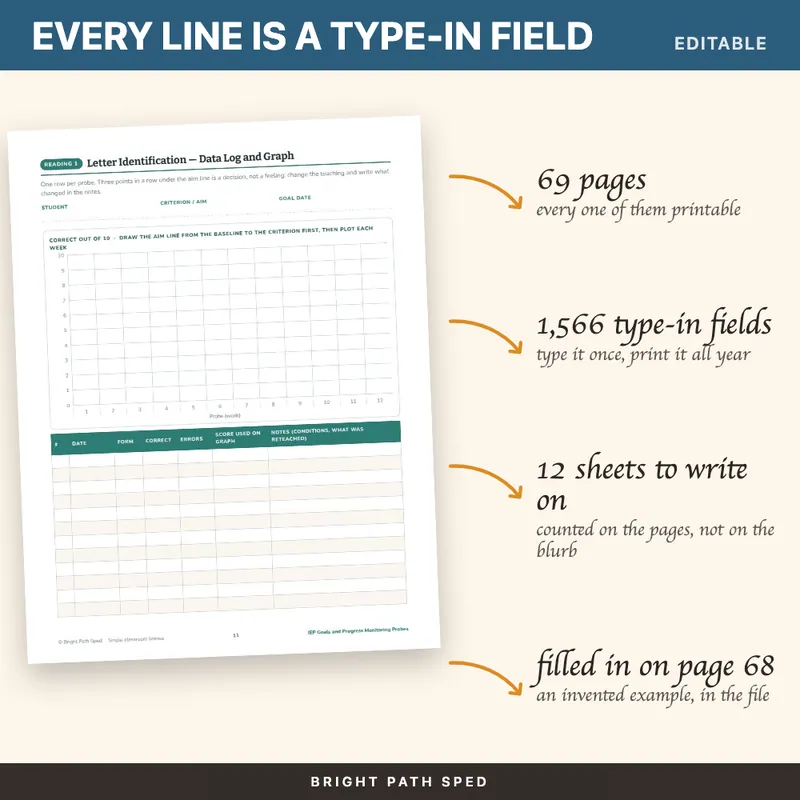
WHAT IS INCLUDED - 69 pages, 12 skills, 36 probe forms, 12 graphs, 1,566 type-in fields
READING (6 skills, 10 items per form, untimed)
- Letter Identification - 10 upper- and lowercase letters per form; the three forms are drawn from all 52 letters without repeating, so together they cover 30 different letters
- Letter Sounds - 10 lowercase letters per form; the three forms cover all 26 letters; a line to write the accepted sound for c, g, x, q and y
- CVC Word Reading - 10 real words, two with each short vowel, so errors can be logged by vowel; no word repeats across the three forms
- Blends and Digraphs - 10 one-syllable words with sh, ch, th, wh, ng or a beginning or ending blend, from a fixed bank with no repeats across the three forms
- Sight Words - 10 words per form from the Fry first hundred, no repeats across the three forms (30 of the 100)
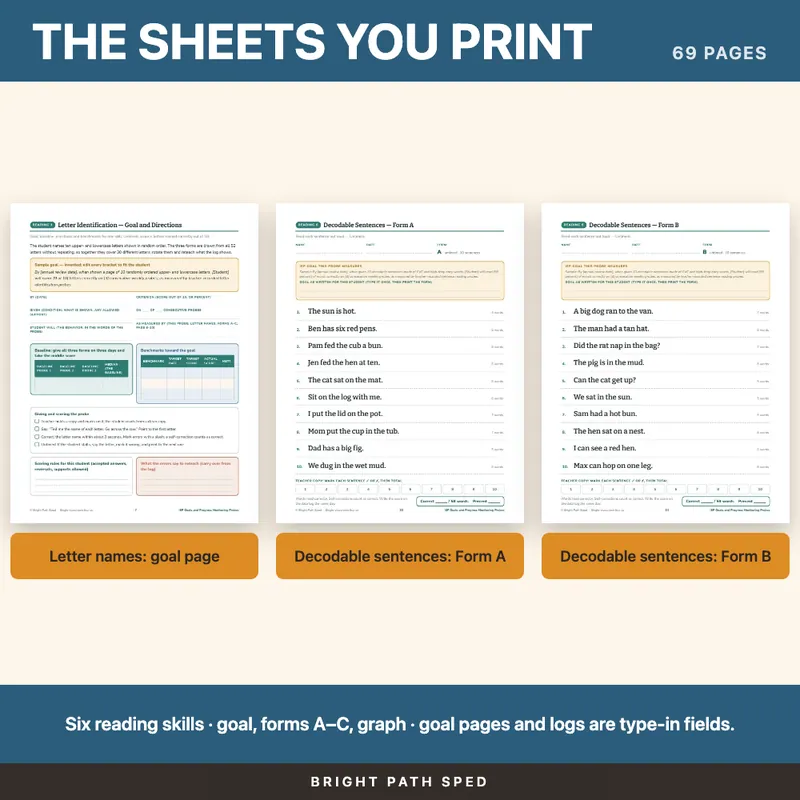
- Decodable Sentences - 10 short sentences per form built only from CVC and first-hundred words, none repeated across the three forms; the word total is printed on each form and the score is a percent
MATH (6 skills, 10 items per form, untimed)
- Number Identification 0-20 - 10 numerals per form, cut from one shuffle of all 21 numbers so every number appears across the set
- Missing Numbers to 30 - 10 runs of three consecutive numbers, the blank first, middle or last at random
- Addition Within 10 - 10 facts, vertical, no repeats within a form
- Subtraction Within 10 - 10 facts, vertical, no repeats within a form
- Addition and Subtraction Within 20 - 5 addition and 5 subtraction problems mixed, every one crossing ten: the additions have two addends between 2 and 9 with a sum above ten, the subtractions a minuend from 11 to 20 with a difference below ten
- Comparing Numbers to 100 - 10 pairs with a circle for the symbol; two equal pairs on every form
For Each Skill
- A goal page: what the probe measures, a sample goal (invented, every bracket edited by the team), the six-part goal frame with type-in fields, a baseline table for three probes and the median, benchmark rows, the administration and scoring directions, and lines for the student's own scoring rules
- Forms A, B and C: the same number of items, drawn the same way, rotated so the graph is the student and not the paper. Every form carries the IEP goal it measures: the sample goal, plus a type-in box for the goal as written for this student, so the goal prints on the sheet the person giving the probe is holding. A teacher scoring strip (1 to 10) and a total box sit at the foot of every form
- A data log and graph: twelve rows, a y-axis already scaled to that probe's score, and the aim line drawn first
Plus
- How This File Works, the weekly ten-minute routine, and the print plan
- The Goal Frame page: six parts, what goes in each, and a draft area
- Which Probe for Which Goal: a chooser that matches the goal's wording to the probe that measures it
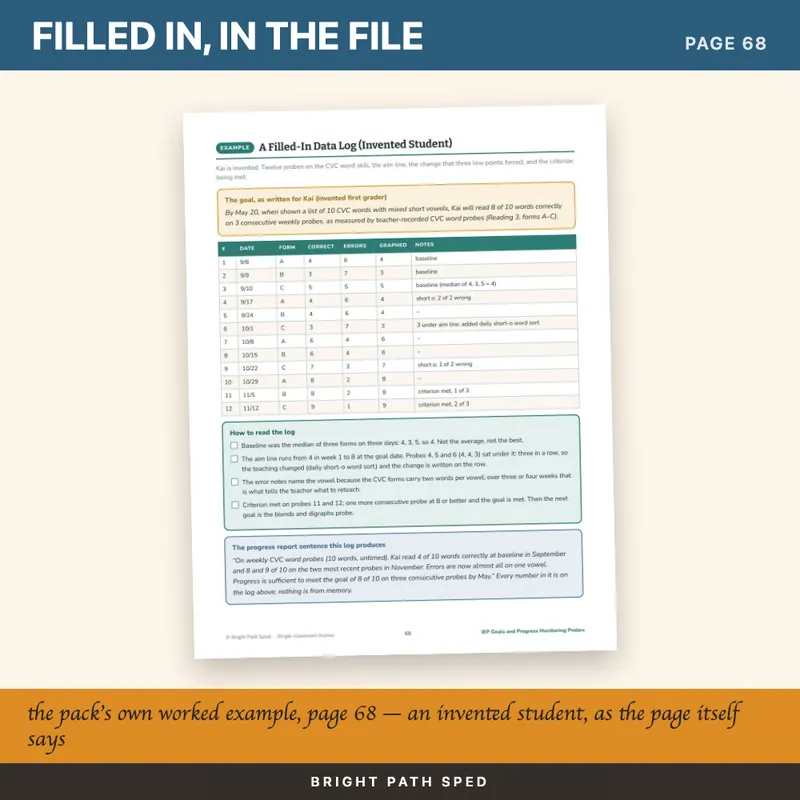
- A filled-in data log for an invented first grader on the CVC probe: baseline, the aim line, three low points forcing a teaching change, the criterion being met, and the progress-report sentence the log produces
What This Is, And What It Is Not
It is a fillable PDF. The goal pages, the goal box on every probe form, and the data logs are type-in fields: open the file in a PDF reader, click a line or a cell, type, and Save As once per student. The probe forms are meant to be printed; the student reads from or writes on paper. It works offline with no account or subscription. It is NOT a Google Forms file, a Google Doc or a spreadsheet; it does not calculate percents or draw the graph.
It is not a norm-referenced assessment and it carries no benchmark scores or "typical" rates. The criteria in the sample goals are in brackets because your team sets them from the baseline and the student's IEP. Every probe is untimed on purpose; the goal page says so, so the condition stays the same all year.
Who This Is For
Special education teachers and case managers writing K-2 level reading and math goals for any age student, intervention and Title teachers, and the paraprofessionals who give the weekly probe.