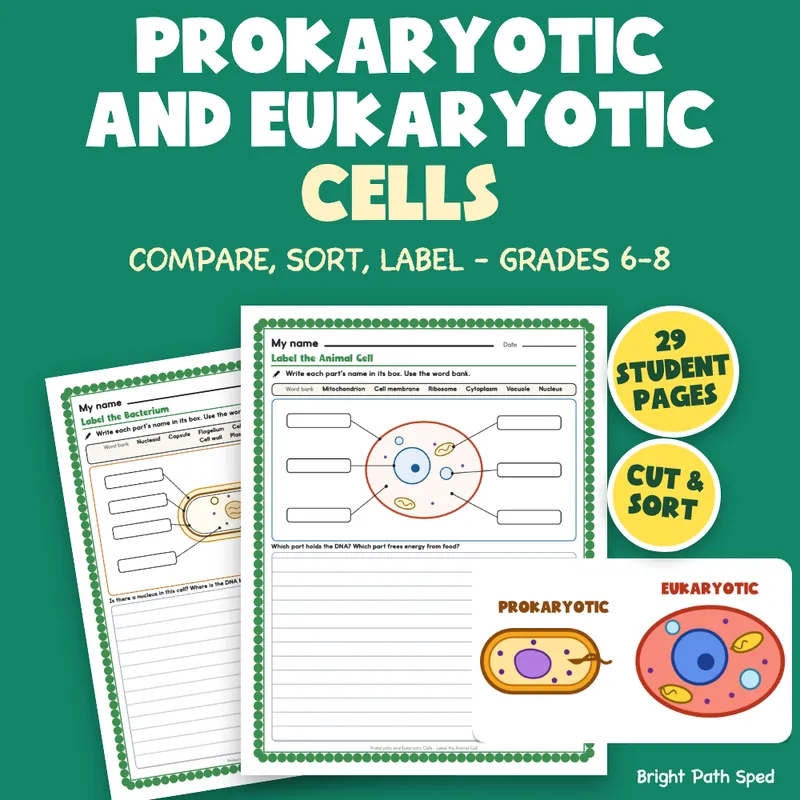
Prokaryotic and Eukaryotic Cells Worksheets
- 48 pages
- 6th, 7th, 8th
$2.50 $5.00 on Teachers Pay Teachers
Half the Teachers Pay Teachers price. The same PDF, sold direct.
DownloadOr get it with All-Access: pick any 20 resources a month for $7.
New here? Your first month of All-Access is half off with code TEACHERTOK
Already bought this, or a member?
Instant download. One teacher's license: colleagues need their own copy. Each file carries a license number.
Also on Teachers Pay Teachers: see the Bright Path Sped store
About this resource
EVERYTHING INSIDE (48 pages)
- 29 student pages in 15 kinds of sheet, each with a name line and one short instruction
- 171 scored items on 27 sheets, with every answer computed from the words and numbers on the page
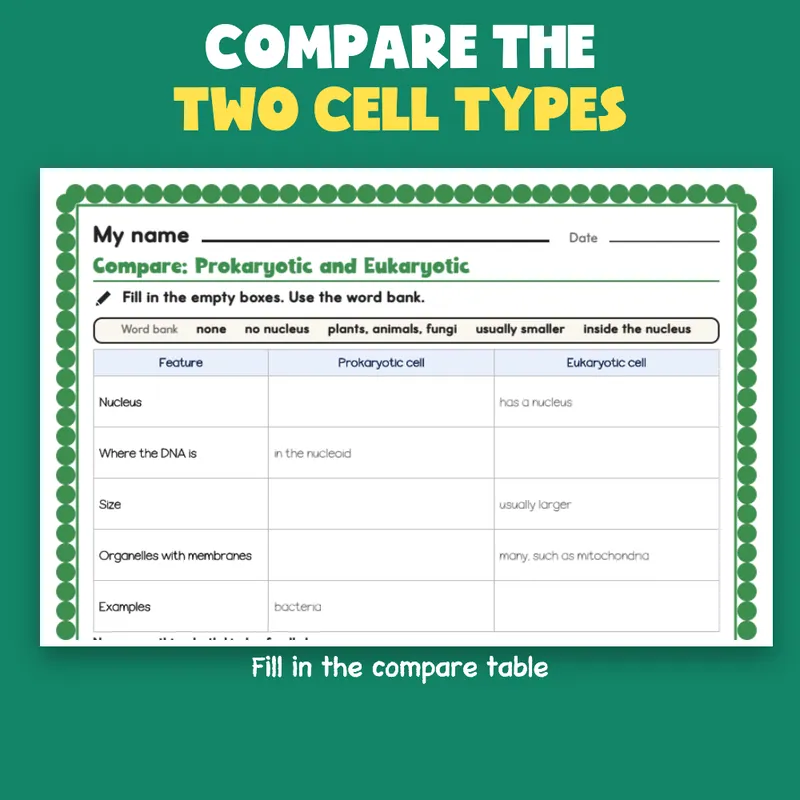
- 2 reference pages: a labeled bacterium, a labeled animal cell and a labeled plant cell, plus a compare table of 5 features
- 1 cell words page: 6 words to match
- 5 reading pages (what is a cell, prokaryotic cells, eukaryotic cells, plant and animal cells, how big a cell is), 5 questions each, 25 in all
- 1 worked example with a Your Turn (3 items)
- 16 Which Kind of Cell items across two sheets (8 everyday examples, 8 clues)
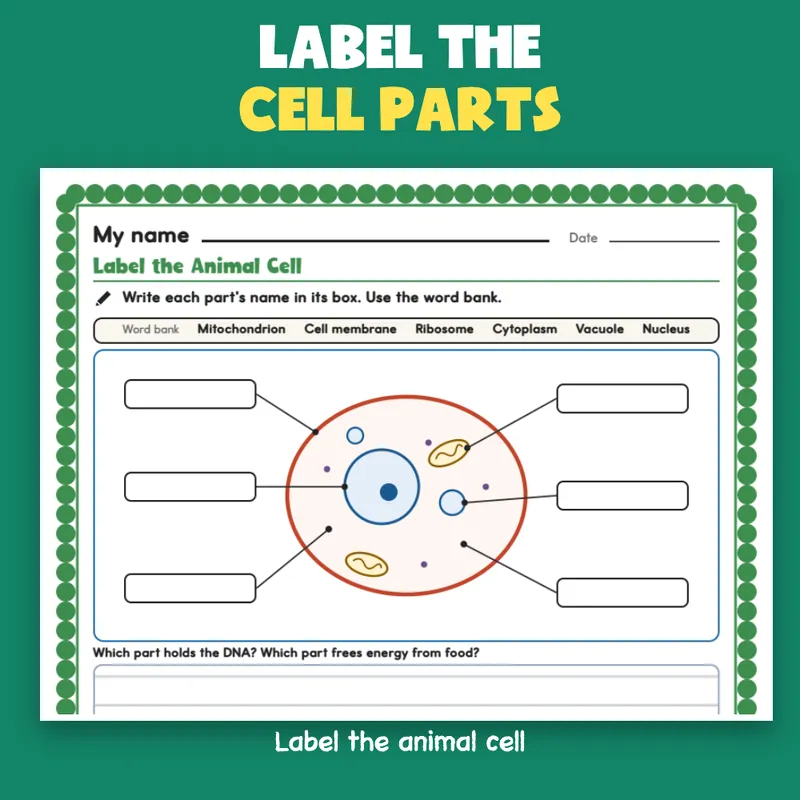
- 3 label pages: a bacterium (8 parts), an animal cell (6 parts) and a plant cell (7 parts), 21 boxes, a word bank on each page
- 1 Find the Part page: 7 jobs matched to the lettered parts of a plant cell
- 1 compare table to fill in (5 boxes) and 1 plant and animal table (10 yes or no checks)
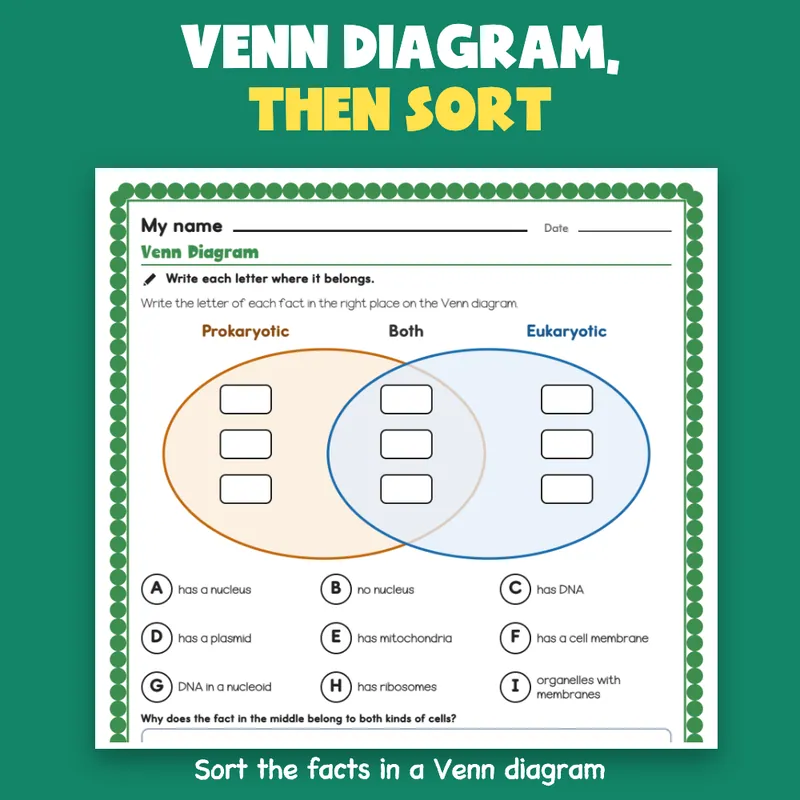
- 1 Venn diagram page: 9 facts to place
- 1 cell size page: 4 cells with invented rounded widths, a bar chart to shade and 6 items
- 10 Fix It statements across two sheets (6 false, 4 true)
- 4 claim, evidence, reasoning panels across two sheets, 12 items
- 10 quiz items, 5 short-answer questions with sample answers and 4 exit tickets
- 22 cut-and-sort pieces on 3 mats: 10 pieces in two boxes (prokaryotic or eukaryotic), then two three-way mats of 6 pieces each (plant, animal or both; holds the DNA, energy, protects and supports)
- 6 answer keys; 1 tracker, 1 class grid, 1 team note, 1 family page
- 1 filled example (an invented student), 1 phrase bank (17 starters in 6 groups), 1 binder cover and 6 divider tabs with a spine label to cut out
- Start Here and a Teacher Notes page
Built For The Student Holding The Page
A "My name" line, one short instruction with a small picture cue, and a plain scalloped border. Nothing on a student page is written for an adult: the keys and records are on separate teacher pages. Prokaryotic cells are orange and eukaryotic cells are blue, and every box also carries the words, so a black and white copy reads too. Every diagram is drawn in the file from circles, ellipses, lines and a curve; clip art is kept to a lightbulb and a pencil.
Invented Examples
Every number is made up and rounded for practice, and the student in the filled example is made up and says so. The cells are simplified on purpose. There is no lab procedure, health advice, disease claim, equation or standards code anywhere in the file.
Type In, Or Print
The name line, every answer box, every check box and every ruled work box are type-in fields in any PDF reader: click one, type, then save. The cut-and-sort pages are for scissors and glue and the cell size chart is for shading in pencil on a printed page. This is a fillable PDF; it is not a Google Slides or PowerPoint file.
What This Is, And What It Is Not
A unit on how prokaryotic and eukaryotic cells differ and what they share, how to name the parts of a bacterium, an animal cell and a plant cell, and how to use a clue or a number to back up a claim, with the record-keeping around it. It does not include a lab procedure, a microscope activity, or detail on any cell part beyond the simplified diagrams. It is not a timed test, a screener, a clinical tool, or a claim about any student's age or rate of progress. There is no IEP goal language or eligibility wording anywhere in the file.
If You Want More
Homeostasis Worksheets | Feedback Loops, Sort and Diagrams Grades 6-8 (check it is live before pasting); Abiotic and Biotic Factors Worksheets | Sort, Diagram, Short Answer Grades 6-8; Nitrogen Cycle Worksheets | Diagram, Sequence and Short Answer Grades 6-9.