Read and Build a Scene Short A CVC Sentences Cut and Paste Kindergarten 1st
- 25 pages
- Kindergarten, 1st
$5.00
DownloadOr get it with All-Access: pick any 20 resources a month for $7.
New here? Your first month of All-Access is half off with code TEACHERTOK
Already bought this, or a member?
Instant download. One teacher's license: colleagues need their own copy. Each file carries a license number.
Also on Teachers Pay Teachers: see the Bright Path Sped store
About this resource
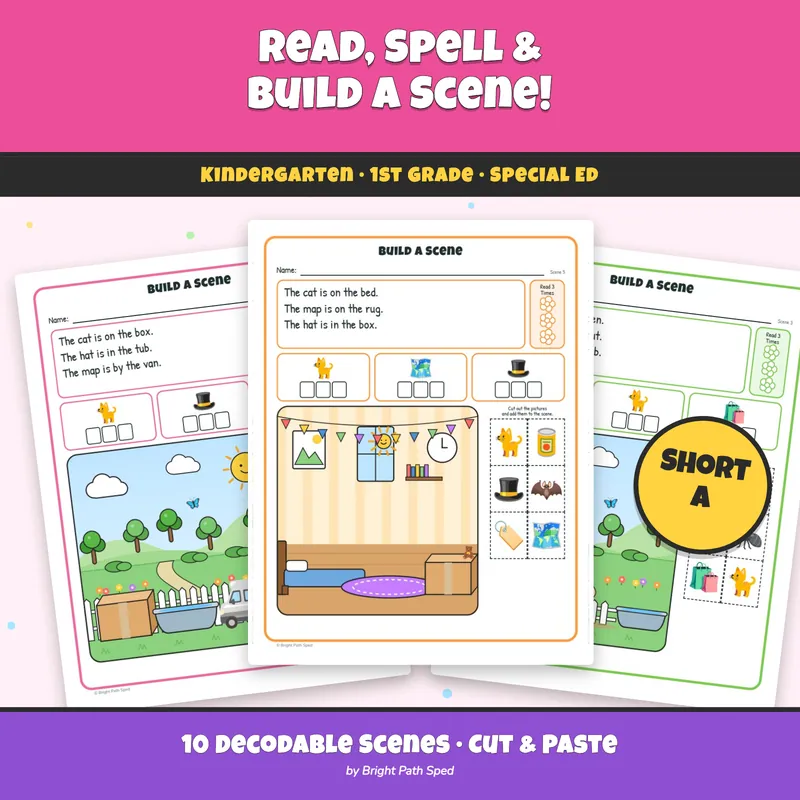
A build-a-scene activity where every piece — and every piece that ISN'T supposed to go in the
scene — is a word the child has to read, not guess from the picture. Ten short-a CVC scenes: a
yard, a campsite, a farm, a pond and a bedroom, each visited twice with new sentences and a new
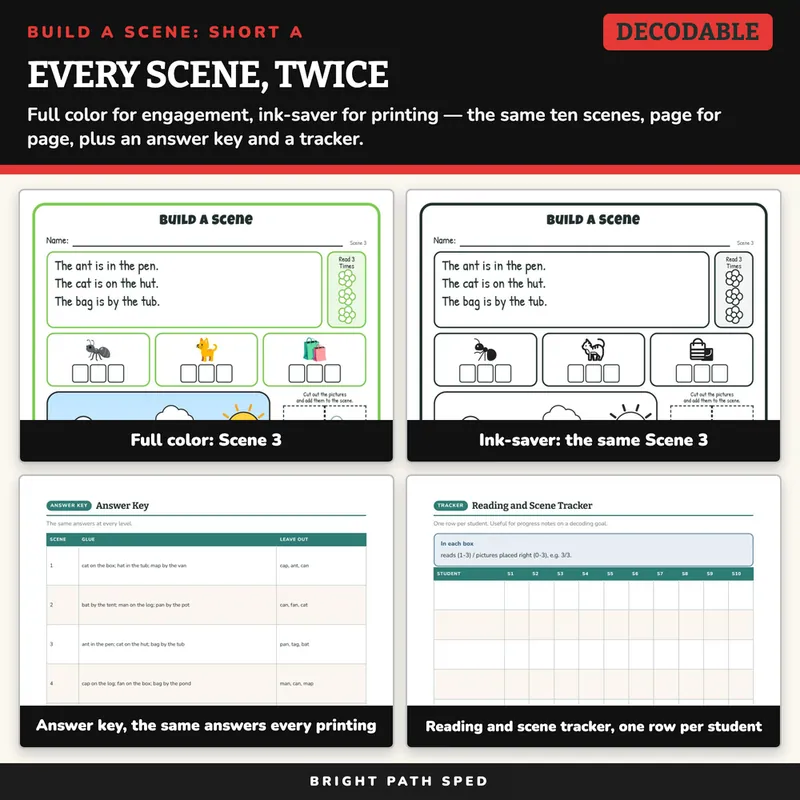
set of pictures. Every scene comes twice — full color and an ink-saver black-and-white twin — so
one purchase prints either way.
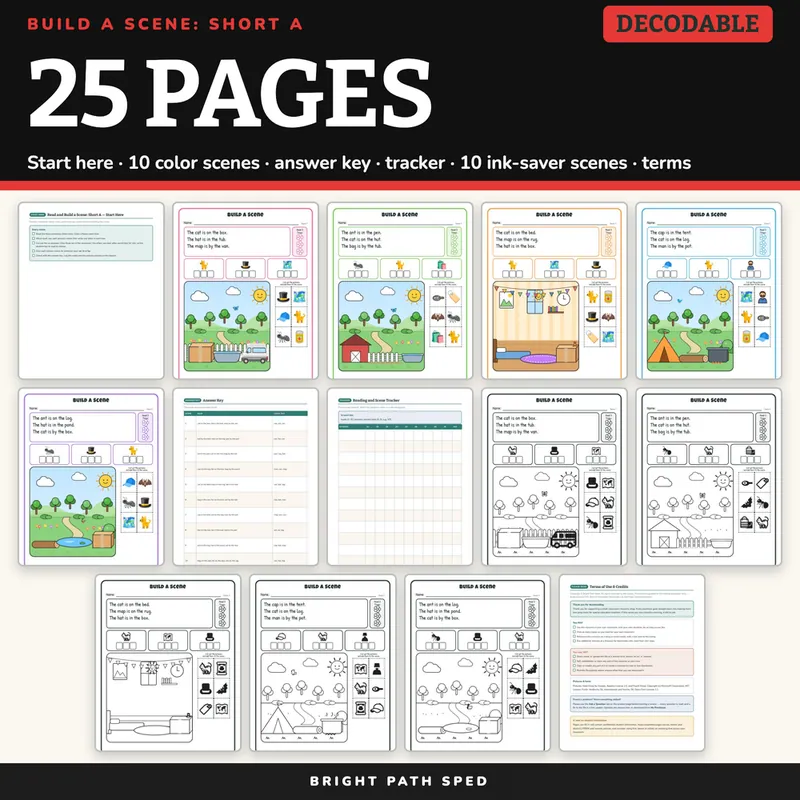
EVERYTHING INSIDE (25 pages)
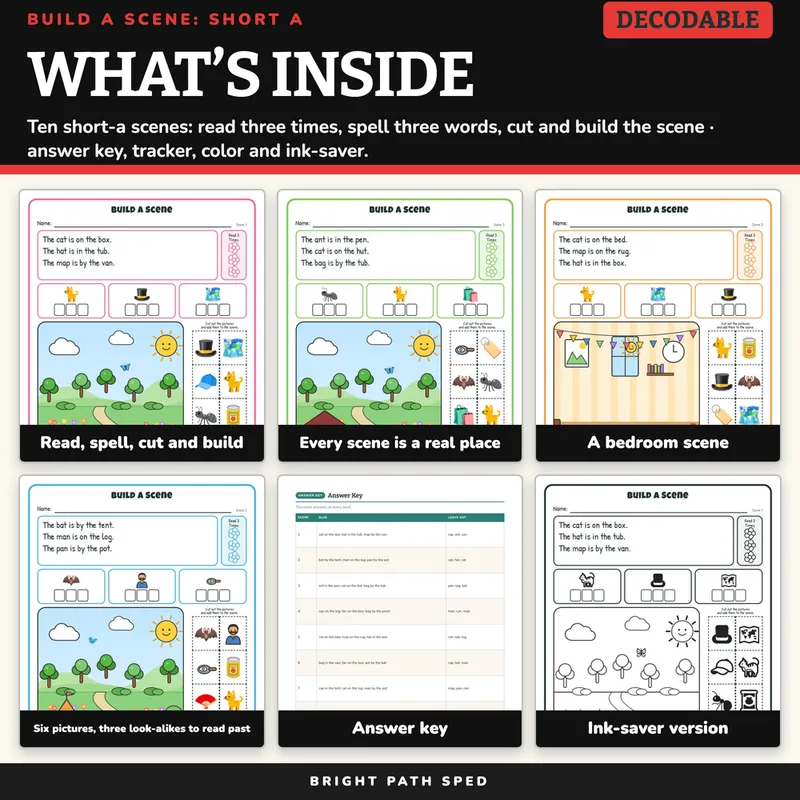
- 10 full-color scenes: three decodable sentences ("The ___ is on / in / by the ___."), a
Read-3-Times flower tracker, three word-work boxes (say the picture, write one letter per box),
a large illustrated setting, and six cut-and-paste pictures in an edge-to-edge strip — only
three belong in the sentences; the other three are short-a look-alike words (cat/ant, hat/bat,
cap/man) the student has to read past
- The same 10 scenes again, ink-saver black-and-white, page for page
- 1 Start Here page with the five-step routine
- 1 answer key (the same three answers per scene, whichever version is printed)
- 1 reading-and-scene tracker, one row per student, ten scenes across
- 1 Terms of Use & Credits page
- 13 short-a CVC words total (cat, ant, bat, hat, cap, bag, fan, man, map, can, ax, tag, pan),
12 drawn from Google Noto Emoji and Microsoft Fluent Emoji so the color and ink-saver pictures
always match, plus "pan," drawn for this product (no emoji in either catalog reads unmistakably
as a pan)
How Each Scene Works
1. Read the three sentences three times, coloring a flower each time.
2. Word work: say each picture's word, then write one letter in each box.
3. Cut out the six pictures. Only three are in the sentences — the other three are look-alike
words, so the student has to read to choose, not match a picture to a picture.
4. Glue each picture where its sentence says: on, in or by.
5. Check with the answer key. Log the reads and the pictures placed on the tracker.
Why The Look-Alikes Matter
A cut-and-paste page with only the pictures a sentence needs can be solved by matching shapes,
never reading a word. Every scene here adds three more short-a words that could belong in the
picture but don't belong in THIS sentence (a cat scene also offers a look-alike ant; a cap scene
also offers a look-alike man) — so building the scene correctly means decoding the sentence, not
recognizing the picture.
Cut-And-Paste, Not Fillable
Pieces are cut with scissors and glued by hand; the name line, word-work boxes and tracker are
pencil work. This is a print-and-go PDF; it is not a Google Slides or PowerPoint file, and it is
not a fillable/type-in PDF.
Who This Is For
Kindergarten and first-grade classrooms, self-contained and resource rooms — anywhere a student
is ready for short-a CVC words and a simple prepositional sentence, with room to work and pieces
sized for scissors that aren't yet precise.
What This Is, And What It Is Not
A decoding and prepositional-sentence cut-and-paste activity. It is not a reading assessment, not
a speech-language evaluation tool, and not a claim about any student's age, grade level, or rate
of progress — the tracker has a blank line for your own district's criterion.